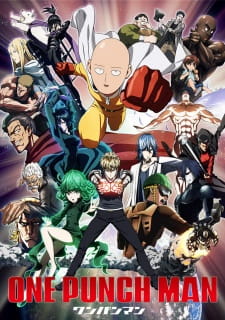
Anime Review: One Punch Man Season 1 (2015)

TL;DR – Saitama wants to be a hero and achieves his goal becoming practically omnipotent and capable of defeating any enemy he faces with one punch. This results in an unexpected consequence where his life is incredibly boring…

Review (warning: spoilers)

One Punch Man is an absurdly funny take on the hero genre. Saitama is a hero but you would be forgiven if first impressions told you otherwise. He wears a yellow superhero outfit with a white cape that makes him look like he has sewn it himself. He has lost all his hair during his training and now looks like a shiny cue ball. His physique is one that looks more sickly child than Hercules. He is so non-descript in every way that neither friend nor foe would give him a second glance.

The absurdity of how he became a hero is made all the more hilarious when he reveals his training involved doing one hundred push-ups, one hundred sit-ups, running ten kilometres, and one hundred squats every single day for three years. Now that will make you an incredibly fit person but a hero that is nigh indestructible and can defeat the most powerful villains in the universe with one punch, it will not.

Yet, that is Saitama’s transformation; an ordinary fellow with extraordinary strength, speed and power. The initial thrill of defeating the bad guys quickly turns to outright boredom as Saitama experiences an existential crisis involving the inability to feel any excitement when he battles.

The world of One Punch Man is familiar in that the city Saitama lives in looks like every other crowded metropolis in Japan. However, Saitama’s world is filled with super powered monsters and villains ranging from a giant lobster man to evil geniuses to aliens.

Thus the Hero Association was born to defeat all this evil. The association is made up of heroes that are ranked and do not get along happily together. Saitama joins the association in order to achieve some level of recognition as well as the hopes of meeting a monster or villain that will be able to challenge him properly. He also takes on an apprentice named Genos who tries to figure out how Saitama became so powerful.

The interactions between the deadpan Saitama and other heroes and villains is what makes this anime refreshingly engaging and totally enjoyable. The animation itself rivals other action packed animes such as Dragonball, My Hero Academia, Naruto etc.

Season one culminates in Saitama facing off against Boros, leader of a group of alien invaders known as the Dark Matter Thieves. Boros is so powerful that he, too, experiences an existential crisis where he believes no one can defeat him or give him any sense of excitement during battle. He journeys to Earth in hopes of finding a hero that can battle him toe-to-toe. The climatic final episode is a ripper and though you know Saitama will be victorious, you still want to watch to see how it will unfold.

It is an achievement that a storyline involving a character that is seriously too powerful can still have you cheering him on. This is because the story is rich in characters (both hero and villain) and Saitama’s actions are both jaw dropping and comical.

9 out of 10

Movie Review: Hypnotic (2021)

TL;DR – A psychiatrist uses hypnosis to take control of women who look like his late wife. A drivel of a film lacking any substance.

Review (warning: spoilers)

Hypnotic opens with a female security guard being asked over the intercom by some male security guard to go ahead and do her rounds and he will come and cover the desk. It is late in the evening and the place is largely empty. The desk has a single monitor with CCTV coverage of various areas of the building. The camera then shifts to inside the building to an office with the name ‘Andrea B’ on the glass door and a woman peeks through the blinds from within. The woman is Andrea Bowen (Stephanie Cudmore), she’s scared and nervous as she makes a call to a Detective Wade Rollins (Dulé Hill) from the Portland PD and leaves a message saying she believes ‘he’ is still watching him. With eyes, red-rimmed and tearful, she walks to the elevator which takes her down from the 18th floor to ground, as the numbers count down, she receives a phone call from ‘Unknown Caller’ and thinks it is the detective.

Cue strange man’s voice who says, “Andrea, this is how the world ends.” The elevator stops suddenly, Andrea starts screaming as the walls of the elevator start closing in… literally. Trapped in a vice, the scene fades as Andrea is crushed.

Without having read anything about this film, given this opening scene and movie title, I’m guessing there’s a psychopathic psychiatrist who uses hypnosis on his patients and when using a key word or sentence such as “this is how the world ends”, triggers the patient to mentally believe they will die even if part of their brain says, “I’m in an elevator and elevator walls do not suddenly start moving in to crush me like a garbage compactor”.

We now meet Jenn Tompson (Kate Siegel) who arrives at a party with a pot plant that has seen better days. At the front door, she is greeted by her friend, Gina Kelman (Lucie Guest), and Jenn confesses she bought a bottle of wine to bring to the party but already drank it and instead brought a plant that she now notices is dead. Gina doesn’t care about the plant and says she tried calling her to tell her ‘Brian’ is here. Jenn’s expression is all you need to know that her and Brian were once a thing but they are now not a thing anymore. Jenn decides to brave the party anyway and asks for a glass of wine. Clearly, alcohol being the only thing getting her through life at this moment.

During the party Jenn is introduced by Gina to Dr Collin Meade (Jason O’Mara). Gina speaks glowingly of the assistance and therapy Collin has given her and attributes her recent promotion up the career ladder to him. For all the alcohol consumed, Jenn is still astute enough to say to Collin that she didn’t know that therapists could hang out with their patients. To which, Collin replies bashfully that he follows the rules 99% of the time then lowers it to 95%, which gets a giggle out of Jenn.

She excuses herself when she sees Brian (Jaime M. Callica) and ends up in a four-way conversation with him, Gina and Gina’s husband, Scotty (Luc Roderique). Collin inserts himself into the conversation by asking what Jenn does and discovers she is a software engineer like Brian. We also find out that Brian has a severe sesame seed allergy requiring an epi-pen to be carried around with him. I’m already guessing Brian is not going to make it to the end of the film and will consume sesame seed unknowingly with no epi-pen in sight. Collin leaves his business card for Jenn before the party ends.

Sessions ensue involving hypnotherapy and three months pass with Jenn turning her life around. She invites Brian over for dinner (at the suggestion of the good doctor). To prepare, she is at a grocery store when she receives a phone call from an ‘Unknown Caller’ and she freezes. She then awakens sitting down in her house with dinner laid out on the table, she doesn’t remember any of this (and has lost a passage of time) and hears someone choking in the bathroom. Sure enough, it’s Brian having an allergic reaction. She manages to find an epi-pen and calls the ambulance, but Brian ends up in a coma (so, I was close, he doesn’t die but almost).

The rest of the film follows the path of psychological thrillers where Jenn tries to figure out what is happening to her, and the good doctor espouses ‘therapy’ that talks about not letting fear win and allowing her to trust him when we know he is said psychopath. It’s a by-the-numbers affair which delivers style over substance and thus falls short of any thrills.

I cannot stress strongly enough that this film takes great liberties surrounding what it portrays as ‘therapy’. The idea of just being happy and not letting fear win is not something any proper psychiatrist would seek to instil in their patient. Part of who we are is feeling the spectrum of emotions that comes from being human and that includes happiness, joy, sadness and fear. Suffice to say, however, that even if I turn my mind off and treat the idea of hypnosis as mind-control purely as a story mechanic designed to bring tension, it still falls flat. That Collin uses hypnosis to control women who look like his late wife is both contrived and cliché. Any attempt at twists or shocks failing miserably due to a plot that has nothing going for it.

Hypnotic is truly a boring affair.

1 out of 10

Book Review: The Etymologicon by Mark Forsyth

TL;DR – How words in the English language came to mean what they mean sounds like a topic best suited for language academics, but Mark Forsyth delivers fascinating insights into how words came to be and does so in hilarious fashion.

Summary (warning: spoilers)

Ever wonder what John the Baptist and the Sound of Music have in common?

Turkeys were first discovered in the magnolia forests of the Americas, yet they did not originate from the country, Turkey, so why are they called that?

Why was the horrible beheading device known as the guillotine named after Dr Joseph-Ignace Guillotin, who was actually against the death penalty?

If these questions circle your head like a bunch of vultures, and you toss and turn at night because you desperately seek answers to these mysteries, then (apart from the need to perhaps re-examine your life) look no further then The Etymologicon by Mark Forsyth.

Review

Mark Forsyth is the brilliant author of The Elements of Eloquence (a must-have book for any writer’s toolkit). You can check out my review of The Elements of Eloquence on my book reviews page. While both that book and The Etymologicon examines the English language, this one is quite a different read.

The Etymologicon is more about words that have come into existence that have origins that are often confused, funny and intriguing. Forsyth manages to actually make you interested in the words that we use and take for granted every day.

Of course, there are words that he explores that we don’t use in every day life but he dives in any way because it leads to results that will have you in awe (or perhaps because I’m a writer I’m left in awe and everyone else will just shake their heads in dismay).

One of the best examples of this is the word ‘buffalo’. Forsyth explains how buffalo came to mean buff (as in to ‘polish’, along with to be an ‘enthusiast’ like a music ‘buff’ or movie ‘buff’, and also the link with the word ‘to bully’). He then shows the connection of this word to New York firefighters and then to the city of Buffalo.

But wait there’s more…

Forsyth then writes the following sentence: Buffalo buffalo Buffalo buffalo buffalo buffalo Buffalo buffalo.

Believe it or not, this is the longest grammatically correct sentence in the English language that uses only one word. This is known as a antanaclasis, which means that it keeps using the same word in different senses. One can translate the aforementioned ‘buffalo’ sentence into:

Buffalo bison [whom] Buffalo bison bully [then] bully Buffalo bison.

You think that would be enough right? But Forsyth can’t help showing off. The man decides to go into other languages like Chinese, which is a tonally inflected language (i.e. you can change the meaning of a word in Chinese by changing its tone slightly – no wonder it is so difficult to learn!)

So if you think the buffalo antanaclasis is impressive, Forsyth reveals what a Chinese-American linguist did by creating a poem that in Westernised script comes out as:

Shishi shishi Shi Shi, shi shi, shi shi shi shi

Shi shishi shi shi shi shi…

This goes on for ten more lines of varying length all with the word ‘shi’ in it. Thankfully, the translation is given which talks about a poet named ‘Shi’ who lives in a stone den, is hungry, wishes to eat ten lions, goes to market to buy ten lions, seeing the ten lions he shoots them with arrows, who then takes them back to his den only to discover the ten lions are actually ten stone lions.

Yeah, makes as much sense as the untranslated version… still I laughed… somewhat hysterically.

4 out of 5.

Anime Review: Voices of a Distant Star (2002)

TL;DR – Mikako is recruited into the UN Space Army to battle an alien race that is waging war against Earth and the rest of the solar system. She boards the spacecraft, Lysithea, to chase down the aliens, and she leaves behind her closest friend Noboru. The pair communicate via email, but as the Lysithea travels deeper into space, the emails take longer to reach each other.

Review (warning: spoilers)

Long before there was Your Name, Weathering With You, and The Garden of Words there was Voices of a Distant Star. Director, Producer, Writer and Animator Makato Shinkai created this sci-fi original video animation (OVA) that is a heart-rending tale of a long-distance relationship taken to the extreme. The production of this OVA is made more impressive by the fact that Shinkai created it basically by himself using off-the-shelf software packages on his personal computer (he even voiced the male character with his girlfriend doing the voice of the female character in the original version. Professional voice actors were used in the DVD release). It is a testimony to his vision, patience and skill that he has created a film that rivals larger studio production efforts.

The story follows Mikako Nagamine and Noboru Terao, close high school friends who grow up during a time when aliens known as Tarsians are at war with humans. Mikako becomes a pilot of the Tracer robotic mecha and joins the UN Space Army corps aboard the Lysithea spaceship. Noboru remains on Earth, though he wishes to join the UN Space Army and reunite with Mikako.

They communicate using mobile phones sending emails that take longer to send and receive as the Lysithea journeys further into the dark reaches of space. The film opens with Mikako in her Tracer orbiting a planet in the Sirius Solar System. She sends a message to Noboru knowing it will take almost nine years to reach him.

The mecha animation and the vastness of space is captured in stunning detail by Shinkai. I have read it took him seven months to create Voices of a Distant Star, which is remarkable given the quality of the end product (I envisage he sacrificed all manner of sleep to accomplish this and drank lots of coffee).

What he has also managed to do is not simply deliver eye candy, but explore the emotional depth and connection of human relationships. It is this depth that sets this film apart from other mecha animes.

The growing despair between Mikako and Noboru, the heartache of whether they will ever see each other again, and the reaction every time Noboru’s mobile buzzes to indicate receipt of an email culminates magnificently in a final scene where we see Mikako face off against one of the Tarsians.

Though it is not entirely clear, the Tarsian she faces appears to have the ability to be a doppelganger and transforms into a mirror image of Mikako. This triggers memories for Mikako and has her pleading with the doppelganger to allow her to see Noboru again and confess her love for him.

The doppelganger appears to show her a life that she could have lived. For those with an astute eye, you will see the doppelganger version of Mikako wears a wedding ring.

When the alarms on Mikako’s Tracer go off, the spell is broken and Mikako battles the Tarsian one-on-one before rushing back to the Lysithea and the rest of the human spaceship armada, who are being attacked by a large Tarsian force. The final battle scene is accompanied by beautiful piano music and an ongoing imaginary dialogue between Mikako and Noboru.

“Noboru, we are so far apart,” says Mikako. “But maybe thoughts can overcome time and distance.”

“You mean, do I think something like that can happen?” asks Noboru.

“One thought,” says Mikako. “Yes.”

“One thought, what would it be?” asks Noboru.

“It would be…”

“I am here,” says Mikako and Noboru together.

Brilliant stuff. Now if you’ll excuse me, I have a bit of dust in my eye…

8 out of 10

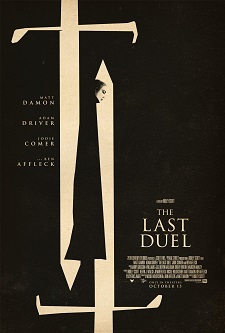
Movie Review: The Last Duel (2021)

TL;DR – Officially the last trial by combat held in France. The judicial duel between Jean de Carrouges and Jacques Le Gris was triggered when Carrogues’s wife, Marguerite, claimed that Le Gris raped her. The winner was said to be the one who told the truth (through God’s will making him victorious), the other condemned to death.

Review (warning: spoilers)

Based on the book of the same name written by Eric Jager, The Last Duel depicts the harsh and ruthless time of medieval France when war raged constantly between the French and English. The story centres on three individuals. Jean de Carrouges (Matt Damon), his wife Marguerite (Jodie Comer) and Jacques Le Gris (Adam Driver).

Jean and Jacques are friends who have fought together in many battles, but their friendship becomes strained when Jacques earns the favour of Count Pierre d’Alençon (Ben Affleck). Jacques starts earning land and riches over Jean even though both have bled for their country and fought bravely. When Jean marries Marguerite, he was meant to receive a rich piece of land as part of her dowry, but instead Jacques seizes the land as payment of tax owed to the Count. The Count, in turn, having his financial affairs sorted by Jacques, gifts this land to Jacques.

When Jean attempts to sue the Count for the land he deems rightfully his, the King throws out the lawsuit. Adding insult to injury, the Count then appoints Jacques the captaincy of a fort that has been held and run for generations by Jean’s family.

After a period of time, Jean and Jacques attempt to bury the hatchet but the truce is temporary as it becomes clear that Jacques has eyes for Jean’s wife, Marguerite. When Jean leaves for a campaign to fight in Scotland, and Jean’s mother and her servants depart for the day, Marguerite finds herself alone in the castle. Jacques visits and tricks her into letting him in. He confesses his love for her and believes that Marguerite feels the same, but when she tells him to leave and he does not, she attempts to flee to her bedroom to lock the door. Jacques chases her down and rapes her.

When Jean returns from his campaign, Marguerite tells her what happened leading to Jean challenging Jacques to a duel even though he denies having raped Marguerite. The accusations are presented to the King who sanctions that duel and leaving it to God to show who is in the right.

Director Ridley Scott delivers an impactful film that captures the brutality of medieval times and how men held the power and the women were largely powerless. There are many strengths to the film. When I watched it in the cinema, the sound immediately grabbed me; every galloping horse, clashing sword, battle cry, and dying soldier reverberated through my entire body. The choreography was stunning as scenes were shot in both France and Ireland, and the dirt roads and castles made me feel how hard life would have been during that time. The costumes, both male and female, are elaborate, and the way knights are suited up in armour is captured in pain staking detail.

All these audio and visual elements are combined in a story told in three chapters. Chapter one is told from the perspective of Jean, chapter two from Jacques, and chapter three from Marguerite. Scenes are replayed in each chapter with both subtle and striking differences. These differences bring significant impact on how the viewer is presented the events leading up to the last duel.

Ridley Scott and company depict the truth as being Marguerite’s chapter. However, I have read that historians have long debated the innocence and guilt (and truth) of all three of these individuals.

Regardless, the final trial by combat had me shaking in my chair as both fighters (who were once friends) bloodied each other before the King’s audience and Marguerite who is standing alone in a wooden tower, chained to the floor, watching with heart in mouth. Marguerite did not know until too late that if her husband loses the duel then it would be viewed that God declared Jacques as telling the truth and that she lied about being raped. The penalty for her would be being tortured and burned at the stake.

Having read nothing about the historical events, I had no idea who would triumph. However, given the way the film unfolds, and it is the events of chapter three that is shown as the truth, I was relieved when Jean comes away triumphant and Marguerite is released from her chains and allowed to reunite with her husband. There is interesting ambiguity as the camera focuses on Marguerite as she rides silently several paces back from her husband who basks in his triumph and is being mobbed by the masses. It is an expression that speaks of how women were treated at that time, an expression that shows the crime of rape takes a backseat to a knight’s honour, and how women are cast in shadow, fit only to give birth to heirs.

Overall the film is engrossing. The only thing that I struggled with was the casting. More specifically, the casting of Matt Damon as Jean de Carrouges. The rest of the cast are excellent, especially Comer and Driver. However, while Damon puts everything into his performance, I was not convinced. His speech and accent were mixed at best, and I felt the role would have been better suited with another actor (dare I say, an actual French actor or an actor who can speak French may have been a better fit? Tahar Rahim comes to mind). Still I enjoyed The Last Duel and the fact I want to pick up the book and read it says a lot to how effective the film is.

8.5 out of 10

Book Review: Big Little Lies by Liane Moriarty

TL;DR – Three mothers become friends and discover the deep pains they hide beneath the surface. They want to be good wives and loving mothers, but they first have to be true to themselves and that means confronting lies that have taken on a life of their own.

Summary (warning: spoilers)

Jane is a single mother. Her son, Ziggy, is a result of being raped. Jane is angst riddled and nervous about trying to be a single parent and she secretly worries that some sort of violent DNA is inside Ziggy because of her past trauma. Her fears appear self-fulfilling as Ziggy is accused of bullying another child.

Madeleine has turned forty-years old and is not quite sure how to deal with that milestone. She is a go-getter of a woman, divorced once, married twice, and gave birth thrice. Her eldest daughter, Abigail is now fourteen and is from her previous marriage to Nathan. Nathan did a runner on Madeleine when Abigail was a baby but has returned, apparently a reformed man, and remarried to Bonnie, a Zen-like yoga instructor, and they have their own child who happens to be going to the same kindergarten as Madeleine’s five-year old daughter, Chloe. It is difficult enough that Madeleine has to confront Nathan frequently but things become more challenging when Abigail starts idolising Bonnie. Jealousy and past pains arise.

Celeste is married to Perry, a rich banker, and has twin boys – Max and Josh. Celeste is a stunner, lives a life of luxury, has a handsome husband (with whom she still has hot sex with), and appears on the surface to have the perfect life. But as we all know, appearances can be deceiving.

Together these three develop a bond that will see them through some of the toughest and most horrific situations they will ever have to face including… murder.

Review

To be clear, the summary above makes it sound like the three main characters conspire to commit a murder. This is not the case.

However, the book opens with a school trivia night for parents that ends with someone dead and the police make it clear that it is being treated as a murder investigation. What events transpire that results in the trivia night transforming into a bloody disaster is revealed through subsequent chapters of the book. After chapter one, we are taken back six months prior to the trivia night and are introduced to Jane, Madeleine and Celeste.

Liane Moriarty captures Sydney suburbia and the daily trials and tribulations of motherhood with an ease that makes me jealous. It demonstrates the effectiveness of her writing and makes Big Little Lies an effortless page turner. The distinct voice she gives to her three main protagonists propels the reader into their minds and how they see their world. Their lives connect you and you want to find out where they end up and what choices they make.

This is the greatest strength of the story, and while there is an underlying mystery (i.e. who got murdered on the trivia night? why were they killed? and how?) that assists in driving the reader forward, it is how Moriarty captures the characters so well that it is engaging and engrossing.

Big Little Lies is all about how lies fester and damage us, and how truth can set you free. Nowhere is this more evident than with Celeste, who appears to have everything on the outside but behind closed doors, she is actually trapped in an abusive relationship. Moriarty captures this domestic violence situation with authenticity and shows us how Celeste convinces herself (essentially she is lying to herself) about her husband, Perry.

Moriarty then builds up the story to create a believable connection between Jane and Celeste (who, initially, appear to be polar opposites in terms of lifestyle and where they are in their lives). Astute readers will see the connection before it is revealed in the climatic scene at the trivia night, but you should still be rewarded with how it unfolds. I certainly was riveted by how Moriarty reveals that Perry turns out to be not only an abusive husband to Celeste but also Jane’s rapist. Madeleine is the glue that keeps the trio together, a bond that allows them to rely on each other even in the face of this horrific revelation.

But the icing on the cake comes from an unexpected source. An action by a character that I doubt many readers will foresee. That character is Bonnie, the level-headed, Zen-centred, loving-wife/mother that has filled Madeleine with jealousy and angst for most of the book. The final revelation is not that Perry is Jane’s rapist, it is that Bonnie grew up in a domestic violent family as well; Bonnie’s father would beat her mother. The life she has led has sought to bury her childhood and counter all that trauma. Though the story does not delve into Bonnie’s history more than this, one can only assume that Bonnie never sought to let this go or seek help for the trauma she experienced witnessing her mother being abused. Thus, when the trivia night occurs, and Bonnie witnesses the revelation that Celeste is in an abusive marriage and that Perry was the man who raped Jane, the calm demeanour vanishes, and the explosion is immediate. Bonnie attacks Perry with years of pent up rage and pushes him off the balcony to his death.

It is a brilliant piece of writing because 1) it actually makes sense and 2) you believe Bonnie’s hidden pain is as real as the pains the other three mothers have hidden. When she screams at Perry, “Your children see!” it is a pure reflection of her own childhood and completely believable. That is, the fact that in domestic violent situations, the children also see and absorb the abuse even if they are not the direct victims. This is a clever bit of writing indeed because Bonnie is a supporting character that we, the reader, believe has her head screwed on right and is there only as a focal point for Madeleine’s jealousy and insecurity. If you want to read any of Liane Moriarty’s work, then this is one you will not regret.

4.5 out of 5.

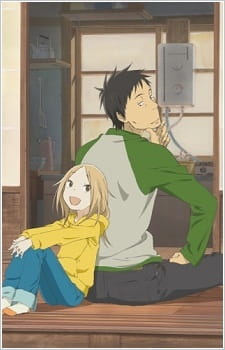
Anime Review: Usagi Drop (2011)

TL;DR – When Daikichi discovers that his deceased grandfather has left behind an illegitimate daughter, he is thrown out of his bachelor life comfort zone and learns about a greater purpose in life (i.e. taking care of a child) and the challenges and rewards that comes with that responsibility.

Review (warning: spoilers)

Imagine you have a stable job, currently single, and you hit thirty without quite knowing where all the time went. Your life is not entirely fulfilling but you are also not unhappy with where you are and what you are doing. There is a simplicity to your life that is not bad, even though every now and then there is that little niggle that you want to do something more.

Now, imagine you receive the news that your grandfather passes away. You attend the funeral and return to the family home to pay your respects only to discover a six-year old girl who is being shunned by the rest of the family. You initially have no idea who this girl is or why she is being looked like some sort of blight, but you soon discover that she is the illegitimate child of your grandfather. The family debates who will look after the child (seen as a constant reminder of the shame your grandfather has brought onto the family), yet you realise it is not the girl’s fault that she was born. Why should she be ostracised when her very existence was beyond her control? Do you take the step and be this girl’s guardian and parent?

This is what confronts Daikichi Kawachi in this delightful, funny, emotionally touching anime series Usagi Drop. When Daikichi takes that step (much to the surprise of his other family members), he knows he does not have the faintest clue of what it means to be a parent.

The little girl, Rin, embraces the kindness shown by Daikichi and starts living with him. The series showing the day-to-day interactions between the pair with both hilarious and poignant results. What makes this work is how Daikichi evolves from an individual who only thinks of himself to an individual who has a loving, nurturing parent-child relationship with Rin. The way the anime conveys Daikichi seeing through the eyes of a child and thus learning from Rin (as much as Rin learns from Daikichi) is marvelous.

Whether it is the simple act of holding hands, buying Rin clothes, and making onigiri rice balls, or dealing with the more challenging situations such as Daikichi juggling work with life, Rin entering elementary school, and wetting the bed due to her fear of death, these are all examined in thoughtful ways that will connect the viewer to this story.

If you have a heart of stone then this anime will not be for you. For everyone else, it is pure magic.

10 out of 10

Movie Review: The Tomorrow War (2021)

TL;DR – Soldiers from the future travel 30 years back in time seeking to recruit the help of humanity to fight against aliens. Dan, ex-military soldier come scientist, is drafted to take the perilous journey into the future. There he discovers his daughter, grown-up and also a scientist. Together can they come up with a way to stop the aliens killing every last human being on earth?

Review (warning: spoilers)

Dan Forester (Chris Pratt) drives home while talking on the phone for what appears to be an interview for some science job in a lab. He mentions he has leadership experience from doing military tours and running two combat missions in Iraq. He is in the final round and desperately wants to be chosen even if it means missing out on watching the game with his daughter and abandoning his wife to a house full of guests because they are hosting a Christmas party. It is December 2022 but there will be no early presents for Dan as the selection panel informs him that they have gone with someone else. Dan takes out his disappointment on a rubbish bin knocking it over.

Entering the house dejected, and in no mood for partying, it is his daughter, Muri (Ryan Kiera Armstrong), who comforts him by saying she wants to be the best like he is the best at science. He then tells her daughter that to be the best you have to say, “I will do what nobody else is willing to do.”

The game on television is a World Cup soccer game, and it is at this moment that everything changes as (play ominous background music) a portal opens in the middle of the field and a bunch of soldiers emerge. Lieutenant Hart (Jasmine Matthews) taps into the stadium speakers (using some sort of advanced sci-fi tech) and announces to everyone at the stadium and all the viewers watching the game around the world that they are from the future. Thirty years to be exact. She announces that she comes from a future where humans are fighting a war against aliens called Whitespikes and they are losing. She has come back in time to recruit people to take back to fight the war and concludes, “You are our last hope”.

Thus, the introduction to Tomorrow War completes. Soldiers in 2022-23 start making the jump into the future but the casualties are high and most do not make it back. This leads to two things: 1) the global announcement for a worldwide draft involving civilians that will be sent to fight the future war and 2) rise of anti-war protests across the globe.

Dan is found teaching biology in high school and all his students have lost hope. They do not see the point in going to school and learning if they all wind up dead in thirty years time. Dan says there is still hope, but it will require scientists to come up with a solution and to continue to innovate to find a way to defeat the aliens.

He is then called to a building where he undergoes tests for conscription. By shoving his arm into a device that scans his DNA and shows his future, he is told that he will die in seven years time. You find out later that to avoid some sort of time travel paradox, people who go that far into the future are already dead and those from the future who travel to the past are not already born (thus avoiding the situation of oneself meeting oneself in another time). The machine then fuses a metal band, that reminded me of those gladiator wrist bands, to his arm that allows the government to track him wherever he is and perform the portal jump (he is also informed that any attempt to tamper with the band or evade the draft will result in his imprisonment or his spouse or his dependent of legal age taking his place). Happy days…

Things do not go as planned when he makes the jump into the future along with an army of other civilians-turned-soldiers. Dan manages to survive the jump out of sheer luck along with a small group of others and is contacted by Colonel Muri Forester (Yvonne Strahovski) over comms. Yes, little Muri is now all grown up and a Colonel battling the Whitespikes though Dan does not know this yet. Muri orders Dan and his makeshift group of soldiers on a rescue mission to save a group of scientists and retrieve a dozen vials of some sort of blue liquid. Suffice to say, by the time, Dan and his crew find the scientists they are not alive, but he does manage to get the dozen vials.

The action sequences are pretty impressive and the Whitespikes are suitably monster-like and ruthless. Where the film struggles is the idea of civilians who receive little to no combat training are thrown into the future against aliens that are very good at killing. Why the government and the people from the future think that throwing more humans into the meat grinder is a good idea is beyond me. But plot hole aside, and with the body count rising exponentially, Dan manages to survive his first encounter with the Whitespikes and meets Colonel Muri.

The emotional pull in the film is meant to be between father and daughter. A now adult Muri, tells her father that by the time she turns twelve, he separates from her mother, then at fourteen he files for divorce and then on her sixteenth, he was in a car accident and died in hospital. This revelation is met with confusion and disbelief. Dan is adamant he would never leave her and her mother. That is pretty much all that gets revealed. Muri does not explain why he leaves the family other than to indicate that he was never happy. The inference is that he was driven more by his career but never achieved success in this space and thus Muri and her mother suffered as a result.

Queue more alien swarms, big explosions and endless gunfire. The rest of the film has Muri coming up with a toxin that can wipe out the Whitespikes and when she succeeds she tells Dan he needs to go back in time with the toxin and mass produce the stuff. Dan says he will but will come back to this future to wipe out the Whitespikes and save her, but the good Colonel Muri is swarmed by aliens as he teleports back to his own time.

The helicopter views of the alien swarms are impressive. The closer quarter fight scenes between Dan and company and the Whitespikes are more mixed; some sequences are well done such as when they capture the “mother” alien, other sequences like when they are trying to escape from the Whitespikes is not so effective because watching civilians act like soldiers beggars belief. The film is not helped by the premise that the entire world in 2022 agrees to send as many people as they can into the future to fight a war they do not know actually happens. Governments suddenly all get along and unite to send soldiers (and then later civilians) into the future war. This happens as a series of news clips in a space of a couple of minutes at the beginning, so you have to suspend all belief in quick time because the director thinks you are not interested in any exposition, and you just want to see aliens being blown up and humans having their bodies dismembered.

Sadly, action does not equal plot.

6 out of 10

Book Review: Eleven Rings by Phil Jackson and Hugh Delehanty

TL;DR – Phil Jackson coached two teams – the Chicago Bulls and Los Angeles Lakers – to a combined eleven NBA titles. No other NBA coach has won more. This is his story of how he achieved such success with a group of professional athletes with huge egos.

Summary

Between 1991 to 1998, the Chicago Bulls won six titles (two sets of 3-peats), and between 2000 to 2010, the Los Angeles Lakers won five titles (one 3-peat and one back-to-back title). Those two dynastic teams were built around superstars Michael Jordan (Chicago Bulls) and Kobe Bryant (Los Angeles Lakers). They are arguably considered the two greatest scorers in the history of the NBA and were renown for taking on opposing teams by themselves in order to win.

But basketball is a team sport and there were plenty of other players and egos on those teams. As head coach, Phil Jackson had to be the central voice and present a road map and strategy that the players would buy into. How he managed to achieve this is detailed in this book and demonstrates that beneath the sport, the training, the games, the skills, is the essential need to understand human relationships.

Review

Like all professional sports, the need to win often overshadows everything else. Accomplishments achieved prior to taking that final step over the finish line are not given the credit they deserve because media and memories tend to focus only on whether the team (or individual) lifted up the championship trophy or won a gold medal. Just ask the Buffalo Bills (NFL American Football Team) who went to four straight Super Bowl finals but lost all four. To date, no other team in the NFL has ever reached four Super Bowls in a row and that achievement should be celebrated but instead all anyone looks at is the fact that they never won the Super Bowl in those four attempts.

However, unlike the Bills, the Chicago Bulls of the 1990s and the LA Lakers of the 2000s did obtain success in “winning terms” but their true success was blending together players and coaching staff into a cohesive unit. More importantly, they were not just championship teams, they became family (or as Jackson puts it a “tribe”). And because we are talking about humans and not robots playing a sport, the personalities, passions and conflicts all arise.

It is these narratives that make for fascinating reading (not the games themselves). Generally, my favourite read is in the fantasy/sci-fi genre, but I will read anything if it engages me. Non-fiction is not something I normally gravitate towards and Eleven Rings being about basketball is helped if you, the reader, understand the game. But there is enough in this book to show that some of the best stories revolve around real life people.

Phil Jackson was also unusual as a sports coach as he embraced approaches involving meditation, mindfulness and combining it with psychology and Native American philosophy. Players on Jackson’s teams reacted to his methods in varying ways. As you would expect some did not find meditation and mindfulness all that useful, while others embraced these alternate ways of improving team chemistry and performance on the basketball court. Jackson was coined the “Zen Master” in basketball circles and was considered quite unorthodox compared to other NBA coaches during that time.

The insights into how Jackson worked with and managed players such as Jordan, Scottie Pippen, Dennis Rodman, Kobe, Shaq etc. allows the reader to understand the challenges he faced and how leadership can blossom in different ways. The bonds formed and the chemistry that comes about if those relationships are allowed room to grow shows that even on the basketball court, creativity, understanding and trust can flourish.

Jackson, himself, is not immune from ego or internal struggle. I kind of wished he explored that more in this book regarding his own foibles, doubts and weaknesses, but overall he delves into the adventure undertaken during those years. That journey rivals any good fantasy quest or sci-fi saga and thus is worth a read even for non-basketball or non-sporting readers.

4 out of 5.

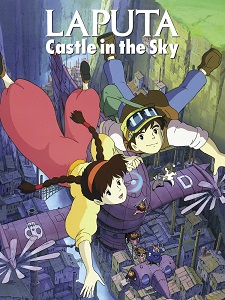
Anime Review: Laputa: Castle in the Sky (1986)

TL;DR – Sheeta owns a mystical amulet that contains the power to levitate. She is targeted by both government agents and air pirates seeking the power of the stone. With the help of a boy named Pazu, the pair go on an adventure to find the flying castle, Laputa, and the origins of Sheeta’s amulet.

Review (warning: spoilers)

Before there were big furry creatures and cat buses (Tonari no Totoro), before young witches tried to make their mark (Kiki’s Delivery Service) and pigs flew seaplanes (Porco Rosso), before forest gods and girls that rode on giant wolves (Princess Mononoke), there was Laputa: Castle in the Sky. Hayao Miyazaki’s masterpiece brought steampunk fantasy to the masses and spawned numerous steampunk anime and manga to follow including the likes of Fullmetal Alchemist and Miyazaki’s later work, Howl’s Moving Castle.

I have said in my previous anime reviews of Miyazaki’s work that the man is a storyteller of the highest calibre and has an attention to detail that creates worlds that are full of depth. In anime (and indeed animation) circles, Miyazaki’s ability to capture the little things on the screen while depicting multi-layered characters and fascinating story plots is second to none.

Laputa: Castle in the Sky follows young orphan Sheeta aboard an airship who has been captured by government agent Muska. The airship is attacked by pirates led by Dola, and Sheeta attempts to escape only to lose her footing scaling the outside of the ship and plunges to her death. Or so we think…

Instead, a glowing blue light bursts forth from an amulet around Sheeta’s neck slowing her descent. We are then introduced to Pazu, a boy who works in a mining town, who sees an unconscious Sheeta floating down from the skies. The animated physics of the characters grabbed me immediately and the scene where a confused Pazu opens his arms to “catch” Sheeta and as soon as she is in his arms the power of the amulet turns off is both funny and charming. Pazu’s legs buckle as Sheeta’s full weight has been released by the stone and he strains to lift and carry her to safety.

He takes her to his home to recover. His home, an odd construct of wood and stone with several floors connected by ladders, reminded me of a cross between a castle tower and a hobbit house. The scene where he wakes the next morning to release doves into the valley and play his trumpet to greet the new day is divine.

But their peace is short lived as Sheeta reveals to Pazu those seeking to hunt her down, a race between government agents and pirates to get a hold of Sheeta first. When action is triggered, it is thrilling and filled with complexities that boggles the mind when you think this was done all through traditional cell animation techniques back in the 1980s (way before CGI became common place). One such sequence is when Pazu and Sheeta are escaping on a train and being chased by the pirates and army. The explosions and collapsing of bridges where the train tracks run is nothing short of brilliant. Like something out of Looney Tunes Road Runner cartoon but with way more detail and care.

Through the twists and turns, Sheeta is eventually captured again by Muska while Pazu joins forces with Dola and her pirates. They manage to rescue Sheeta but at the cost of the amulet which falls into Muska’s hands. The climatic final act involving the discovery of Laputa (a giant floating castle that has at its centre a giant levitation crystal) and a series of sentinel robots that can be activated to defend the castle or wage war. This is Muska’s end game. He wants to take control of Laputa and its robot army and take over the world. It is only through Sheeta and Pazu’s actions that they prevent this from happening, and watching the disintegrating Laputa is horrifying, mesmerising and truly epic.

An adventure film that is essential viewing. One to be watched and re-watched.

10 out of 10