Movie Review: The Mauritanian (2021)

TL;DR – star studded cast delivers a legal drama with punch. Based on the memoir Guantanamo Diary by Mohamedou Ould Slahi who was detained and tortured at Guantanamo Bay detention camp on suspicions of terrorism.

Review (warning: spoilers)

There is a statistic shown at the end of the film that states, “Of the 779 prisoners who have been held at Guantanamo, eight have been convicted of a crime. Three of those convictions have been overturned on appeal.”

Mohamedou Ould Slahi was one of those 779, and spent 14 years at Guantanamo. Seven of those 14 years were spent after he won a court case where the judge ordered his release. Yes, you read correctly. He spent seven years in prison, testifies in court, wins his case, and then spends a further seven years before finally being released. Not only that but Mohamedou Ould Slahi was held in prison for 14 years without ever being charged for a crime.

Both the statistic at the end of the film and Mohadmedou’s story demonstrates a system that has failed. Terrorism suspects are detained without due process and interrogated without restraint. It is a damning indictment on human rights.

Directed by Kevin Macdonald, The Mauritanian is a semi-documentary style drama that is straight forward in its telling. It’s a heavy film, depressing and frustrating, where the shocks are mainly attributed to the torture scenes as opposed to the legal failings. The film is elevated by incredible performances of its cast.

Slahi (Tahar Rahim) and Nancy Hollander (Jodie Foster, Slahi’s lawyer) are a tour de force. Both Rahim and Foster were nominated for their roles (Foster won Best Supporting actress at the Golden Globe Awards). Teri Duncan (Shailene Woodley) is Hollander’s co-counsel and Stuart Couch (Benedict Cumberbatch) is the prosecutor. Together, both prosecution and defence go through the process for which they are hired and encountering all manner of obstacles along the way in getting the information they need to build their case.

It is clear early on that Couch is a principled lawyer. He has every reason to prosecute Slahi and wants the man to get the death penalty. But only if there is irrefutable proof that Slahi had a significant hand in the 9/11 terrorist attacks. The proof comes in the form of Slahi giving a signed confession. But when Couch demands to see the process undertaken to obtain Slahi’s confession and is met with a brick wall of individuals saying just prosecute the guy and don’t worry about how he came to confess, you know that the end does not justify the means.

Hollander receives what occurred from Slahi himself, and the inhuman ways he was treated before he “confessed”. This isn’t mere confession under duress, this is pure hell. How Slahi survived is a miracle in itself. The interactions between Hollander and Slahi are the highlight of the film.

However, in the end, the film does not pack the punch you would expect from such atrocities. There’s something missing in the telling, as if the writers were merely reporting on events as opposed to telling a story. Nevertheless, it is still worth watching. The real life footage at the end of Slahi returning home and his lawyers Hollander and Duncan are incredibly moving.

7.5 out of 10
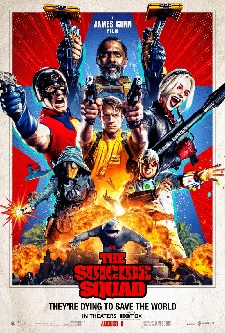
Movie Review: The Suicide Squad (2021)

TL;DR – more blood, more mayhem, and a giant starfish does not make a great comic book movie.

Review (warning: spoilers)

I’m a big fan of James Gunn. Guardians of the Galaxy was directed and co-written by Gunn, and one of my favourite Marvel films – the soundtrack, cinematic style, and storytelling were wrapped up wondrously into a popcorn film that satiated many comic book fans including me. Guardians of the Galaxy Vol. 2 (also written and directed by Gunn) fell short of the first film but still delivered a decent sequel.

Unfortunately, expectations are a dangerous thing. I managed to keep my expectations low for The Suicide Squad (a standalone sequel to 2016’s Suicide Squad), but even then I struggled with this film.

Before I continue, I should preface this with the fact that while I am an avid reader of novels and comics, Suicide Squad isn’t one of them. My understanding is that Gunn has stayed true to the source material. If this is the case, then perhaps I missed a good deal that the die-hard fans will pick up.

With that caveat in mind, I didn’t enjoy The Suicide Squad as much as I had hoped.

As with the first film, the Suicide Squad is comprised of super criminals/villains serving jail time. The government use them for missions in exchange for reduced time. To ensure compliance during the missions and extinguish any temptation to escape, each member of the squad has an explosive chip inserted in the back of their head, which can be detonated if they stray too far from the mission’s path. So far, so good.

The movie opens with an introduction to a bunch of super villains, some new and some coming back from the first film like Harley Quinn (Margot Robbie). None of these characters except Harley registered, so I could not tell the new from the old (which demonstrates how forgetful they all are to me). Still, as they all load up to fly to a South American island nation to destroy a laboratory named Jotunheim along with an evil experiment called ‘project starfish’, you get glimpses of what this dysfunctional mob is all about. There’s the field leader of the squad, Rick Flag (Joel Kinnaman), a dude with boomerangs, another with a javelin, some alien chick, an anthropomorphic weasel named… you guessed it… ‘Weasel’, some guy that can throw a handball and rebound it off multiple surfaces with pin point accuracy, a guy who can detach his limbs and a mercenary figure named Blackguard.

Just when you get to know who’s who, any attempt to build a story on this bunch is wiped out in the first fifteen minutes when they land on the island and are ambushed (it’s revealed Blackguard has somehow betrayed the squad, but it’s never explained how he managed to do this as he’s shot in the face by the very soldiers that he gave information on the squad to). An attempt to salvage the situation is quickly snuffed as all of them perish in an assortment of comic ways except Harley (who gets captured) and Rick (who escapes).

We, the viewers, then see there is a second Suicide Squad that has landed on the island and the first squad was a distraction. Yeah, I don’t know. It took quite a bit of effort to invest in the first bunch and now we’re being asked to get to know a second bunch. The back stories and emotional depth is explored in greater detail with this second squad along with Harley and Rick who join up with them. For the first half of the movie, I felt it did not go anywhere and there were only small glimpses of depth and story.

The scene where Harley is tortured and escapes is probably the best sequence in the film. And when Bloodsport (Idris Elba) and Peacemaker (John Cena) go at each other even though they’re meant to be on the same team brings a real feeling of conflict rather than a farcical feeling of one. There’s some emotional backstory revealed for both Bloodsport and Ratcatcher 2 (Daniela Melchior) that is an attempt albeit feeble in getting us to care about them.

But after that we have a giant starfish aiming for world domination. Think Godzilla but a starfish. I kid you not. The climatic battle scene falling flat in my view. I am pretty sure Suicide Squad aims to have the highest death count of any comic book movie ever filmed so far. The collateral damage (no matter how creative or gruesome) ends up being ho hum because you end up saturated in it.

In a credit scene, we find out that Weasel, who we thought drowned in the opening scene cause he can’t swim, is actually alive and we watch him wander off into the forest on the island. Why? Who knows? Who cares? It’s almost like they had some leftover CGI budget and decided to throw that in for laughs. The Suicide Squad had the potential to add more depth and build on the first film. Sadly, expectations got the better of me.

5.5 out of 10

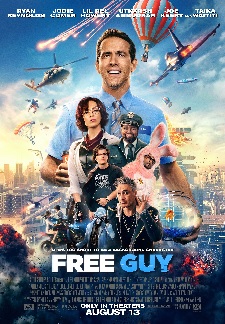
Movie Review: Free Guy (2021)

TL;DR – who knew the existential crisis of an artificial intelligent bank teller could be so much fun?

Review (warning: spoilers)

“Don’t have a good day, have a great day,” says Guy (Ryan Reynolds).

“In case I don’t see you, good afternoon, good evening, and good night,” says Truman (Jim Carrey).

It it not just with their catch phrases that there are similarities between Guy (in Free Guy (2021)) and Truman (in The Truman Show (1998)). Both characters do not realise that the world they reside in is not the real world. Both live a life of routine; they interact with real people who know the truth; their innocence and naivety are used for comic purposes; and their lives are turned upside down when they discover the truth.

The primary difference is that Guy is a non-player character (NPC) in a video game called “Free City” (i.e. he’s not real), while Truman is an actual living being in a reality show.

All NPCs in video games have programmed instructions on how they act and react to real life gamers who interact with them. They never deviate from this, as their code prescribes their actions. For Guy, he’s a bank teller NPC who serves customers, says his catchphrase and every day the bank is robbed by multiple gamers, he reacts like any good bank teller when they’re getting robbed by lying on the ground and being as little a threat as possible.

He lives in “Free City”, a popular massive multiplayer online role playing game, where players create characters that are as bad-ass as possible. Leveling up involves accepting any number of criminal tasks and acquiring a bat cave load of weaponry and vehicles.

However, Guy’s routine suddenly changes when he encounters Molotov Girl (created by gamer and programmer Millie Rusk (Jodie Comer)). It soon becomes apparent that Guy is not constrained by his underlying code, if anything his code base expands indicating he actually has artificial intelligence, and he undergoes the expected existential crisis when Molotov Girl reveals to him that he is inside a video game and is not actually a real person.

In parallel to this, Millie and co-programmer, Walter McKeys (Joe Keery), work together to find evidene that “Free City” is actually based on code they created for a game they made called “Life Itself”. Pathways intersect when Walter reveals to Millie that Guy is based on artificial intelligence code he created. Millie (as Molotov Girl) and Guy go on to discover that the game “Life Itself” is hidden beyond the boundaries of “Free City” and look to bridge the gap to find it.

Meanwhile, Antwan (Taika Waititi in hilarious form) plays the villain responsible for stealing Millie and Walter’s code and is now looking to destroy all evidence of “Life Itself” by shutting down “Free City” in order to release its sequel “Free City 2”. Waititi must of had a ball being part of this movie as he delivers his lines with comic vitriol and also gets to destroy an entire server room with an axe.

The balance between humour and drama struck a chord for me, and the overall roller coaster ride filled with geek references, cameos from YouTube gamers, great chemistry between the entire cast and solid story had me smiling from ear to ear. It’s always a good sign when I walk out of a cinema and feeling the desire to watch the movie again. For some viewers, it may all seem too geeky or silly (a pale imitation of The Truman Show), but I’m a geek so this is right up my alley. Thank you very much.

Free Guy also has the underlying positive message to go live your life and not get stuck in a loop. So, go do what you really want to do. Don’t have a good day, have a great day!

9 out of 10

Movie Review: The Half of It (2020)

TL;DR – a teenage version of Cyrano de Bergerac or Roxanne without the big noses.

Review (warning: spoilers)

Both Cyrano de Bergerac and Roxanne (both based on Edmond Rostand’s 1897 play) revolves around a male character (with a large nose) who is in love with a female character. He’s good with words and poetry but does not profess his love to the female because he considers himself physically unattractive. Enter a second male character (who doesn’t have a large nose and is considered physically attractive) who also has a crush on the same female character but is incapable of stringing two sentences together when speaking to her. First male helps second male by telling him what to say… comedy and drama ensues.

Now take the above and do the following:

– Make the male character (that’s good with words) be female (that’s good with words & has a normal nose).
– Turn them all into teenagers.
– Add all the joys and challenges that comes with being a teenager.

Ellie Chu (Leah Lewis) is the introverted and dutiful daughter who makes some extra money on the side by writing papers for other students so they can get good grades. She is the ‘Cyrano’ in the film but without any attempt to make her look like Pinocchio. In fact any attempt to make her like a character with self-esteem issues when it comes to her physical appearance is thrown out the window; I don’t care how much they try to make her look like a nerd with Harry Potter type glasses who is obsessed with drinking Yakult, you know she’s pretty underneath.

Paul Munsky (Daniel Diemer) is a football player that is a little slow and has a major crush on Aster Flores (Alexxis Lemire). Knowing Ellie helps other students with papers, he seeks her services in writing a love letter to Aster. The scenes where he chases after her on foot while she’s riding her bicycle home are genuine, funny and touching.

Additional tweaks to this story give it a fresh feel. For one, Ellie doesn’t have a crush on Aster, she doesn’t even know she’s attracted to her until they start communicating through letters and texts. The light dawning on Ellie that Aster isn’t just a pretty face, has her own inner struggles and dreams, and a depth of personality that draws them toward each other. Problem is that Aster thinks its Paul Munsky doing all the writing.

The second tweak is that Aster has an existing boyfriend, Trig Carson (Wolfgang Novogatz), who has his whole life mapped out with Aster (much to her dismay). His confidence and surety of what their lives will be like (i.e. they get married, have a family etc.) is a clear red flag for Aster who battles internally with the fear of being alone versus following her own dreams.

The last tweak is Ellie’s father, Edwin (Collin Chou), who works as a station master, or rather he did until his wife passed away and now Ellie picks up the slack and feels like she can never leave to live her own life because it would mean her dad would be alone.

There’s also the modern day splash of religious beliefs thrown in about homosexuality. So, there’s plenty to watch and follow in this engaging, more than a few times funny, poignant film about what is at its heart, two girls trying to discover their own identity and in the process identifying an attraction to each other. In truth, while it may start off as a Cyrano de Bergerac, it ends squarely as its own story, transforming into something else that has nothing to do with unrequited love but everything to do with living one’s own life to the fullest.

The scene where Ellie and Aster talk at the hot spring is beautifully done. A moment that captures their hopes and fears, sharing their loneliness, and desiring to be understood.

The Half of It is fabulous film by director Alice Wu, so grab a Yakult with your popcorn and enjoy.

8.5 out of 10

Movie Review: Kajillionaire (2020)

TL;DR – a family of con artists live off the grid but face eviction unless they pay the rent. They figure how they can get the money by doing a travel insurance scam, and along the way bump into a woman who wants in on the act and in the process, changing the course of their lives. A quirky, comedy drama that will leave you thinking long after the credits roll.

Review (warning: spoilers)

Extremes in behaviour make for intriguing stories. The movie Nomadland, which won the 2021 Academy Award for Best Picture, revolves around a woman who makes the choice to live as a modern day nomad in her van after losing everything in the recession. It’s an intriguing story even if it doesn’t go anywhere, and it should be noted that ‘intriguing’ doesn’t always equal ‘satisfying’.

Kajillionaire is similar in that it’s about a family that chooses to live a life as grifters. They live frugally, doing small scams and cons, and exist largely off the grid. Unlike Nomadland, which for all its existentialism and great acting, I found largely unsatisfying because there isn’t much of a plot, Kajillionaire delivers a story that starts off quirky and funny, turns toward the disturbing, before rounding out to an ending that transforms the main character.

Robert (Richard Jenkins) and Theresa (Debra Winger) live a life as con artists. They have a daughter, Old Dolio (Evan Rachel Wood), who they have raised to be one of them. The why of it is largely because of Robert who has a paranoia about all forms of surveillance and tracking and ultimately believes that society is corrupt. Why Theresa goes along with this, I have no idea, other than she’s married to the man and must have the same beliefs. They have chosen this life, which frankly, requires more work than getting a normal job. Are they happy? Doesn’t seem like it, but maybe that’s not the point when you can stick it to “The Man”.

Old Dolio, on the other hand, born into this family, has had no choice in becoming a con artist. She does so in order to get her parent’s approval and some semblance of affection, which never happens. Robert mostly blames her when things go wrong and takes the credit when it goes right. Theresa will not win any award for mother-of-year as she exhibits not a modicum of love for her own daughter. They named their daughter ‘Old Dolio’ after a hobo who won the lottery in hopes he would leave his namesake some of his money. This sums up how they perceive their daughter, a tool to be used for a con.

There is a quirky comedy to how they go about their lives in the opening scenes of the film, but once this passes, I came dangerously close to switching it off because you come to realise that Robert and Theresa have no redeeming values and they treat their daughter like a robot with no feelings. However, Director and Writer, Miranda July doesn’t drag this out.

Enter Melanie (Gina Rodriguez) who meets the trio on a flight. A flight done purposefully as part of an insurance scam conjured up by Old Dolio in order to get some quick cash to pay their landlord, who has been chasing them for rent. Melanie ingratiates herself with the parents and gets Robert to start drinking, which leads to him divulging their plan and getting her on board.

Why Melanie does this is not clear to me, and why she does not see Robert for what he is was also somewhat baffling because later on he reveals his creepy intentions by trying to seduce her in a hot tub. The reason that Robert’s wife, Theresa, goes along with it is also baffling. Perhaps it demonstrates how base they both are. At the same time, there are ambiguities (purposeful) in their character that demonstrates that they stay true to their choice as grifters (for example, they always split their scams three ways with Old Dolio even at the bittersweet end).

Regardless, Melanie sees that Old Dolio has been brainwashed into thinking she has no choice but to live this life that her parents have raised her to be in. The transition from off-beat comedy to romance between the two is genuine (a lot occurs beforehand for the connection to be realised, so it does feel believable and not something that comes out of left field). Old Dolio’s transformation is not by any means smooth. Like a video she watches of a newborn baby crawling on her mother’s chest, to unlearn her behaviours is difficult, at times painful, and altogether uplifting. She is able to do this because Melanie does not give up on her and that is key to the film not drowning in despair. A worthwhile watch.

7 out of 10

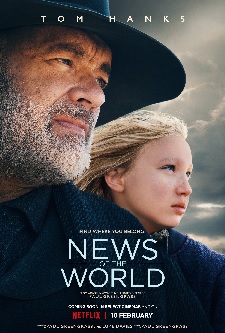
Movie Review: News of the World (2020)

TL;DR – an American Civil War veteran commits to returning a young girl raised by a Kiowa tribe to her last remaining family.

Review (warning: spoilers)

Having just written a book review on Lincoln the Unknown by Dale Carnegie, it was coincidental that I stumbled upon News of the World which follows Captain Jefferson Kyle Kidd (Tom Hanks), a Civil War veteran, who travels from town to town reading stories from newspapers in front of audiences who pay a dime a person. It’s a stark contrast to today where we can obtain the world’s news with a touch on our mobile devices.

Set in 1870, five years after the Civil War, the south has not recovered from the ravages of war and the nation is still going through reconstruction. The story follows Kidd on a road between towns, encountering an overturn wagon with a lynched black freedman hanging from a tree and finding a young white girl named Johanna Leonberger (Helena Zengel) hiding in the bush speaking in Kiowa. Kidd discovers that Johanna has been orphaned twice over; her birth parents killed in a Kiowa raid, and subsequently her Kiowa family releasing her from captivity to the black freedman. After a couple of attempts to unload Johanna and make her someone else’s problem, Kidd commits to taking her to her remaining family, an aunt and uncle who live near San Antonio.

Based on the book of the same name by Paulette Jiles, Director Paul Greengrass has created a movie rich in detail of a time when the aftermath of war has left many wounds; some open and unable to heal, others festering, and some that have scarred over and never forgotten. The film is ably supported by its strong cast led by Hanks in fine form and Zengel capturing well the lost look of a child trying to survive in a world of violence and hate. The cinematography is stunning and shows that it is not only the people you have to be wary of but also the weather itself.

At its heart though, this is a story about family, and how ultimately family is what is lost in war. What starts off as a lost girl being delivered by a war veteran, on a dangerous road to find home, ends with a war veteran who is just as lost and realises that home is with the ones you love. It’s a touching story with a heartfelt ending, and certainly in these isolating COVID times, it is a much needed reminder of what is important in life.

7.5 out of 10

Movie Review: Green Book (2018)

TL;DR – a road trip film about identity, race, culture and friendship.

Review (warning: spoilers)

The title of this film is based on The Negro Motorist Green Book which was an annual guidebook for African-American road trippers. From this, you immediately get a sense of what this movie is about. Set in the era of Jim Crow laws where state and local laws enforced racial segregation in the southern United States, the green book provided information on where places were relatively friendly and safe to travelling African-Americans.

The racial divide underlies the story but this film is much more than that as it focuses on two men of different childhoods, backgrounds and cultures overcoming the narrow views imposed on them to find a connection that grows into friendship.

Inspired by a true story, we follow gifted classical and jazz pianist, Don Shirley (Mahershala Ali) on a road tip into the deep south with chauffeur and bodyguard, Frank “Tony Lip” Vallelonga (Viggo Mortensen). Don is educated, refined, well-spoken and seeks to rise above (in his own way) the prejudices and discrimination he faces every day. Tony works as a bouncer, struggling to find work in an America coming out of a recession in 1962. The scene where Tony competes in a hot dog eating contest to win a bet sums up the lengths he will go to earn some cash for his wife and two kids. He’s rough, says-it-how-he-sees-it, and has been infected by racial and cultural prejudices himself through society and his own upbringing in a robust Italian family.

When his job as a bouncer is put on hold because the club is being renovated, he applies as a driver for Don on a music tour of the south. The initial friction between them slowly transforming as they continue on their journey together. Examination of Don and Tony’s own idiosyncrasies and fallibilities along with their building trust lifts the film. And when faced with all manner of unsavoury incidents from Don being beaten by a group of white men at a bar to a country club refusing him to eat in the whites-only dining room, Tony comes to the realisation of his own prejudices and their bond becomes one of genuine friendship. There’s plenty of comic moments too that enhances their on-screen chemistry.

Winner of the Oscar for Best Picture at the 91st Academy Awards, this is an uplifting film that is in stark contrast to more recent Best Picture winners in Parasite (black comedy thriller) and Nomadland (bleak drama).

I have also read that Green Book has received controversy in its depiction of Don Shirley along with the white saviour trope (white character saves a non-white character while also learning something about him/herself). Whether such criticism is fair or otherwise, had it not been inspired by a true story, the movie is still highly enjoyable and when viewed through that lens, the message of hope and reconciliation is worth being said. For without it, how will we ever change for the better if such things are kept silent?

9 out of 10

Movie Review: Anon (2018)

TL;DR – a sci-fi film that has been largely panned by critics is actually a real gem.

Review (warning: spoilers)

The use of technology to record evidence of criminal activity is nothing new (e.g. CCTV, digital recorders, facial recognition etc.) With the ever expanding advancements that allow social networking to connect us around the globe, and the increasing collection of personal information by corporations, the idea of “big brother” has allows loomed heavy over society and governments. The balance between human rights/privacy and law enforcement/monitoring through the use of technology is an ongoing challenge.

It’s also ripe material for creating dystopian sci-fi stories of which Anon examines in clever detail. The film starts with us following detective Sal Friedland (Clive Owen) walking to work, and through his eyes, we see that every person he focuses on, he can bring up all manner of information from name, age, address to social and biographical information. Law enforcement also have different clearance levels to access things like criminal history as well as be able to video replay past events as seen through those individuals.

The CGI effects are clean and minimalist in nature. They provide an augmented reality that I found engaging and immediately shows the viewer that we’re in a futuristic society. There’s a definite Matrix feel to the environment. We watch as Sal passes various civilians and profiles are brought up through his ocular enhancements, but when a female pedestrian (Amanda Seyfried) walks by and brings up an error (i.e. no profile and flagged as “Anon”), Sal pauses, puzzled and wondering if there’s a glitch in the system.

When a series of murders start to unfold, it becomes clear that someone has hacked the system and found a method to get away with the killings. This part of the story drew me in completely. What the killer does is take over the victim’s ocular system and transfers their sight to the killer’s view. Imagine seeing yourself through the eyes of the killer as they calmly walk up to you with gun in hand. Disorienting and confusing, you watch yourself beg, cry out, asking what is going on, only for your brains to be blown out. In this way, the victim never sees who kills them.

After further detective work, the Girl/Anon becomes linked to the killings and is the primary suspect. She has the ability to replace recorded histories with fake events and her services are sought by the wealthy. For example, a married man who has an affair can have the affair erased and replaced with innocuous events. So long as you pay her price in cash, she can create a whole new history for you. Sal goes undercover to hire her services and a cat and mouse game ensues. The twist to this sci-fi mystery is worth the wait in my opinion.

Clive Owen is a bit wooden as Sal. I’m not sure if that’s how the character is meant to be portrayed or not. In a world where practically all crime can be solved with little actual detective work because everything is recorded, his character is mostly bored at the beginning, but this picks up when the killings begin. Amanda Seyfried plays the femme fatale with conviction and her analog existence demonstrates a cautionary tale of our reliance on digital technology.

Critics (and many audience reviews) have panned the film as bland and lacking substance. I found it a pleasant surprise that mixed elements of Minority Report and neo-noir L.A. Confidential.

Anon may not reach the heights of either of those two films, but it is certainly better than some other bigger budget sci-fi offerings out there.

7 out of 10

Movie Review: Palm Springs (2020)

TL;DR – Time-loop romantic comedy that’ll delight fans of Andy Samberg’s schtick.

Review (warning: spoilers)

Andy Samberg and Cristin Milioti team up in this off-beat comedy that sees them stuck repeating 9 November due to entering a time paradox that resides in a cave somewhere in Coachella Valley. Think Groundhog Day in Palm Springs, California instead of Punxsutawney, Pennsylvania.

There’s a lot of dysfunction with the entire cast of characters (except perhaps one). The cleverness of this film comes from exploring that no one is squeaky clean, that being human means being flawed and that even if you know everything that is going to happen (i.e. if you were living the same day over and over again), you make choices and your actions do have consequences even when you think they don’t because you’re in an infinite loop. The consequences come at chipping away at Nyles (Andy Samberg) and Sarah’s (Cristin Milioti) own souls because even though everyone around them has reset to 9 November, they haven’t; they carry the knowledge and memory of everything they’ve done on those hundreds/thousands/millions of 9 Novembers previously.

The dysfunction carries both the comic and surprisingly thriller moments in the film, and I became invested in finding out what fate lay in store for Nyles and Sarah. The premise for their paths crossing in the first place surrounds a wedding being held at Palm Springs between Sarah’s sister, Tala (Camila Mendes) and her future brother-in-law, Abe (Tyler Hoechlin). Through subsequent loops presented in the film and through the eyes of Nyles or Sarah, key elements of the story are revealed including:

  • Nyles’s girlfriend, Misty (Meredith Hagner) cheats on Nyles at the wedding reception.
  • Sarah actually slept with her sister’s groom, Abe, the night before the wedding.
  • Roy (J. K. Simmons), a family man and wedding guest, has a wild night with Nyles, does drugs, gets stuck in the loop and proceeds to hunt Nyles to kill him (repeatedly) through future loops. The first appearance of Roy with bow and arrow shooting Nyles and Sarah’s subsequent reaction is nothing short of priceless.
  • Initially, it appears Nyles comes to rescue Sarah when she’s asked to do a speech as the maid of honor at the wedding reception. Sarah is unprepared, didn’t realise she had to do a speech, so Nyles swoops in and does a wedding toast instead saving her from embarrassment. Later, it is revealed that Nyles, does this because he knows Sarah will end up sleeping with him when he does this.

All these nuggets are a sample of the fallibility in all the characters. The only one exempt appears to be Tala, who doesn’t know Abe has cheated on her with her sister and is portrayed almost like a saint having donated bone marrow previously to save her brother’s life.

The many attempts to get out of the loop contain the usual dark humor and creative ways of suicide. The movie is edited skillfully to ensure that repeated scenes don’t bore but have purpose, and the plot moves at a pace that allows for sufficient self-realisation by the main pair even if predictable. The culmination of character development and change in Nyles and Sarah leads to the eventual escape of the time loop.

Make sure you also watch for an extra scene during the credits showing an interaction between Roy and Nyles. It’s a nice touch at the end even if open to interpretation.

7.5 out of 10

Movie Review: Black Widow (2021)

TL;DR – When the past catches up to her, Natasha Romanoff needs to confront more than her previous sins, she needs to confront her family.

Review (warning: spoilers)

In the Marvel Cinematic Universe (MCU), this movie occurs after the events of Captain America: Civil War and before Avengers: Infinity War. It’s not an origin movie for Natasha Romanoff (Scarlett Johansson) a.k.a. Black Widow but more an examination of past choices and their impacts on her present life.

For fans of the Marvel comics (note I said ‘comics’ and not ‘movies’), there will be a number of elements adapted into MCU that may rub the comic purists the wrong way. For example:

  • Natasha was raised by a man named Ivan Petrovich. She was given to him as a baby during the Battle of Stalingrad in 1942 by a woman who perishes in a burning, collapsed building. In the movie, Melina (Rachel Weisz, ex-Black Widow) and Alexi (David Harbour a.k.a. Red Guardian) are depicted as Natasha’s surrogate parents.
  • Speaking of Alexi, in the comics, both he and Natasha meet through the KGB and are trained as agents (no familial ties through blood or otherwise). They fall in love, get married and are husband and wife until Alexi is trained to be the Red Guardian and told he can no longer have contact with his wife by the Soviet government.
  • In MCU and the comics, both Natasha and Yelena Belova (Florence Pugh) are trained in the Red Room. But they were never adoptive siblings as depicted in the film. In fact, the story-line in the comics has Yelena as Natasha’s foe and is sent to kill her.

All the above may be acceptable differences when adapted to make a movie, and in fact, I found Yelena as the younger sibling allowed for much greater character development for Natasha. Their relationship also serves as an integral stepping stone to what is revealed at the end credits (yes, there’s a post-credit cut scene so stick to the end). There is also a scene where Yelena mimics Natasha signature, superhero landing pose (one leg spread apart, crouch position, hand hitting the ground… you know the one).

“Why do you always do that thing?” asks Yelena.

“Do what thing?” asks Natasha.

“The thing you do when you’re fighting. The….like, the…” Yelena proceeds to do the superhero landing, flicking her head back, crouched position, hand out and making her long hair fly backwards. “…you’re a total poser.”

It makes you gravitate toward the pair in ten seconds of screen time.

However, there will be one difference that comic fans may take particular exception to, and that is Taskmaster (Olga Kurylenko).

Taskmaster is the Red Room’s ultimate weapon and plays a role as the main one-on-one kick-ass threat to Black Widow. The fight scene on the bridge where Natasha is ambushed by Taskmaster is brilliant. Taskmaster’s abilities involves “photographic reflexes” where she is able to copy the fighting style of her opponent. She is part of the (predictable) twist in the Black Widow film.

The problem that purists will have with Taskmaster isn’t that she’s female (in the comics, Taskmaster is a male character), it’s the fact that the character is so far removed from the comic story-line that the MCU writers might as well have created a new character. Heck, it’s revealed Natasha’s belief that she destroyed the Red Room and its spymaster was mistaken. Both are alive and well and there’s a bunch of Black Widows all over the world. The writers could have honed in on one “other” Black Widow and given her the ability to copy the exact fighting styles of her opponents. Oh wait… that’s exactly what the writers did. The problem is they called her Taskmaster.

In the comics, Taskmaster has different origins entirely, and his history is complex using his unique abilities on both sides of the hero/villain fence; he’s not in it for the power, he’s in it for the money and thus is more a mercenary type figure. He has fought against HYDRA and the Avengers at different times; assisted both the US Government, S.H.I.E.L.D and criminal organisations. Was the teacher responsible for training the likes of Crossbones, Diamondback, Spider-woman and U.S. Agent. And clashed with Spider-man, Fantastic Four and Deadpool to name a few. None of this fits the story-line in the Black Widow movie, yet they tie the name to one of the characters anyway.

Putting all this aside, the story still struggles in some other key areas:

  • The surrogate parents in Melina and Alexi are confused; do they care more about their jobs or their adoptive children? It doesn’t even seem that they know. It takes Natasha and Yelena together to make their parents realise what their actions have cost them and for the ‘family’ as a whole.
  • In the prologue start of the film, Red Guardian gives his two girls over to the Red Room program. Twenty years later, it is revealed the Red Guardian is locked up in an arctic, maximum security prison because he criticised his own government (forget the fact that he gave over his two girls to be brainwashed into assassin drones). Doesn’t really make much sense but I guess those Russians can be a stickler to critique.
  • Then there’s the puppet-master behind the Black Widow program, Dreykov (Ray Winstone), whose global machinations never feel quite as earth-shattering as they should be (it probably doesn’t help that we know that what is around the corner is Thanos, a much greater threat to humanity).

Still, for all its shortfalls, Black Widow is carried through to the end by the great chemistry between Johansson and Pugh. Their sibling rivalry and bond is the highlight. Every scene the pair are together is where the Marvel magic is unleashed.

Fast forward to post-Avengers: Endgame (or the Black Widow post-credit cut scene), and Yelena is visiting Natasha’s grave. A mysterious woman appears next to her, but those who have watched “The Falcon and The Winter Soldier” series on Disney+ will know she is Valentina Allegra de Fontaine (Julia Louis-Dreyfus). Her exact character role is not revealed in either movie or TV series but if you can’t wait, you can search and get the character bio. Valentina hands Yelena a photo of Clint Barton a.k.a. Hawkeye and says he is the one responsible for Natasha’s death. Thus Black Widow 2.0 is born, and I look forward to seeing Florence Pugh taking on the title character in future MCU movies.

7 out of 10