TV Review: Foundation (2021) – S01E06 – Death and the Maiden

TL;DR – Brother Day looks to stabilise the Empire by consolidating the Luminist leadership. The Anacreons are on the move. And Brother Dawn begins to develop feelings for a servant.

Review (warning: spoilers)

Please go to my TV reviews page to read reviews of previous episodes.

Trantor is the city at the heart of the Galaxy; the heart of the Empire. On Gal Dornick’s (Lou Llobell) home world, Synnax, they believe the denizens of Trantor are sinners who follow a false prophet. That false prophet is Emperor Cleon and the endless line of clones that come forth, enabling Cleon immortality and eternal rule.

This is the opening narrative of episode six, and we watch as the current Cleon in power, Emperor Day (Lee Pace), is woken after performing the jump from Trantor to the Surah System. We learned in episode four that Proxima Opal, the leader of the Luminist religion which has three trillion followers, has passed. The succession is being contested between Zephyr Gilat (Julia Farino) and Zephyr Halima (T’Nia Miller).

Gilat is an obedient follower of the Empire while Halima wishes to separate from Imperial rule and return to the Primary Octavo (a doctrine that essentially states a person’s soul is tied to an individual, and thus cannot be tied to clones such as the Cleon line).

This causes Emperor Day to visit Maiden (an arid, habitable moon where Luminism originates) to meet Gilat and see her through to achieving the title as the next Proxima. It is one of the first signs that mathematical prophecies of Hari Seldon (Jared Harris) are coming true. For Emperor Day who, in all his lifetimes, has never known doubt, he is suddenly confronted by it thanks to Hari. And, uncharacteristically, has taken it upon himself to visit Maiden when no Brother Day has left Trantor since Cleon the First.

There’s a fascinating dialogue between Brother Day and Demerzel (Laura Birn) before they arrive at Maiden where we get a history lesson on Luminism and its faith. What makes it fascinating is that we learn Demerzel (a self-aware AI robot) is a believer of Luminism and is questioned by Brother Day as to why. She explains that Luminism is about seeking purpose, to which Brother Day counters saying she knows her purpose (to serve the Empire and to serve him). But she goes on to say that it is not just knowing your purpose but the process of seeking that enlightens.

The scene then expands beyond the spaceship carrying Day and Demerzel to the Maiden landscape; desert as far as the eye can see and buildings that appear a cross between Egyptian and Aztec. The political machinations then unfold as Brother Day seeks to shore up support for Zephyr Gilat by promising the Empire will build a first-class desalination plant that means the people of Maiden will always have access to fresh water.

However, this play falls short as Zephyr Halima comes on stage with a rousing speech that stirs the faith and causes Brother Day to realise he could potentially lose three trillion people as part of the Empire. Seeing every individual of Maiden lower themselves in service to their faith including Demerzel, who is clearly conflicted but also bows showing her belief overrides her service to the Empire, is an epic scene and leaves Brother Day standing amongst a giant crowd of worshippers who do not worship him.

Episode six also continues the storyline on Terminus. The Anacreons have succeeded in securing the Foundation town and set in motion a plan called Invictus, which involves securing a starship planet destroyer and having it operated by certain members of the Foundation.

Salvor Hardin (Leah Harvey), Hugo (Daniel MacPherson) and her father attempt to destroy the corvette ships that the Anacreons arrived on and do so but Salvor’s father sacrifices his life in the process.

We also witness Brother Dawn (Cassian Bilton) and gardener, Azura Odili (Amy Tyger) grow increasingly closer. Dawn’s actions have come under the watchful eye of Brother Dusk (Terrence Mann) who begins to suspect Dawn is diverging from previous Cleon ways.

The wheels have been set in motion, and we get a front row seat on the multiple fronts where the Empire looks likely to be attacked. The Anacreons are in full swing on their mission of revenge, and Zephyr Halima has the momentum to achieve a secession from the Empire.

But the greatest threat may very well be within as Brother Dawn looks more and more likely to choose a path for himself. A destiny of his own making that will have nothing to do with ruling the Empire.

Strap in and buckle up.

9.5 out of 10

Book Review: Sin City (Volume 1) – The Hard Goodbye by Frank Miller

TL;DR – Artistically, one of the greatest noir graphic novels ever drawn with a solid crime story to back it up.

Summary (warning: spoilers)

Marv is good at killing. Very good. With a military background, he is now a professional killer for hire. He has been doing it for so long, he no longer knows why. It doesn’t help that he has been on the receiving end of several violent encounters and now looks like a bloke who dunked his face in a blender just for laughs. Still, you know whatever he has been through the other guy is far worse off.

When he meets Goldie, a gorgeous prostitute, they get drunk and spend the night together. He can’t believe his luck. Is it out of pity? Or something more? An act mercy from an angel from heaven?

Three hours later, Marv wakes up with cement in his head from all the alcohol and realises that Goldie’s beautiful naked form is not moving. She’s dead. No signs of the cause of death. Looks like she died in her sleep except Marv, who has always felt in his gut when something is wrong, knows she didn’t die of natural causes. She was murdered.

When police sirens come hurtling his way, he knows he’s been framed.

Set against the backdrop of Sin City, a place where corruption, crime and depravity are as common as the foul weather and foul streets, we follow Marv on his quest for revenge. Finally, he is feeling something. He knows it is fleeting, but he has a purpose. A sense of clarity that allows him to raise his head above the stink and despair. Even if he knows he will likely be dragged back down in the sewers, he’ll embrace the hard goodbye.

Review

Frank Miller’s crime noir follows the well-trodden path of other stories within this genre. The main protagonist is instantly recognisable as a character who is barely holding on to the remnants of his sanity and soul in a city that wants you experiencing nightmares when you’re asleep and awake. Marv is a hulk of a creation that you gravitate towards even though you would never want to meet him alone in a dark alley. While there is a simplistic intellect about him, there is also a cunning and survival instinct honed from many years in the trenches. And through the many hells he has experienced, there is still this sliver of decency that seeks to rise out of the mire.

As Marv seeks to dish out his own justice for Goldie’s murder while evading (corrupt) authorities, his investigation eventually unveils not just an abuse of power but an evil that has festered in a way that makes Jack the Ripper look like a saint. The men responsible for Goldie’s murder and a string of other prostitute deaths is a serial killer named Kevin and a powerful cardinal of Sin City named Roark. Turns out Kevin and the Cardinal have a very sick relationship where Roark believes Kevin has a divine voice that only speaks to him, and they go about not only killing prostitutes but eating them and keeping the heads as trophies. Divine cleansing through cannibalism… like I said, sick.

Though Marv achieves his revenge and Kevin and Roark are taken down in suitably gruesome ways, he cannot escape the underlying corrupt power that runs through Sin City. He is eventually forced to sign a false confession for the murders of Goldie and the prostitutes in order to protect his innocent mother. And the story arc of Marv comes to an end when he is sent to the electric chair.

The narrative is well written and places you in Marv’s head. His willingness to not care about his own fate in order to get his hands on Kevin and Roark is both noble and distressing. But what truly elevates this above the standard crime noir is Miller’s art.

Never before have I seen a graphic novel that uses black and white in this manner. The ability to create light and shadow through stark straight lines, and the striking complex mix of silhouette and distinct physical character traits (e.g. the folds of Marv’s trench coat, the cowboy hat and lasso of an exotic dancer, the solid black outline of a revolver held by Marv’s parole officer etc.) evoke an atmosphere that fits so snugly in Miller’s crime noir story that you’ll be convinced the genre could never be depicted in any other way.

But what probably is most stunning of Miller’s art in The Hard Goodbye is how he captures rain. And how he uses rain to create outlines of the characters that are walking through it. It is an astounding effect that captures everything that is hellish about Sin City and the people who seek to survive living in it.

While the writing is evocative and done with loving care, when combined with the art, this first volume of Sin City will grab your throat, reach down into your guts with a vice like grip and keep your eyes glued on its pages even when the voice in your head is screaming for you to look away.

Good luck trying to resist buying the rest of the series.

5 out of 5.

Anime Review: Child of Kamiari Month (2021)

TL;DR – Kanna believes she is responsible for her mother’s death. When she discovers her mother was a descendant of the God of Running, Kanna undergoes a journey to collect offerings and deliver them to a festival of the Gods where she hopes she will see her mother one last time.

Review (warning: spoilers)

On the 10th month of the ancient lunar calendar, it is said that gods gather together at the Izumo shrine in Shimane to discuss human matters. This meeting, known as Kamihakari, includes a giant feast requiring the delivery of offerings from the gods of various regions of Japan.

A descendant of the God of Running is assigned the task to journey across the land to the different shrines where gods reside and request chiso, a speciality food for that region, and deliver it to the Izumo shrine. If the feast does not occur at the allotted time and day then Kamihakari does not proceed and the following year the regions of Japan will suffer.

Kanna’s mother, Yayoi, is the current descendant and the film opens with a young Kanna racing her mother through a forest. Though Yayoi encourages her daughter to keep running, Kanna cannot keep up and soon lags behind. As the scene fades to white, we see this was a dream and Kanna awakens in her classroom, embarrassed at having dozed off.

She stares out the window and sees the athletics track, an expression of melancholy on her face. She’s promised her dad that should would run the school marathon though her heart is not in it and hides her sadness behind a mask of exaggerated positivity to her friends.

The reason for the well of heartache inside her is because an ill Yayoi forced herself to attend Kanna’s marathon a year ago. Kanna didn’t want to participate, but Yayoi encouraged her to do her best saying that in return she would try her best to get better. Kanna interprets this (wrongly) to mean that if she is able to win the marathon then Yayoi would have the strength to get better. When Kanna doesn’t win, not even getting on the podium, she is distressed, but Yayoi is still happy and tells her it is not about winning or losing but getting across the finish line. For a brief moment, Kanna feels a little better, but then her mother collapses on the ground in front of her and passes away in hospital shortly thereafter resulting in Kanna believing it is her fault that her mother died.

Back to the present and Kanna participates in this year’s school marathon more for her father’s sake, even though her father tells her that she doesn’t need to race. When Kanna does force herself to race it brings back the memories of yesteryear and she fails to cross the finish line. A storm rushes overhead and the teachers, parents and students rush for shelter, but not Kanna who is distraught and runs out of the school grounds to the nearby shrine, her father chasing after her.

When she reaches the shrine, she trips and drops the jade amulet that was her mothers. With the rain matching the tears falling down her face, she puts the amulet on her wrist and suddenly everything around her stops; raindrops hover in the air, people in mid-walk are frozen, and the leaves of trees blown by the storm are still.

Thus commences Kanna’s discovery that she and her mother are descendants of the God of Running and she has taken on the task to gather chiso to deliver for the great feast of the Gods at Izumo shrine. It takes some convincing from Shiro, a talking white rabbit that is a messenger of the gods, and some white lies that makes Kanna believe that if she fulfils her mission and reaches Izumo on time she will get to see her mother.

With the eventual help of a demon boy named Yasha and Shiro by her side she commences her quest. Turns out that so long as she wears the amulet, time has not stopped but has slowed down (one hour in the human world is roughly five days in jade amulet time).

Though she encounters a number of challenges along the way, Kanna’s greatest threat is herself. Guilt and the belief that she was responsible for her mother’s death causes the manifestation of a shadow-like creature that seeks to consume her. It is only when it appears she has totally given up, does she realise that the connection to her mother has always been through running and her denial towards it is a denial towards the love she feels. Thus, she comes of age and manages to complete her mission.

The story is solid and there is enough material to create a fantasy-grounded-in-the-real world movie that could rival the likes of Hayao Miyazaki and Makoto Shinkai films. However, I felt Child of Kamiari Month fell short in two areas.

The first is there is no real antagonist. Any sense of urgency or danger only comes from Kanna’s guilt and the depiction of a morphing darkness that builds around her like black fog when she dwells on said guilt. The lack of tension makes for a straight forward telling of the story. With the lack of tension and thrills (traits that are normally critical in an adventure of this nature), the story could have been gripping by introducing elements of mystery. However, there is nothing hidden nor are there story elements that are unknown that raise questions that draw the viewer into watching more to see the answers to those questions. Again, it is a straight forward telling in this regard.

The second area is the animation itself. This is where I have been spoiled by the brilliance and detail of Miyazaki and Shinkai films. Animation studio, Liden Films, keeps the animation child-friendly. This itself isn’t a problem, but I found certain sequences unpolished. For example, the adults in the film like Kanna’s father and mother look like the children but just taller and bigger. I think it has to do with the eyes of the adults appearing the same size, so in the end they just look like big kids as opposed to Kanna’s parents. Another example, is the scene where they meet the dragon god at Suwa shrine. This could have been an opportunity to showcase an electrifying introduction to a mighty dragon, but when we see him his eyes look like the rest of the anime character eyes and instead makes him look childlike. Like a pet dragon instead of a dragon god to be feared.

I could forgive the animation if the story behind it was the driving force, but because the story lacked the elements of either 1) danger/thrills or 2) mystery, Child of Kamiari Month, turns out to be coming-of-age tale that will appeal to young kids only. Teenagers and older will be wanting more. A promising film that falls a little flat.

5.5 out of 10

Movie Review: BigBug (2022)

TL;DR – a group of humans get trapped in a home by its household robots in order to protect them from a rogue artificial intelligent android called Yonyx who has determined that humans don’t need to exist.

Review (warning: spoilers)

I am a big fan of Amélie and director Jean-Pierre Jeunet. A combination of colourful cinematography, fantasy and drama story-telling, spot-on casting, and a plot that was both simple and whimsical led to a magical allure that surrounded Amélie and shot actress, Audrey Tautou, onto the international stage.

All these signature elements within Jeunet’s arsenal are used in BigBug, a sci-fi comedy that piqued my curiosity when I watched the trailer. Set in a futuristic suburbia, people live their lives serviced by robots and androids, and homes have built in artificial intelligence. The background settings reminded me Edward Scissorhands and indeed, the BigBug cast of characters act in an exaggerated and caricature type way similar to the characters in Tim Burton’s film.

In BigBug, the household robots have their own personalities and play an equal role to the human characters. This is both a pro and a con. The pro being that the characters (both human and non-human) are quirky and (initially) interesting. The con being that unlike Amélie and Edward Scissorhands there is a lack of focus on both a ‘main’ character and plot.

Audrey Tautou’s portrayal of Amélie, and Johnny Depp’s portrayal of Edward in their respective films is key to being drawn into their world and the highs and lows they experience.

In BigBug, there are a multitude of characters including:

  • Alice (Elsa Zylberstein) – a divorcee trying to find love and owns a fully automated home that still holds objects of the past (e.g. physical books, journals, pens and paper).
  • Monique (Claude Perron) – an android maid wanting to understand humans.
  • Max (Stéphane De Groodt) – Alice’s love interest who pretends to be interested in everything she is interested in so he can sleep with her.
  • Victor (Youssef Hajdi) – Alice’s ex-husband who is in a relationship with his secretary, Jennifer (Claire Chust), and drops off their daughter, Nina (Marysol Fertard), so he can take Jennifer on a holiday.
  • Françoise (Isabelle Nanty) – a neighbour who becomes trapped in Alice’s house and owns a specialist android lover named Greg (Alban Lenoir).
  • Einstein (voiced by André Dussollier) – a fantastic robotic head that looks like Einstein that operates within Alice’s home.
  • Yonyx (François Levantal) – an AI android that achieves a level of consciousness where he concludes that humans do not need to exist.

Alice is the main character, but it soon becomes apparent that the supporting cast all vie for equal billing. This would not be a problem except the plot does nothing to flesh out the characters (not even Alice) and their predicament of being trapped in Alice’s home which leads to a number of comic situations doesn’t strike the funny bone like it should.

The plot itself is a means to an end. Yonyx has become self-aware and takes over the human population (turning them into servants, or making them act like animals on his TV show). Alice’s household robots identify Yonyx as the threat and lock down Alice’s home so no one can get in or out. You could achieve the same end if it was a reality TV game show or the cast was trapped on an island together. Again, this would not be a problem if the characters were fleshed out but they are all stereotyped and shallow (well, the adults are. The two teenage characters show deeper range).

There’s an emotional pull in movies like Amélie and Edward Scissorhands because you’re cheering on Amélie and Edward. But there isn’t any character like that in BigBug. You are meant to feel for Alice being stuck with her ex-husband and his lover but by the end you don’t care. You are meant to find it funny when Max keeps trying to find a moment to seduce Alice and whisk her away for sex but something always happens that prevents this from happening. When he finally does succeed in getting her alone in bed, he can’t perform because the anticipation and build up was all too much. Likewise the build up was too much for any genuine laughs.

To emphasise the lack of genuine laughs, there is a sequence of events where Alice’s robots are suspected by the humans trapped inside Alice’s home of turning rogue and becoming evil. At this point in the film, Alice and company haven’t realised the robots have trapped them for their own good to protect them from Yonyx. So, Alice’s robots try to become more ‘human’ to gain their trust. This involves Einstein, Monique and the other robots trying to learn about humour and what makes humans laugh. Quite frankly, it’s an alarming sequence trying to chuckle while Einstein attempts to tell a joke or Monique tries to laugh but comes off as a maniac.

Taking the comedy out, it is ironic that the only real emotional pull comes from the non-human android maid, Monique, when she sacrifices herself in order to protect Alice from being shot by a laser through the head by Yonyx.

By the time you are an hour in, you won’t care about what happens to any of them, which is a shame because the pieces are all there, it just doesn’t have a strong enough story…or actual humour.

4 out of 10

Book Review: The Time Traveler’s Wife by Audrey Niffenegger

TL;DR – they say absence makes the heart grow fonder unless that absence is caused by the love of your life vanishing uncontrollably due to time travel.

Summary (warning: spoilers)

This is a love story about Clare and Henry. Except it’s not. You see Henry suffers from a mysterious genetic disorder called chrono-displacement, which results in him disappearing at any given moment and reappearing in the past or future for unknown lengths of time.

His time travels all revolve mostly around Clare, who he falls in love with and marries. Clare does not suffer chrono-displacement disorder. When it comes to the progression of time, her life is as normal as the rest of us.

She learns very early on (starting from six years old when she meets a 36-year old Henry) about Henry’s genetic anomaly to time travel. Though various versions of Henry (i.e. at different ages) will visit her at different points in her timeline, the Henry she meets and marries will disappear for blocks of time causing her to suffer and wait not knowing when he will return.

Will their connection be one that quite literally stands the test of time?

Review

Life is ephemeral. Life is impermanence. Life is trying to be present while constantly being reminded of the past and challenged by the future. It is pain and struggle and joy and ecstasy. It is mindfulness and forgetfulness. It is the never ending search for meaning in whatever form that touches your heart, your soul, your core.

For Clare, she lives a life that experiences all the above in a way that we all experience it. Each day we are a day older, and time flows in a linear constant fashion.

For Henry, he lives a life that experiences all the above in a way that is so far removed from how the rest of us experience it. For Henry, time flows like buckshot fired from a shotgun. He can be in the present one moment, and then in the past or future the next. His trips along various timelines can last for minutes, hours or days. He can’t control when he time travels and to make matters worse, when he appears in another time, his body has time traveled but his clothes and possessions have not. Meaning he has to resort to stealing, scavenging and survival skills to navigate the dangers of appearing buck naked at any time anywhere.

The central mechanic around this type of time travel (I say this ‘type’ because everyone has their own theories about how time travel works) results in Niffenegger being able to conjure up an assortment of encounters that range from perilous and frightening to intriguing and funny. The strength in her writing is in the dialogue between Clare and Henry, and the idea of what they know or don’t know about each other based on the their age and point in time Henry has traveled to.

To add to the time travel paradox, Henry performs his vanishing act to ‘elsewhen’ and sometimes even meets himself at a different age. For example, one event involves a 27-year old Henry traveling back in time to meet a 9-year old Henry. Adult Henry takes his younger self to the Art Institute of Chicago to teach pick-pocketing.

To help the reader keep up with all the time jumping, each chapter or section is titled with the date and the ages of Clare and Henry. The ability of Niffenegger to capture the essence of Clare at aged 6 to Clare in her 20s and 30s is a remarkable achievement. Likewise, how she captures the thoughts and speech of a young and adult Henry is beautifully crafted.

How do two people live a life together under such strange circumstances? Niffenegger explores this in ways that will make you laugh and cry in equal measure. From meeting the in-laws to trying to conceive a baby (Clare suffers multiple miscarriages and Henry believes it is due to his genetic ‘flaw’), every page is filled with a poignancy that seeps into your bones.

When one fatal time jump results in Henry unable to find shelter and clothing resulting in frostbite and the amputation of his feet, you know it is only a matter of time before Henry’s time traveling adventures will come to an end. And you will want to make sure you have that tissue box next to you.

For while Henry’s life gets cut too short, it is Clare that you will truly mourn for. She is the one who has to deal with not knowing if she will wake up with Henry next to her, she is the one who has to wait, the one who is never sure whether Henry will come back in one piece. Though they plan as best they can to ensure his safety, there are holes, loops, knots that cannot be predicted.

The final pages are so bittersweet that you will find yourself flipping back through the pages as if you are time traveling yourself to events when Clare and Henry are together and it is just the two of them in the present, living life, happy.

4.5 out of 5.

Anime Review: Super Crooks (2021)

TL;DR – there is a fine line between superhero and supervillain.

Review (warning: spoilers)

Super Crooks has the art and style that raises expectations. From the poster alone, it oozes a sense that this could be the next Cowboy Bebop. A collection of quirky characters with troubled histories seeking to find their own way in life, or redemption, or even oblivion. The OP, Alpha, by Towa Tei with Taprikk Sweezee, even has its own funky and distinctive beat that rivals Cowboy Bebop‘s jazz OP, Tank! by Yoko Kanno.

The series starts off a little slow. The first episode is an origin story of a boy named Johnny Bolt who discovers he can generate electricity. He wants to be a hero but after causing the deaths of a number of people at a swimming pool, he becomes a small-time crook. The end of episode one sees him as an adult in a prison for villains with super powers. Nothing particularly riveting but let’s give the series the benefit of the doubt. After all, episode two in Cowboy Bebop was about a dog named Ein that supposedly has super intelligence… riveting this episode was not.

Episode two of Super Crooks introduces us to Kasey who is Johnny’s main squeeze and love interest. She has an incredible psychic ability to control what other people see and experience. She can, when she puts her mind to it, create an entirely different world for the individual under her control.

There’s an old school, Bonnie and Clyde chemistry between Johnny and Kasey and I found it effective rather than cliché. Kasey has dutifully waited for Johnny to serve his time in prison and wants to go straight, living a normal life free from the dangers and stresses of being a super crook.

However, Johnny can’t help himself as he is swayed to do a robbery involving a chain of jewellery stores with his small-time crook buddies who all exhibit their own power (one can generate ice, another can teleport, and a third causes bad luck to befall those around him). You know things won’t go according to plan and when heroes start appearing, our crew of crooks are in big trouble. It leads to a confrontation with superhero, Praetorian, who exhibits as many powers as the deck of cards he is always shuffling in his hands. Johnny’s mates all get smashed in bloody fashion (the first sign that a hero such as Praetorian isn’t all that ‘heroic’, he dishes out excessive violence without any particular care for collateral damage).

It is only because of Kasey coming on the scene and temporarily controlling Praetorian’s mind that Johnny and his mates escape. Kasey is not happy that Johnny has been out of the slammer for less than a couple of days, and he is already jumping back into criminal activities.

She convinces Johnny to give up his life of crime if they can pull off one more heist; a big one that will net them enough money to support themselves for the rest of their lives. Enter a cast of more crooks seeking to score including a pair of brothers, Sammy and Roddy Diesel, who are able to regenerate their bodies from many forms of slicing and dicing, a guy named Josh who is known as The Ghost for his ability to become ephemeral and pass through walls, and an old fella named Carmine who is the mastermind of their heist and former mentor to Kasey.

Throughout the series there is this weird but intriguing dynamic between two groups. There is the ‘Union of Justice’ which is the headquarters of the most powerful superheroes, and the ‘Network’ which, from what I can tell, is an established organisation of criminals. The Network oversees all major acts of crime and super crooks cannot act on their own without paying the Network a tithe. The Network is run by Christopher Matts (aka The Bastard) who has the power to look at someone and make their heads explode. Matts is looking to retire and move to Japan where he sets up his own casino.

What is not really fleshed out in the series is that the line between hero and villain gets blurred, but it is not explained why.

For example, the Supermax prison where Johnny serves his time along with a host of other notorious villains, also holds parties for VIPs, political dignitaries and government officials and is funded by the Network. This conflict of interest does not seem to bother anyone as Matts waltzes in and announces he is retiring from the villain world and tells a story about how he killed his mother.

And then we have the Praetorian who is part of the Union of Justice but also ends up serving Matts as the Bastard’s bodyguard.

Why the Union of Justice superheroes do not try to stop Matts, and why they seem to allow the Praetorian to switch sides is never explained. I guess no one thought that part of the story is worth telling.

The focus of the series is on Johnny, Kasey and their merry band of crooks looking to outmanoeuvre the Network (because they are operating without the Network’s consent and don’t intend to pay the tithe) while also pulling off a heist under the Union of Justices’ noses.

The action sequences are impressive and care has been taken to make the viewer become entranced by the animation. But this cannot alleviate the muddled mess of the plot. It doesn’t help that other than the Praetorian and the Gladiator (another superhero) the rest of the Union of Justice are glossed over.

And even if you can accept Praetorian’s motives for switching sides (never explained), and the Bastard’s blatant villainy and every superhero turning a blind eye to him (again, never explained) there are other sequences that simply do not make sense. For example, when Johnny and company seek to infiltrate the Bastard’s casino, they disable technology that nullifies their powers for ten minutes. But when they fail to get out in time and the technology reboots, their powers are no more and their exit is blocked by the Praetorian. Yet the Praetorian’s powers are not fully nullified, and he is able to reflect Carmine’s flame throwers? How the technology differentiates between hero powers and villain powers is beyond me.

Super Crooks could have been the next Cowboy Bebop. It could have been a series that elevates above the others and subvert the anime genre itself. Sadly, it does not.

6 out of 10

TV Review: Foundation (2021) – S01E05 – Upon Awakening

TL;DR – Gaal Dornick finally awakens aboard a ship that has a ton of secrets. Lots of questions for Gaal but few answers. The biggest one being, where is the ship taking her?

Review (warning: spoilers)

Please go to my TV reviews page to read reviews of previous episodes.

Finally, we return to Gaal Dornick (Lou Llobell) and see what is happening with her. With events of the past couple of episodes focused on the actions surrounding the Cleon emperors on Trantor and the foundation team on Terminus, there was fear that Gaal had fallen by the wayside. The last we saw of her was she was being ushered into an escape pod, put into hibernation and jettisoned off from the main ship, Deliverance, that was travelling to Terminus. This after we see psychohistorian Hari Seldon (Jared Harris) murdered by his adopted son, Raych Seldon (Alfred Enoch) in cold blood. Add to that heinous act that Raych and Gaal were in a loving relationship and you can understand Gaal’s horror and confusion as she falls into stasis, floating off into space leaving many questions unanswered.

At the end of the last episode, Terminus is being invaded by the Anacreons but just before the credits roll we see Gaal’s escape pod being picked up by an unknown spaceship. Thus, this episode sees her awaken inside an unmanned mysterious ship travelling to an unknown destination with an AI that has protocols in place preventing Gaal to piece together where she is and what is going on.

It is a great episode as we get a mix of flashbacks of Gaal living on her home planet (and the trials and tribulations she experienced in a village that shunned science) and her current dilemma trying to unlock the secrets of the ship that has saved her with only her smarts and a bloodied knife (the same knife used to kill Hari, which Raych threw into the pod with her for reasons unclear).

Was it to get rid of the evidence? Was it to frame her as the murderer? The answer to these questions is revealed partially as we discover that the knife, which has Raych’s DNA on it, is used to activate the ship and a voice comes over the comms stating, “Uploading cryo-session data. Initiating Raych Foss arrival protocol.”

Gaal eventually finds herself in the command hub of the ship and discovers she has been in cyro-sleep for 34 years and 223 days. It dawns on her that the Deliverance would have landed on Terminus ages ago and colonisation of the planet would have commenced.

The flashbacks shows Gaal’s internal turmoil as she is surrounded by a people who believe faith and science do not mix and knowledge is considered heretical. Her home world is being flooded by ever rising sea levels and her tribal village believes it is because they have offended the Sleeper (some unseen God that has taken exception to them reading from books and studying at a university). So those of the faith have condemned such knowledge gathering in order to appease the Sleeper and hopefully prevent the seas from destroying their world. Heretics are bound in ropes and weighed down by the very books they wish to learn from and thrown into the sea as a sacrifice to the Sleeper. Still the waters continue to rise…

The events on Terminus are also shown as the Anacreons plan for the arrival of an Imperial ship sent from the Empire after communication is lost with Terminus while also pinning down the Foundation town. The Anacreons have a clear vendetta against the Empire (who attacked their home planet) but their motives for invading Terminus are unclear. What we do know is Hari Seldon’s predictions stated that the downfall of the Empire would commence on the outer reaches of space and Terminus is one such planet.

The CGI of the Imperial ships and the subsequent attack on them by the Anacreons is visually stunning. The lack of understanding of the Anacreons’ motives leads to the Imperial ship being destroyed and the energy fence protecting the Foundation town going down.

But for me, it was all eyes on Gaal and the use of her intellect to piece together her situation. She manages to bypass the authorisation restrictions on the ship by outsmarting the AI and accessing public information, star charts, making calculations, and venturing outside the ship in a spacesuit to view stars using infrared wavelengths to finally figure out where her mystery ship is taking her.

And that destination is Helicon; Hari Seldon’s home world. Gaal attempts to order the ship to change course as Helicon is of the belief that Gaal was an accomplice in Hari’s murder. The final minutes of this episode has Gaal confronting what appears to be a holographic image of a dying Hari Seldon on the floor of the ship. What it means and what is going on is left for the next episode. Captivating and multi-threaded, I’m eager to find out what will happen.

9 out of 10

Book Review: The Electric State by Simon Stålenhag

TL;DR – our greatest threat is not technology itself, but how we use it.

Summary (warning: spoilers)

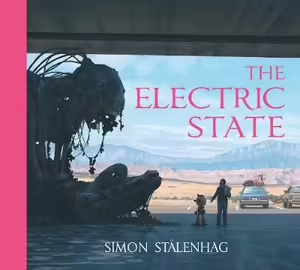
In an alternate universe, a post apocalyptic America in the late 1990s reveals that humanity and machines have become one. Almost everyone has become plugged into Sentre – virtual reality (VR) headsets that make the wearer look like a metal pelican – allowing their minds to be connected to a global consciousness, play games and control giant robots in the real world.

However, the Sentre headsets has led to a drug-like addiction resulting in people staying plugged in, their physical forms becoming emaciated, kept alive by IV drips or withered away until their bodies have died and their consciousness kept alive through machine.

But the headsets do not work on everyone, and teenager Michelle is one such person. With a backpack, shotgun, stolen car and Skip, her robot friend, Michelle treks across a desolated and ruined American west trying to reach San Francisco. There she hopes to find a boat and sail away leaving behind the desiccation, depravity and violence of an America sucked into the machine void. But not before making one final stop at a rundown house in the suburbs of San Francisco to retrieve something stolen from her.

Review

Simon Stålenhag has created an alternate world that is far more haunting and frightening than any other “rise of the machines” type scenarios that you see in sci-fi films. Unlike movies such as “Terminator” and “Matrix”, this is a world where humans have willingly embraced a technology and been consumed by it without even realising what they have done. The Electric State reminded me more of “The Road” (the film directed by John Hillcoat based on the book of the same name by Cormac McCarthy) with creepy, tentacled, giant robots thrown in.

It is a world where vast landscapes show nothing but drought, desolation and death. Skeletal remains of humans still connected to their Sentre headsets lie in rundown homes, on the side of streets, in their cars, or in the middle of shops with desert sands and decay enveloping them.

Giant robots (controlled sometimes by a single consciousness, sometimes by many) roam the land. Their purpose a mystery, but their ability to dole out death and destruction very real. And then there are the remaining humans that are not plugged in, who have become scavengers and hunters. It is survival of the fittest where the strong prey on the weak, so you best be wary and armed at all times.

As we follow Michelle and her robot, Skip, across America’s west, every page has an illustration that will linger in your mind and penetrate your dreams. Stålenhag’s artistic skill to mesh the familiar with the futuristic is disturbing. Debilitated 3-D billboards of mechanical faces, gigantic tanks riddled in the shape of animatronic rubber ducks, a broken down shed with a puppet robot peering out waving its hand, and roaming metal behemoths with hundreds of cables trailing behind them connected to humans with Sentre headsets making them all stumble around like zombies worshipping a mechanical sentinel are some of the disturbing images that take you through The Electric State.

The text that accompanies each page provides both history of how America became what it is while also providing the narrative from Michelle’s perspective. Stålenhag is careful with his story telling, revealing only so much through his words as he does through his illustrations. Together, you will re-read the paragraphs while re-examining the pictures. To and fro, trying to decipher Michelle’s intent and why things are the way that they are.

The dangers she encounters are both subtle and obvious, and by the time she reaches San Francisco to the one-storey house that has seen better days with its overgrown garden, there will be this little voice in your head screaming at Michelle to be careful or to not even bother going into the house and just head to the coast, find a boat, and leave this nightmare behind.

I won’t spoil the finale but the astute should figure out what is inside the house. And when you turn the final page, part of you will flip through its pages again to look at the pictures not knowing why you feel compelled to do so.

4.5 out of 5.

Anime Review: Chihayafuru Season 2 (2013)

TL;DR – season 2 of Chihayafuru throws us into the action with both team and individual tournaments. With a huge cast of characters from multiple schools, the focus is still on Chihaya, Taichi and Arata, and the journeys they undertake to be part of the karuta elite.

Review (warning: spoilers)

Please go to my anime reviews page for previous seasons of this series.

Who knew a card game could be this exciting? And a card game that involves Japanese poetry no less!

Season 2 introduces us to new characters, each with their own quirks, insecurities, and passions while still revolving around our trio of main protagonists – Chihaya, Taichi and Arata. Their bond is one of love and friendship where the line between the two emotions moves throughout the series depending on which character you are looking at.

A lot of ground is covered in season 2. The twenty-six episode series includes:

  • Tokyo regional team tournament
  • The National Team competition
  • The National Individual competition per grade level (i.e. ‘A-class’ being the highest to ‘D-class’ being the lowest)

Chihaya’s karuta club is made up of a modest following of members. These are:

  • Taichi Mashima – who is in B-class but is bordering on A-class
  • Sumire Hanano – who has only joined the club because she’s infatuated with Taichi (so, she’s at beginner level)
  • Yusei Nishida – an A-class player who gave up karuta after losing to Arata but is convinced to play again by Chihaya
  • Kanade Oe – a lover of poetry and traditional dress
  • Tsutomu Komano – quiet and observant, Tsutomu is a C-class player bordering on B-class. He’s also very good at scouting other teams and their players to identify how they play and strategies that might be effective against them
  • Akihiro Tsukuba – an overconfident D-class player. He wants to be one of the greats of karuta but learns over time he has a long way to go.

Together they go through the challenges and growing pains of any club competing in a sport. The beauty of the anime is not only in the matches between players but also the game itself. The history, poetic meanings, and the many skills required to play the game are all showcased. And when you combine that with the emotional and mental undercurrents that we get to listen in on with each character, you cannot help but be glued to the screen.

Key characters from other schools also play a huge part in showing different perspectives and reasons why people play karuta. The most intriguing of these I found to be are:

  • Shinobu Wakamiya – the current Queen of Karuta., She is the youngest female to hold the title
  • Megumu Osaka – considered western Japan’s strongest player and competed for the title of Queen
  • Rion – a very strong B-class player whose grandmother is a legendary karuta reader (the person who reads out the poems)
  • Nayuta Amakasu – an A-class player that Chihaya faces
  • Hiro “Retro” Kinashi – a very competitive B-class player

While all the matches grabbed me, and the team versus team competition had plenty of interesting facets. At the end of the day, it all came down to three matches that really drove home how great this anime series is.

The first was seeing Chihaya versus Shinobu. What Chihaya has to go through to reach the round where she meets Shinobu is extraordinary in itself (she injures her right index finger and plays left handed in the initial rounds). The interaction between her and the current reigning Queen is fascinating and though Shinobu ends up winning, you can tell the Queen’s curiosity has been piqued.

The second was Taichi versus Rion for the winner of the B-class. Chihaya had already played Rion previously in the team competition, so I already knew how good she was. And Taichi, with his own internal conflicts, tries to rush the victory but realises he will not succeed unless he plays with greater accuracy. Taichi manages to win and gets promoted into A-class.

The third match that had me completely riveted was Arata versus Shinobu for the A-class final. Prior to the final, we see that Arata and Shinobu have a bit of history playing against each other. Both are not interested in team competition and both wish to become the master of karuta. Though their goals are the same, they come to realise different things by playing against each other.

An anime that is more than the sport it depicts, Chihayafuru season 2 will have fans binging this series in record time.

9 out of 10

TV Review: Foundation (2021) – S01E04 – Barbarians at the Gate

TL;DR – Hari Seldon predicted that the Empire’s downfall would start on the edge of the galaxy. Right where it just so happens the Foundation has been exiled to and operating on the planet Terminus. When Anacreon forces (enemies of the Empire) land on Terminus, we see them set up the dominoes for the first to fall.

Review (warning: spoilers)

Please go to my TV reviews page to read reviews of previous episodes.

In episode four, we see Cleon the 14th (Cassian Bilton) aka Brother Dawn staring behind a thin curtain in his bedroom on the top floor of the palace, down to the gardens below. Gaal Dornick’s (Lou Llobell) voice narrates a story of a man who goes to see psychohistorian Hari Seldon asking Hari to tell him his fate. We then watch as Brother Dawn steps out onto the window ledge. The drop from the top floor of the palace to the ground below would surely mean death. As Brother Dawn willingly falls off the ledge, Gaal continues her story saying that Hari told the man that his predictive model only showed the future of the masses and that the fate and actions of one individual would always be a mystery.

The big splat that you would expect from Brother Dawn’s suicide does not occur. All Cleon emperors have protective shields that repel kinetic energy built around their bodies which prevent harm, so instead of a bloody mess we see Cleon floating inches above the ground, the technological nanites preventing his death. We also see a young female gardener, Azure Odili (Amy Tyger), witness the event and drop the pot plant she is carrying. She runs away, and you know she was not meant to see Cleon’s attempt at suicide.

The minute cracks in the Empire we saw in episode three begin to get larger in this episode. We learn that a leader of one of the planets under Empire control has died, and there is potential for the successor to look to break away from the Empire. This leads to an interesting dinner conversation between Brother Dawn, Brother Day (Lee Pace), and Brother Darkness (Terrence Mann). The Cleon clones are all meant to work in unison; actions are synchronised without thought. They are, after all, meant to be perfect copies of the first Cleon emperor. But what we see is Brother Dawn stand slightly after Day and Darkness stand, we see Dawn pick up his wine glass with his left hand while Day and Darkness pick it up with their right etc. These little differences show the cracks within.

We then jump to Terminus where we last saw Salvor Hardin (Leah Harvey) being held at gun (and bow & arrow) point by Anacreon invaders. The Anacreons suffered terrible losses when their home planet was attacked by the Empire who believed the Anacreons were one of the groups responsible for bombing the Star Bridge. Salvor manages to subdue the Anacreon leader, Grand Huntress Phara Keaen (Kubbra Sait) by taking her to the Vault. Phara wants access to the Foundation tower and thinks Salvor is taking her to that location only to be confronted by the floating Vault and its null field which renders her unconscious.

Salvor then takes on her role as Warden of Terminus and taking the reigns to lead the Foundation group and marshal their defences. She attempts to interrogate Phara to understand why the Anacreons want to access the Foundation tower with little success. Meanwhile, Phara’s forces start to surround the Foundation’s town (the only thing preventing the army from swarming them is a protective fence of Imperial make).

The episode jumps between these two threads.

In one space, we see Brother Dawn commence interactions with Azura. Though suspicious initially, he begins to see that she has no ill intent toward him and gives him leaves of a medicinal plant that will help with pains he experiences from breathing in certain blossoms in the garden. Meanwhile, Brother Day breaks protocol and decides to go off world to take control of the succession of the planet that potentially may break away from the Empire. He has a confrontation with Brother Dusk who still stubbornly believes that with Hari Seldon dead, the prophecies and the Foundation have died with him, but Brother Day is not so sure. There’s a marvelous scene where Brother Day seeks an update from the Imperial mathematicians to prove without a doubt that Hari was a charlatan. Turns out three decades has the Imperial mathematicians none the wiser and in full denial (they believe Hari and psychohistory to be false but they can’t prove it). This leads to the head Imperial statistician having a heart attack under Brother Day’s rebuke.

In the other space, we see Salvor trying to maintain order with her people while Anacreons continue to mass. At one point, she enters a vision where she is in the Imperial Library on Trantor and confronts a boy with a blade. The vision quickly disappears and she is back on Terminus, not understanding what the vision means. She believes the image of the boy is actually the Vault trying to communicate to her but she can’t piece the puzzle together.

With Hugo Crast (Daniel MacPherson) supporting her, they survey the perimeter and watch as Anacreon soldiers assemble a laser cannon. It doesn’t make sense, however, because the cannon will not be able to penetrate the fence, so what are they planning to do with it?

The closing scene of episode four finally returns us to Gaal Dornick (Lou Llobell) in cryogenic sleep in an escape pod floating through space. And on the edge of the screen we see a spaceship enter. What will Gaal’s fate be? The ship clearly is going to pick her up, but what will she awaken to? We won’t know until the next episode.

I enjoyed this episode primarily because of Brother Dawn. He is clearly going to be different to the other Cleon emperors even though all the clones are meant to be identical. The reason for his attempted suicide is unclear and leaves questions as to what he is thinking. His initial interactions with Azure the gardener indicates a budding attraction. While Brother Day and Brother Dusk debate about Hari Seldon’s predictions and seeking to maintain control and order over the Empire, they appear to ignore (or are in denial) of the differences Brother Dawn is exhibiting.

The events on Terminus are slow building. The biggest revelation being that Salvor has an otherworldly ability to discern when someone is lying and sense who they are and what has happened to them in the past. Her interrogation scene of Phara was intriguing as she displayed the ability to predict the result of flipping a coin repeatedly with 100% accuracy. This act unnerves Phara and leads her to reveal more about herself than she intended.

Yet another engrossing episode requiring the viewer has patience.

8.5 out of 10