Movie Review: Doctor Strange in the Multiverse of Madness (2022)

TL;DR – Less to do with Dr Strange and more to do with Wanda Maximoff (aka the Scarlet Witch)

Review (warning: spoilers)

For those who have not seen WandaVision, I would recommend watching that TV series first before diving into Doctor Strange in the Multiverse of Madness.

Devastated after losing Vision to Thanos in Avengers: Infinity War, Wanda (Elizabeth Olsen) uses her chaos magic to alter the reality of a small town and control all its denizens to create the idyllic life she dreamed of with Vision which included having a family with twin boys. WandaVision unveils the slow spiral Wanda descends into and the mental breakdown that ensues.

The end of that TV series, Wanda also obtains the Darkhold (aka the Book of the Damned), a magical grimoire, that contains powerful magic but corrupts the user. The Darkhold reveals to Wanda the presence of the multiverse where alternate versions of her actually have twin boys that she is the mother of.

Now, to the movie, where we are thrown into an opening scene involving Steven Strange aka Dr Strange (Benedict Cumberbatch) helping a young girl named America Chavez (Xochitl Gomez) escape from a demon chasing them between alternate universes. The pair are trying to find the Book of Vishanti, the anti-thesis to the Darkhold. They manage to find the book but have to face off against the demon. The demon kills Strange but Chavez escapes through a magical portal that she creates.

It’d be a short film if Strange dies in the first ten minutes, and sure enough we discover that the Strange that got killed was one from an alternate universe. We then see the version of Dr Strange that we know awaken from the nightmarish vision of his alternate self being killed. Chavez has now entered our universe and is chased by another demon before being rescued by our Dr Strange and Sorcerer Supreme Wong (Benedict Wong).

Steven then makes the mistake of seeking Wanda for help. If you’ve watched WandaVision then what follows won’t be a twist, but for those who haven’t, they might be surprised to see Wanda turn to the dark side. Turns out she’s the one who has been sending demons to hunt down Chavez, and she wants to acquire Chavez’s portal making ability to traverse the multiverse so she can take over one of the alternate versions, so she can have her family and live happily ever after with her twins.

What possibly is wrong with that? Obviously a lot. Dr Strange, his unrequited love interest Christine Palmer (Rachel McAdams), Chavez and Wong all work together to try and stop the Scarlet Witch.

The Dr Strange films do not have the benefit of reboots or remakes. So while Spider-man: No Way Home had previous Spider-man flicks starring Tobey Macguire and Andrew Garfield and an assortment of other villains that were able to cross over into Tom Holland’s Spidey world, the only alternate universe that Dr Strange draws from is one where he sacrificed his life to defeat Thanos rather than Tony Stark’s Iron Man, or an alternate universe where he ends up married to Christine.

For Marvel fans, it was a joy, however short-lived, to see that in the alternate universe where Dr Strange sacrificed his life, the Illuminati oversee the protection of that universe’s Earth. The Illuminati is led by five heroes:

  • Karl Mordo (Chiwetel Ejifor) – who is the Sorcerer Supreme in this alternate universe.
  • Captain Carter (Hayley Atwell) – who was Steve Rogers’s love interest in our universe but in this alternate one, she is the one injected with the super soldier serum.
  • Charles Xavier aka Professor X (Patrick Stewart) – leader of the X-men and the first indication in the MCU that the world of mutants is crossing over into the world of the Avengers.
  • Captain Marvel (Lashana Lynch) – an alternate version of Captain Marvel to the one we know played by Brie Larson.
  • Black Bolt (Anson Mount) – one of the leaders of the Inhumans who if he speaks (even a whisper) can cause soundwaves that can destroy buildings. Seeing the Inhumans introduced into the MCU was a delight. I was hoping Black Bolt’s love interest, Medusa, would make an appearance but alas she did not.
  • Reed Richards (John Krasinski) – leader of the Fantastic Four.

Watching them judge Dr Strange for travelling the multiverse while he pleads to them to set up defences against the Scarlet Witch’s arrival is one of the best bits in the film. The fact that Wanda comes in and decimates the Illuminati leadership (except Mordo) demonstrates she is uber powerful. And while an exciting sequence of action, I don’t think Marvel comic book fans will be satisfied that Wanda could dispose of Carter, Xavier, Captain Marvel, Black Bolt and Richards so easily.

In the end, this movie was much less about Dr Strange and much more about Wanda, and her anguish and subsequent corruption by the Darkhold. We get glimpses into Dr Strange’s own complex character (e.g. witnessing alternate universes with Christine, confronting an alternate universe that has become broken containing a damaged Dr Strange, and our own Steven’s sacrifice by using Darkhold magic to take control of one of the dead versions of himself to confront the Scarlet Witch).

But it never quite feels like the focus is on him. Rather, the most moving moments are taken by Wanda, and the eventual realisation that her wants are destroying many universes not just her own. Chavez is left as a supporting character. She’s like one of Professor X’s young mutants learning to use her powers rather than being controlled by them. Her eventual confidence to control her power simply by Steven telling her she can do it is a bit weak in the story telling department and frankly quite lazy.

Still, there’s enough going on for Marvel fans of both the cinematic universe and the comic books to digest and wonder what will be next for Steven Strange.

Popcorn fun!

8 out of 10
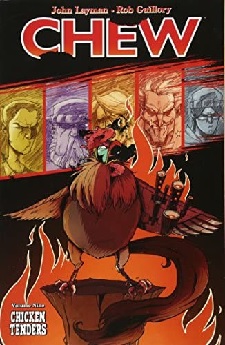
Book Review: Chew (Volume Nine) “Chicken Tenders” by John Layman and Rob Guillory

TL;DR – Against Tony’s warnings, Colby and Savoy convince Applebee and the FDA to try and take down The Vampire. Things are about to hit the fan, and it’s going to be bloody.

Summary (warning: spoilers)

Go to my book reviews page to see what has happened in previous volumes of this award winning graphic novel series.

With the knowledge of future events imparted by his deceased twin sister, Tony now knows the actions that he needs to take in order to bring The Vampire (aka The Collector) to justice. Until such time, he is seeking to embrace his life a little more and finally ties the knot with his girlfriend, Ameila, with a gunshot wedding in Las Vegas.

Tony’s partner, John Colby, who has been in an on-again, off-again relationship with their boss, Mike Applebee (Director of the FDA (Food and Drug Administration)) also ends up tying the knot after a drunken night of drinking too much vodka. This devastates John’s prior boss, Holly Penya, who he also had an on-again off-again relationship and runs the USDA (U.S Department of Agriculture).

Last but not least, we dive into the many missions of our returning killer rooster, Poyo, as he faces off against an assortment of food-related monstrosities and even travels to another dimension to save a different world from killer vegetables. Poyo is the terminator with feathers. He saves the world and protects those who cannot protect themselves. Nothing can stop him. At least, that’s what we think.

Review

Volume nine sees Tony accomplish a number of missions using his cibopath powers. After his gunshot wedding, he is called back to the job and successfully retrieves a prototype blaster that shoots hot fudge that freezes people in place when it hardens. The theft appears to have been done by the religious cult, The Church of the Immaculate Ova, but Tony’s food-related power identifies that the individual behind the scenes is actually The Vampire looking to make it appear that the cultists are responsible. Tony successfully foils The Vampire’s attempts to acquire the knowledge and skills of the scientist responsible for designing the hot fudge blaster.

Tony is then sent on a mission to an underwater sea station near the island of Yamapalu where it has been discovered that the strange chicken-tasting fruit known as Gallsaberry is growing on the ocean seabed. He is there to identify the murderer of an agent known as Sammi (an intelligent seal that worked for the USDA special operations division). Thoughts are that an E.G.G. terrorist spy may be responsible, but it turns out to be a scientist who acquired a food-related power that allows him to grow his brain by eating fish, and he took exception to Sammi eating his fish.

Everything seems to be going well for Tony, but unknown to him is that Savoy, Ceasar, Colby and Olive convince Applebee to bring in FDA resources and work with them to bring down The Vampire. A couple of things to point out from previous volumes:

  1. Tony is unaware that his partner Colby is working with Savoy, who Tony considers a criminal and murderer. While Savoy has committed a number of atrocities, he is looking to uncover the truth behind the avian flu and subsequent prohibition of chicken by the government.
  2. Tony is also unaware that Savoy has recruited his estranged daughter Olive, who not only inherited cibopath powers from her father but is much more powerful. In working with Savoy, she has absorbed powers from other individuals with food-related powers and is looking to take The Vampire down for murdering her aunt, Toni.

With the FDA on board, they locate The Vampire’s current location and touchdown at one of the mansions where The Vampire resides. Colby attempted to bring Tony also, but Tony declined saying that it is not the right time and explaining his interactions with his deceased sister, which was shown in the previous volume (Family Recipes). Tony tells Colby that the team should withdraw, but Applebee convinces Colby to proceed with the mission explaining they not only have the element of surprise and the forces of the FDA behind them but also back-up assistance from the USDA who will bring in Poyo if all else fails.

However, everything goes sideways and then down the tube as forewarned by Tony. The Vampire demonstrates fighting skills collected from all manner of food-powered individuals and inflicts massive casualties on the entire team; Applebee gets gutted in half by a pizza cutter, Savoy becomes a pin cushion of chopsticks, Colby gets stabbed in his robotic eye, Ceasar has his hand dismembered by a butter knife and Olive gets sliced across her eyes.

When the USDA are called in, they cargo drop backup and we’re all expecting it to be Poyo. Instead it’s a squirrel named Babycakes with a cybernetic eye and the poor thing gets shot to pieces. Holly Penya is a woman scorned and has not forgiven Colby for dumping her, so her help ends up being a betrayal.

With everything going south, I half expected this massacre at the hands of The Vampire to be some sort of dream sequence, but with some clever writing from John Layman, the team is rescued by Paneer Sharma (Director of NASA). Paneer was briefly married to Toni Chu and loved her deeply. Toni made Paneer promise that he would look out for her brother (but she didn’t specify which one as Toni has several brothers). We then get to see events leading up to the FDA’s failed attack on The Vampire as Paneer tries to stay in touch with all the Chu brothers without much success. Almost a forgotten character, when Paneer receives satellite imagery of the FDA team entering The Vampire’s compound. He then sends his NASA forces involving “Star Wars” level technology to stop The Vampire from killing everyone and rescuing Colby and company.

The tragedy of the failed attack leads to the entire team in critical condition in hospital. Tony confronts Colby and the pair get into a fist fight because Tony now knows all the secrets Colby has been keeping from him. Tony essentially throws away their decades long friendship and not giving Colby the chance to explain..

Dejected and depressed, Colby ends up at a bar with Poyo and unloading all his woes onto the rooster. And then a rather shocking thing happens on the final page of this volume.

Poyo, the terminator with feathers, the protector of Earth and other worlds in other dimensions, suddenly has his neck broken at the hands of Colby. It’s a shocking end to an action packed volume. Plenty of questions now pop in my head.

Is that really Poyo? Because in this volume, we see that Poyo has plenty of doubles (roosters who are made to look like him to present to the people).

If it really is Poyo, why did Colby kill him? Is it because Colby wants to get back at Holly Penya for failing to back-up the FDA mission on The Vampire? Or is there some other reason?

New questions in an ever evolving and wonderfully complex story. One of Chew‘s greatest strengths is that characters you assume are on the periphery end up playing a key role. At its core, there are three mysteries that we keep coming back to: 1) what are the origins of the avian flu and what is the truth behind the government’s subsequent chicken prohibition? 2) what is the alien fiery writing in the sky (we saw in previous volumes) and the alien Gallsaberry fruit? and 3) how did people start obtaining food-related powers?

Combining all these colourful characters and intricate plot with Guillory’s brilliant art and you’ll throw yourself willingly into the world of Chew.

4.5 out of 5.

Movie Review: The Unbearable Weight of Massive Talent (2022)

TL;DR – Nicholas Cage is suffering from a lack of exposure. Struggling to land his next big movie role, he agrees to be a celebrity guest for a billionaire to get an easy pay check. In the process, he gets roped into helping the CIA. With no CIA training whatsoever, he relies on his acting skills to go undercover.

Review (warning: spoilers)

The Unbearable Weight of Massive Talent suffers from the unbearable weight of expectation.

The trailer presents an interesting premise where actor Nicholas Cage plays himself struggling to land roles for major films. Deciding to retire, he agrees to one final pay check for $1 million to attend, as the guest of honour, a birthday party for a billionaire, Javi Gutierrez (Pedro Pascal). It then takes a funny turn when Javi is suspected of arms dealing and kidnapping a politician’s daughter. And Cage is hired by the CIA to dig deeper into Javi’s affairs and try to locate the kidnapped girl.

Unfortunately, the trailer reveals too much, and all the funniest moments are shown without leaving much left over for the actual film. Knowing Nicholas Cage’s acting career will benefit the viewer as some of the comic moments revolve around previous movies he has starred in.

The fictional depiction of his personal life is one of dysfunction as his relationship with his ex-wife Olivia (Sharon Horgan) and daughter Addy (Lily Sheen) always takes a backseat to his self-absorbed and narcissistic need to secure his next major movie role. It is only through Cage’s acting chops that allows him to pull off this depiction with enough emotional angst to get you to care rather than a standard trope of family neglect.

His interactions with movie buff Javi, who is also a die-hard Nicholas Cage fan, are amusing but you’ll want to turn off your brain at how silly it all gets.

The introduction of the CIA who have been monitoring Javi and trying to locate the kidnapped politician’s daughter is there to propel a plot forward that is really just about Cage going through a mid-life crisis and being steered to persevere through his interactions with Javi. Without the kidnapping plot, we would be watching a movie about two guys discuss existentialism and not much else.

The movie even acknowledges this self-deprecating need to have a hook and progress plot during a dialogue exchange between Javi and Cage. Javi has created a screenplay for a film, and it is Cage who suggests throwing in an action thriller component by introducing a kidnapping that really has no place in Javi’s screenplay.

The cleverness is in a movie about an actor becoming friends and working with a suspected criminal to make a movie about the very events we see on screen.

Nicholas Cage fans will likely be in rapture. For the rest of us, you can watch the trailer and that’ll be enough.

6.5 out of 10

Book Review: Chew (Volume Eight) “Family Recipes” by John Layman and Rob Guillory

TL;DR – Pieces start coming together as Tony Chu gets a little help from his deceased twin sister, Toni.

Summary (warning: spoilers)

Go to my book reviews page to see what has happened in previous volumes of this award winning graphic novel series.

Flashbacks prior to Toni’s death are revealed as she puts in motion a plan to help her brother solve the mystery surrounding the flaming script in the sky, the avian flu, and stopping The Vampire.

Along the way, we see Mason Savoy is hatching his own plan with the help of John Colby by infiltrating a maximum security prison that holds criminals with food-related power. Mason successfully gets his hands on Jack Montero, a man who sought to profit from the avian flu outbreak and the eventual prohibition on eating chicken. Savoy knows that somehow Montero knew the pandemic would occur before it did, and he wants to know how and why. Savoy (like Tony Chu is a cibopath) takes a literal bite out of Jack and receives the information he needs.

Meanwhile, Toni’s machinations to assist Tony after her murder involve her severed toe, a gallsaberry fruit (alien fruit that tastes like chicken), chogs (genetically combined frogs and chicken), and the help of Amelia and Olive. Tony goes on a very psychedelic trip indeed.

Review

I took a break from this series after Volume Seven felt somewhat flat. In a sense, this was expected after Volume Six shook me to the core with the brutal murder of Tony’s fraternal twin sister, Toni. She was a shining light and valuable counterpoint to Tony’s dead serious character. With her death, Tony dived deeper into the darkness and commenced a mission of revenge to find and kill Toni’s murderer, The Vampire.

So, you can imagine my surprise when Volume Eight opens with the story focused squarely on Toni Chu and the events that occurred in the months leading up to her grisly death. As we know from previous volumes, everyone in the Chu family has a food-related power. For Toni, she is able to glimpse future events when she takes a bite out of any living thing. And she foresaw her own death and thus prepared to leave key items to help her brother, Tony, bring The Vampire to justice.

At the end of Volume Seven, we see that one of those items was Toni’s toe. In Volume Eight, we see through flashback that she cut off her own toe knowing she would leave it in Tony’s freezer to find.

We also get to see, for the first time, Sage Chu. Sage is the younger sister of Tony and Toni. Sage is a cipropanthropatic, which is a food-power that allows her to access the memories of anyone close to her who is eating the same thing as she is. Sage often orders weird dishes to avoid her food-power from activating. Unfortunately, even with her best efforts, she ends up eating the same dish as a Mr. Biscotti. The memories she receives from Mr. Biscotti are violent and gruesome as he turns out to be a mobster and killer.

Sage enlists the help of Toni to arrest Mr. Biscotti and successfully does so. Toni also ends up taking a bite out of Sage (I assume because Toni knows she will die soon and wants to see how things will turn out for her younger sister). We don’t get to see what Toni sees, but she says to Sage that her life will be happy and she’s proud of her.

Events then come back to the present, where Tony, his girlfriend, Amelia, and his estranged daughter, Olive have discovered Toni’s present in the freezer. Tony sits down, stares at the dismembered toe, and takes a small bite. Tony’s food-related power allows him to see the origins of the things that he eats. So, when he nibbles on Toni’s toe, he is confronted by an image of Toni that is best described as a combination of a pre-recording mixed with her being in spiritual ghost-form. Toni explains to Tony why she left her toe and how she will help him stop The Vampire.

Toni also leaves a recipe for Amelia for a dish that combines the mysterious gallsaberry fruit with the psychedelic chogs. With the help of Olive, who Amelia convinces to impersonate as an FDA agent by borrowing Tony’s badge, they talk their way into the research lab at the FDA and secure some chogs. They then cook it all up and feed it to Tony, who then goes on a drug-induced out-of-body psychedelic trip to an alien planet (Altilis-738) where he meets with his ghost sister.

She describes to him the phenomenon of the flaming script that appeared in the sky circling Altilis-738 and how subsequently the planet was destroyed. This is the same flaming script that had appeared around Earth in previous volumes.

Toni then goes on to whisper in his ear how Tony can stop The Vampire (of course, we don’t get to read what she says). Tony’s response is that he can’t do that, but his ghost-sister says he can and he will. She warns him that if he continues down the path he is travelling seeking revenge then he will end up just like The Vampire.

Before she disappears, she asks Tony to give the rest of her severed toe to Olive for consumption. It’s gross and funny at the same time. Olive is also a cibopath like her father but she has far greater control in her food-power. Whatever she learns from ghost-Toni after consuming the toe is not revealed, but she smiles and says, “Cool.”

A jam packed volume that finally progresses a number of story lines while also leaving enough mystery that you’ll want to read on.

Every scene with Toni is a delight. And when she finally disappears into the void after bidding farewell to Tony, it genuinely choked me up. I can only hope that somehow Toni’s spirit will re-emerge in future volumes. The art by Guillory is beautiful and captures all the characters (especially the Chu family) vividly and with distinct traits.

Buckle up and get back on the Chew train!

4.5 out of 5.

Anime Review: Bubble (2022)

TL;DR – Inspired by the story of The Little Mermaid, Bubble tells the story of a boy named Hibiki who lives in a flooded and abandoned Tokyo and meets a mermaid. But wait, viewers should be warned this is not some traditional fairy tale but instead meshes it with sci-fi elements and a potential apocalypse surrounding the city. Crazy premise? Yes.

Review (warning: spoilers)

A strange phenomenon has occurred that causes Tokyo to be flooded and sink into the ocean while also being enveloped in a bubble where gravity has gone funky. The phenomenon is literally an invasion of trillions of bubbles that fall from outer space. Buildings and bridges have collapsed, there are dangerous energy whirlpools, and floating (smaller) bubbles permeate the atmosphere.

Tokyo becomes a no-go zone. But some teenagers, who have lost their families in the bubble disaster, have chosen to stay along with a small number of scientists who seek to unravel the mystery of the bubbles.

From the rubble, a sport called ‘Tokyo Battlekour’ has arisen that involves two teams competing in parkour to reach a flag. Teams bet daily necessities for survival. The decimated city of Tokyo has become the perfect playground obstacle course, and the film opens to a team called Blue Blaze (BB) competing against another team to capture the flag. We are introduced to Hibiki, the ace of BB, whose parkour style and athletic ability allows him to traverse the floating bubbles in a way other athletes cannot. He’s not much of a team player though as he gets to the flag first, winning the round, then disappearing leaving his teammates to celebrate without him.

The story focuses primarily on Hibiki, who was present at Tokyo Tower when the bubble phenomenon hit. The tower has now split in two, its upper half defying gravity and floating above a cosmic cloud of red bubbles from which Hibiki periodically hears a female voice singing.

In an attempt to find the source of the voice, Hibiki uses parkour skills to climb the tower only to be prevented by the cosmic cloud and thrown back into the ocean. He almost drowns but is saved by a blue bubble, which combines with the bubbles of his final breath to form a human girl (or mermaid as viewed by Hibiki before he falls unconscious). The girl joins the BB family, and they give her the name Uta.

For those of you who have read “The Little Mermaid” by Hans Christian Andersen, Bubbles draws inspiration from this material and even goes so far as to have one scene where one of the scientists reads to Uta the same fairy tale. Uta doesn’t know how to be human but slowly learns to speak and eat. She has a natural ability for parkour, likely attributed to her bubble form, and she falls in love with Hibiki who she sees as her prince. And just like “The Little Mermaid”, Uta’s family (i.e., the cosmic cloud surrounding Tokyo Tower) is none to pleased and wants her to abandon the human world and return home.

An inciting incident occurs when one of the scientists of the BB family is kidnapped by a rival parkour team known as The Morticians and used as part of the prize for whoever captures the flag. The BB team race against the Morticians and succeed to get to the flag first, but in the process Hibiki grabs Uta’s hand and we see it starts to turn to foam. This reflects the tragic ending in the fairy tale where the mermaid transforms to foam when she returns to the sea.

After the Tokyo Battlekour, Hibiki confronts Uta and gives her a seashell pendant. There he confesses his feelings to her, which causes the cosmic cloud to be none too happy and commences a repeat of the bubble phenomenon seeking to sink the rest of Tokyo into the ocean.

The climax involves Uta willing to sacrifice herself, return to the cosmic cloud and preventing any further devastation. Of course, Hibiki and the rest of the BB team look to save her. And although Hibiki manages to reach her, escaping with her in his arms, the rest of Uta slowly begins to turn to foam.

Uta ultimately prevents the cosmic cloud from destroying Tokyo, and the giant bubble enveloping the city evaporates. In the aftermath, Hibiki has to watch as Uta turns completely to foam but not before she thanks him for giving her the chance to be human. To have a human heart that can feel love and loss. When she disappears, all that is left behind is the seashell pendant he gave her.

The ending sees the city commence rebuilding. Tokyo Battlekour lives on and Hibiki and company continue compete in matches. Blue bubble remnants still float around the city and the song that Uta sang can be heard by Hibiki indicating that her spirit lives on.

Overall, the story is rather abstract and the invasion of bubbles is never explained. My view is the bubbles are sentient aliens, but why they came to earth is unknown. Not that it needs to be explained because it is more about what it means to be human and to experience feelings, which is represented by the bubble-turned-Uta character.

In a way, she ends up being more human because Hibiki spends most of the movie as a stoic character who doesn’t seem to want to spend any time with anyone. We later discover that as a child, Hibiki suffered from hyperacusis; a type of auditory hypersensitivity meaning ordinary sounds are too loud and cause discomfort and pain. Living in a big city like Tokyo meant that a trip outside would be overwhelming. His mother tried to find a cure for him but failed, and Hibiki interpreted these events as meaning that he had failed his mother. He now wears headphone earmuffs to dampen outside noise. When Tokyo was abandoned and encased in a giant bubble, it became the perfect place for him as all that noise disappeared.

The fact that Uta teaches him about the good things being human and to accept that painful things will also happen in life is the transformation that Hibiki undergoes by film’s end.

The animation from Wit Studios (who also brought us other great anime like “Attack on Titan” and “The Great Pretender”) is nothing short of astounding. The parkour action scenes are thrilling and the character animation (especially close-ups of their eyes) are exquisite. The colour is vibrant and even though the idea of bubbles invading a city is absurd, there is no denying the animation is beautiful.

In the end, you need to dig deep to see the meaning behind the story, which is a shame because you really want to feel the meaning and not have to try to decipher it all afterwards.

Bubble is a visual testimony to the greatness of animation in anime even if the plot is somewhat weak.

7.5 out of 10

Movie Review: Everything Everywhere All At Once (2022)

TL;DR – Evelyn’s world is already busy enough. So, when the multiverse comes calling and tells her she is the only one that can save it from destruction, all she wants to do is lie down and take a nap. But the universe rarely gives us what we want.

Review (warning: spoilers)

The multiverse is trending. A common technique in sci-fi/fantasy stories, the idea of parallel universes where a person’s life can be altered by different choices and events allows for an infinite source of material. Movies have long since examined these themes from drama flicks like Sliding Doors to sci-fi dystopias like Terminator.

Like many trends that come and go and then come around again, recent productions such as Spider-man: No Way Home, The Adam Project and the upcoming Doctor Strange in the Multiverse of Madness, all explore altering timelines, different pathways and the existence of one’s self in different universes.

However, never before have I seen a film that takes this idea to the extreme as the incredibly ambitious Everything Everywhere All At Once directed and written by Daniel Kwan and Daniel Scheinert (aka “Daniels”).

There is a helter-skelter, everything-is-chaos feel from the start as we are introduced to the life of Evelyn Wang (Michelle Yeoh). She runs a struggling laundromat with her husband, Waymond Wang (Ke Huy Quan) somewhere in America. She is madly trying to get her tax forms in order as they’re being audited by IRS inspector, Deirdre Beaubeirdra (Jamie-Lee Curtis) while at the same time, trying to prepare breakfast for her father Gong Gong (James Hong), who has flown over from China. They’re also getting ready for a Lunar New Year celebration at the laundromat and Evelyn’s daughter, Joy Wang (Stephanie Hsu) arrives on the scene with her girlfriend Becky (Tallie Medel) and is seeking her mother’s approval of the relationship. To top it all off, Waymond has been holding onto divorce papers and has been wanting to discuss their marriage with Evelyn, but she is always too busy.

This opening scene is one version of Evelyn and represents a microcosm of the multiverse chaos that unfolds shortly after. The film is broken up into three parts. Part 1 “Everything”, Part 2 “Everywhere” and Part 3 “All At Once”.

Everything goes into anarchy mode when they have to attend an appointment at the IRS. In a nutshell, a version of Waymond (from a universe called the “Alphaverse”) takes over Waymond and attempts to explain to Evelyn the existence of the multiverse. In the Alphaverse, technology known as “verse-jumping” has been created that allows the user to jump into alternate universes as well as draw from the skills, experience and knowledge of alternate universe selves upon fulfilling specific conditions.

The arrival of Alpha Waymond is to inform Evelyn of a being known as Jobu Tupaki, who turns out to be Joy from the Alphaverse and was pushed beyond her limits using the verse-jumping technology resulting in her mind being splintered. This Alpha Joy now experiences all universes at the same time and can manipulate matter in any way she chooses.

The comedy and action that ensues in the chaos is nothing short of mind-blowing. One of the funniest mechanics is where I said previously that in order for a person with verse-jumping technology to tap into the skills and knowledge of an alternate self, they need to fulfil specific conditions. The conditions are more outlandish depending on how extreme the alternate universe that is being reached.

For example, there is a version of Evelyn who ends up being a kung-fu master. For the laundromat Evelyn to tap into this version of her and gain these skills she needs to profess her love to the IRS inspector, Deirdre, who at the moment has been taken over by Jobu Tupaki and become a wrestling wrecking machine looking to kill Evelyn and Waymond. It is hilarious watching Evelyn saying, “I love you” at a mind-controlled Deirdre wrestler and trying to mean it.

Another example is Alpha Waymond has to eat a chapstick in order to gain martial arts prowess from an alternate universe of himself. And then there is a sequence where the conditions involve him having to self-inflict four paper cuts before he can tap into the alternate universe. I had tears coming out of my eyes because I was laughing so hard watching Waymond getting a sheet a paper and frantically trying to cut his hand while psycho Deirdre is on the loose and yelling that you never get a paper cut when you want to get one.

But comedy and action are only two elements of this genre defying film. The story also explores themes of relationships/family, existentialism, and the meaning of life. The fact that Jobu Tupaki is Joy demonstrates the fractures in the relationship she has with her mother, and the bigger picture of a generation of teenagers with nihilistic views. The film explores the messiness of family not only with mother and daughter, but also Evelyn’s relationship with her husband along with her relationship with her demanding father.

Everything builds to a bagel induced black hole of oblivion (yes, an actual bagel created by Jobu Tupaki containing all the versions of Joy and her emotions), and Evelyn teetering on a knife’s edge when she sees that the only way to confront Jobu is to splinter her mind so she can experience all universes everywhere all at once also.

Evelyn looks like she is convinced by Jobu that life is meaningless especially when the vast multiverse that she experiences all at once demonstrates that there isn’t any purpose. Just when they are about to enter the bagel of self-destruction, Evelyn hears Waymond.

This was unexpected. Evelyn is very much the alpha female in the family and Waymond appears the emasculated and tentative husband. But there is strength and integrity in Waymond simmering beneath the surface that shows his love for Evelyn and why he has always been by her side. Even when the contemplation of divorce papers comes to the fore, he does not want to actually divorce her. He simply wants to demonstrate the dire state their marriage is in and wants to talk and be heard. It is Waymond that speaks to Evelyn who is about to step into the void and talks of kindness and hope. In turn, Evelyn tells Jobu that she is not alone and she will always be with her.

The reconciliation is not all tied up in a neat bow. Life is messy regardless of which universe you’re in, and when the laundromat version of Joy confronts her mother and unleashes a torrent of emotion, it is representative of all the challenges those teenage years represent, especially when living in an environment where the teenager feels they are not being heard by their parents. The drama from these connections is as integral as the comedy and action if not more and transcends the sci-fi genre.

The acting is a tour de force. Michelle Yeoh and Ke Huy Quan demonstrate they can be in roles that are not boxed in by cultural stereotypes. Their comic timing is brilliant, but their ability to draw out empathy even when the situation is ludicrous is a greater feat. Likewise, Jamie Lee Curtis, James Hong and Stephanie Hsu wring out every bit of their roles.

One of the most original films I have ever seen. I have no idea how the Daniels will be able to create a film any better than this one.

10 out of 10

Book Review: The Elephant by Peter Carnavas

TL:DR – a tale of a young girl looking to bring colour back into the life of her father.

Summary (warning: spoiler)

Olive doesn’t know what to do. Whenever she sees her father, there is a grey elephant with him. An elephant that casts a giant shadow and weighs her father down in a way that makes him look exhausted all the time. If she could only figure out how to get rid of that elephant then she knows there is a chance for the light to penetrate the darkness that envelopes his heart.

Thankfully, she has her grandfather with her who has moved in, and she can always talk to her best friend, Arthur, at school. Surely, the three of them can come up with a way to remove the elephant.

Review

I’m a big fan of picture book author and illustrator Peter Carnavas. When I met him at Maleny on the Sunshine Coast, I bought his picture book ‘Oliver and George’ for my daughter and got his autograph. There is a certain whimsy and nostalgia to his stories and illustrations that remind me of Charlie Brown and the Peanuts Gang by comic strip legend, Charles Schulz.

The Elephant is Carnavas’s debut novel and first foray outside of the picture book realm. Aimed at junior fiction readers, the story examines grief and sadness through a child’s eyes, and how a child can learn about ‘old and wonderful things’ (i.e., the past) to help heal the present and move forward.

For Olive’s father, he is still mourning the death of his wife. Olive is old enough to understand that the manifestation of this sadness in the form of a giant, grey elephant is metaphorical. Conjured by her own imagination. However, its existence is real enough to her that it impacts all her interactions with him. She can tell his mind is elsewhere, full of untold stories and memories that she cannot access.

This naturally causes Olive to feel sad, but she obtains comfort from her little dog, Freddie, and her grandfather who picks her up after school and enjoys spending time with her. She especially gets excited whenever grandfather picks her up wearing a purple backpack because it means he is taking her somewhere she hasn’t been before. Their afternoon field trips include a second hand store filled with old and wonderful things, a nature reserve and a cricket oval where they throw paper airplanes.

The loving relationship between Olive and her grandfather is obvious, but things take a turn when Olive falls out of the jacaranda tree in their backyard. The nasty accident leaves her unconscious for a week and when she wakes up she sees her grandfather looking sad, worried and weary. More so, she notices that he now has a grey tortoise following him around. Her grandfather is guilt ridden because he normally makes sure she puts on her helmet when she climbs the jacaranda tree, but on the day of the accident, he didn’t.

Thus, with the help of her schoolfriend Arthur, she goes about getting rid of the tortoise first. She does this through the school, which is celebrating its one hundred year birthday, and the kids are presenting to their families things that are ‘old and wonderful’. Olive chooses to sing a song that she and her grandfather always sings on their field trips. She then explains to the audience that her grandfather is also ‘old and wonderful’ and her love heals her grandfather causing the grey tortoise to disappear.

Together, they then set up a plan to try and get rid of the elephant. The plan is inspired by all the things Olive has learned about ‘old and wonderful’ things she has seen and experienced. When the plan works, the elephant finally departs, and her father lets in some sunshine in the form of her daughter.

In an unexpected twist (at least for a junior fiction novel), there is a touching scene at the end where it is revealed that Freddie the dog is also imaginary. When she thanks Freddie for being there during all the times she felt sad and says he can now also leave, it is poignant and effecting.

The Elephant is a must read for junior readers but is the type of story that adults (especially parents) will be moved by. We all need colour in our lives, and I can’t think of a better way than reading this delightful story with your child.

5 out of 5

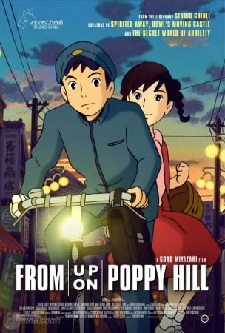
Anime Review: From Up On Poppy Hill (2011)

TL;DR – the story of a post-war Japan focusing on Umi and Shun, two teenagers looking to understand their pasts while also trying to look forward to their future.

Review (warning: spoilers)

Kokuriko-zaka Kara (aka From Up On Poppy Hill) is an atmospheric tale animated with love by Studio Ghibli, scripted by Hayao Miyazaki and Keiko Niwa, and directed by Goro Miyazaki.

The film opens to a new day dawning on Poppy Hill overlooking a seaside port, and we watch high-school girl, Umi Matsuzaki, awaken and commence her morning routine. The sense this is a bygone time in Japan is confirmed as we watch her work in the kitchen preparing breakfast for her siblings and grandmother. The rice cooker, gas stove, kitchen layout, and how Umi goes about washing clothes, all evokes a time period before the wonders of computers and appliances became common place. Among her duties, she also walks outside to the front of their boarding home, Coquelicot Manor, to raise signal flags every day.

My kids would still be asleep by the time Umi has finished her morning chores, demonstrating a maturity beyond her years. She then gets dressed to go to school. When she arrives, a friend in class shows her a newspaper article (yes, this is definitely an era before smart phones and internet) of a poem that talks about a girl who raises flags every morning to the boats that pass by. Umi is surprised and a little embarrassed by the attention, all the more so because the poem asks why she sends her thoughts up to the sky.

At lunch time, the boys at the school unfurl banners around an old house known as the ‘Latin Quarter’ that is part of the school and used for club activities. The Latin Quarter is scheduled for demolition, and certain students are protesting. Thus, we meet Shun Kazama , who performs a stunt by jumping off the old house into a small pool while his classmates take photographs. Shun works on the high school newspaper, is attempting to prevent the demolition, and seeks to build awareness that people shouldn’t solely focus on the future and forget the past.

This is something that Umi can relate to. Her father was a sailor, the one responsible for teaching her how to use signal flags, and when she was younger, she raised these flags to help guide her father home. However, during the Korean war, his father’s ship sank after hitting an underwater mine, but Umi has continued to raise the flags ever since. The importance of holding onto and honouring his memory lies within her.

Umi suspects that Shun is the one who wrote the poem, but initially is unable to find a moment to ask him. Instead, she ends up being enlisted to help the newspaper to help transcribe articles for print. Through these interactions, a growing attraction builds between Umi and Shun.

The scene where Umi returns home late to prepare dinner and discovers she is missing pork for the curry she wants to make results in Shun giving her a lift on his bicycle down to the bottom of Poppy Hill where the markets are. It’s a lovely scene in a film that has all the trademarks of the Ghibli detail.

From these opening events, I thought the story would be straight forward. The club students rally together to try and save the Latin Quarter and, in the process, Umi and Shun would fall in love. And indeed, when Umi suggests that they clean up the old building to demonstrate to the principal it is worth keeping and still holds cultural and historical significance, the scenes of the student body undertaking the Latin Quarter makeover is spectacular and a feast for the eyes.

The soundtrack also aids in the feel of the film as the songs and music reminded me of that era; a time when life was, in a sense, simpler.

However, an unexpected twist manifests itself when Umi shows an old photograph of his father. Shun looks at the photo and clearly he knows something that Umi doesn’t. The next day, Shun completely ignores Umi, much to her confusion.

Eventually the change in Shun’s demeanour is explained. Shun confronts his father, Akio Kazama, with the assertion that Umi’s father, Yuuichirou, is actually his biological father, which would make Akio his adoptive father.

Akio Kazama explains that shortly after the end of World War II, he and his wife lost their newborn child. Yuuichirou turned up at their doorstep with baby Shun and the Kazamas adopted him.

So, now it appears that Shun and Umi are actually brother and sister, which would make all previous attraction very icky indeed. When Umi is presented with this revelation, it confuses her but Shun says they must find a way to only be friends.

You can’t help but feel for Umi. She’s caring, a hard worker, and has held the pieces of her heart together as best she can since her father’s death. Just when you think she might open her heart again, it gets dashed against the rocks. Much to her credit, she perseveres and seeks to be Shun’s friend even with these tumult of feelings playing around in the background.

But wait, it gets more complicated. When Umi’s mother, Ryouko, returns from America, and Umi asks her about Shun, she reveals that Shun is actually the son of another man, Hiroshi Tachibana. Hiroshi and Yuuichirou were best friends. Hiroshi died in an accident aboard a repatriation ship, his wife died in chidlbirth, and all of Shun’s other relatives perished when Nagasaki was hit by the nuclear bomb. Yuuichirou did not want to give Shun up to an orphanage, so he gave him to the Kazamas.

I was relieved at this outcome because prior to Ryouko’s explanation, I was thinking that Yuuichirou wasn’t the ideal father that Umi made him out to be. What father gives away their newborn son to another couple? Turns out Yuuichirou wasn’t the biological father, which means Umi and Shun aren’t siblings.

The Latin Quarter ends up being a side story and thankfully is saved from demolition. It is a lovely sequence when Tokumaru, the school board’s chairman, is convinced to visit the renovated building and is impressed by what the students have done. He chooses to build elsewhere to preserve the Latin Quarter, and the students celebrate.

When Umi and Shun get called away to meet a captain of a ship who was friends with both Yuuichirou and Hiroshi, he confirms what Ryouko said. Though we don’t see Umi and Shun fall in love, we can safely assume they decide to take the next step knowing that they are not at all blood related.

Beautifully animated, and with a surprisingly more complex plot than I anticipated, From Up On Poppy Hill is a moving story capturing a post-war Japan and the impacts World War II had on the generations that followed.

8.5 out of 10

Movie Review: Coda (2021)

TL;DR – Two parents, two kids. All of them deaf except the daughter who happens to have a gift for song. This is a story of the ties that bind a family together, and the challenges of youth being set free.

Review (warning: spoilers)

The 2021 Academy Award Winner for Best Picture, Coda benefits from timing. While the COVID pandemic has kept beating down our doors and the world continues to spiral in ways you would hope we would have learned from by now (e.g., the war in Ukraine), this film lights a much needed flame during a time of darkness.

In truth, Coda is a straight forward telling of Ruby (Emilia Jones) being torn between following her passion in singing and her love and loyalty to her parents and older brother, all of them deaf who run a family fishing business. The family is barely making ends meet, and the parents rely heavily on Ruby to be their interpreter and voice when interacting with people who don’t know sign-language.

As a coming-of-age tale, Ruby is genuine in taking care of her family but realises she cannot spend the rest of her life working on a fishing boat. On a deeper level, the story is also a “coming-of-age” for the parents who have to learn to let Ruby go and forge their own way to interact with others who they cannot hear. The one who sees the necessity for moving forward and letting go is the older brother who is frustrated that his parents rely more on Ruby than they do on him.

Coda contains the richness of a film comprised of many elements coming together in a fashion that lights up like fireworks in the night sky. The choreography is set in Gloucester, Massachusetts, and the scenes on the fishing boat along with Ruby’s cliff diving hideaway sanctuary are stunning. The casting is spot on with Ruby’s parents, Frank (Troy Kostur) and Jackie (Marlee Matlin), and older brother, Leo (Daniel Durant), all being deaf in real life. Troy Kostur’s portrayal of Frank deservedly won best supporting actor at the Oscars, and Emilia Jones also learned sign language for nine months prior to the commencement of filming. Combine all this with a story whose greatest strength is in its simplicity and a soundtrack which includes singing performances by Emilia Jones and co-star Ferdia Walsh-Peelo who plays Miles (Ruby’s love interest) and you have a film that will reignite your belief that things can get better.

While the subject of deafness is one of the themes, it is not the driving focus. The central theme is family, and the growing pains that are a part of life when you’re a teenager trying to find your own path. Deafness just happens to be an additional factor that is part of Ruby’s world, and one that she strives to navigate with sensitivity and integrity. She is not always successful, but neither are her parents or her older brother in navigating her “hearing” world. The fact that Jackie often discards Ruby’s pleas to live her own life and study singing, and Leo explodes with frustration at Ruby’s acts of martyrdom and, at one point, yelling at her that she is not part of the family, demonstrates that whether you’re deaf or not, we’re all human and can be easily blinded by our own driving emotions.

Some of the weaknesses of the film is derived in the high school scenes where female students mock Ruby for being part of a deaf family. While bullying is a real problem in teenage life, its depiction in Coda was stereotyped and not delved into with any degree of meaning. Its merely a mechanism used to create some sort of tension between Ruby and Miles.

It is with touching irony that Ruby is able to slowly communicate her dreams and desires to her family through song. The scene where Frank, Jackie and Leo attend Ruby’s school for a concert, and they watch her perform (not knowing if she is any good at singing) and can only react based on the expressions in the audience is the first step to their eyes opening that Ruby has actual talent. For example, when the crowd gives a standing ovation, they realise the school choir and Ruby are actually good.

When Ruby and Miles do a duet singing the song “You’re all I need to get by” by Tammi Terrell and Marvin Gaye, the camera moves through the audience and the expressions of those who can hear before focusing on Ruby’s family and the scene goes completely silent. It’s a powerful sequence demonstrating not only how much we all take hearing for granted, but also the mountain Ruby has to climb in order to communicate to her family.

When Frank asks Ruby to sing while they sit on the back of his pick-up truck and he places his hands on her neck so he can feel her vocal chords vibrate, you’ll need to be reaching for the tissues quick time.

And finally, when she auditions for Berklee College of Music and she sings “Both sides, now” by Joni Mitchell and sees her family has snuck in to watch, she signs the words as she sings them and you know her love for song is as strong as her love for her family.

Poignant, uplifting, and timely. Coda is a much needed breath of fresh air to escape the COVID pandemic confines and reminds us that we can all strive to be better in a loving and compassionate way.

8.5 out of 10

Book Review: Almost Midnight by Rainbow Rowell

TL:DR – Young adult novel containing two short stories about connections and the changes we go through during our teenage years.

Summary (warning: spoiler)

The first short story titled ‘Midnights’ is about Margaret (nicknamed ‘Mags’) and Noel who are best friends. He remembers their first meeting on New Year’s Eve in 2011 where she saved his life. She doesn’t quite remember it that way, but every New Year’s Eve since then, Noel has tried to dance with Mags in celebration of this “life-saving event” before the final countdown to the New Year. And every year, Mags has politely declined and instead watched, from afar, Noel end up dancing with some other girl and kissing her when the clock strikes midnight.

On New Year’s Eve in 2014, Mags and Noel reunite after attending colleges in different states and not seeing each other for months. Noel finally convinces her to dance with him, but as it draws close to midnight, he gets whisked away to dance with another girl. Will this be another New Year’s Eve with the same outcome?

The second short story titled ‘Kindred Spirits’ is about a teenage girl named Elena; a die-hard fan of Star Wars who lines up for the midnight premiere of Star Wars: The Force Awakens (Episode VII) four days before it opens. She had expected a huge line of die-hard fans ready to do a week long celebration of Star Wars before the midnight screening. Instead, she meets only Troy and Gabe. Two others who are crazy enough to camp outside the theatre during the cold, winter nights.

With an over-protective mother checking up on her several times each day, Elena is determined to do this. Her step towards independence and making her own decisions, regardless of how foolish they may turn out to be. Will she make it through the four days sleeping outside on the hard ground? And more importantly how will she go to the toilet if she needs to pee at night?

Review

Rowell manages to balance sentimentality and sweetness in a way that isn’t overly romanticised, so it will appeal to young readers while also being a nostalgia trip for older ones.

In ‘Midnights’, she is able to capture the angst and wanting that comes from two friends attracted to each other but somewhat stuck in the friends zone. Neither quite being brave enough to walk out on a limb to see if their friendship can be something more. Told from the perspective of Mags, you can understand her hesitation when Noel appears to be carefree with his affection and is happy to share a New Year’s kiss with any girl that raises her eyebrows at him.

Mags is never quite sure whether Noel feels anything more than friendship towards her. Their first New Year’s Eve encounter revolving around Noel revealing to her that he has a severe allergy to tree nuts (and shellfish and strawberries…) as he asks her whether the cracker she’s holding with pesto and cream cheese has pine nuts in it. An amusing dialogue ensues where Mags successfully stops Noel from eating the cracker, pesto and cream cheese combo and thus ‘saving his life’ for another year.

Two subsequent New Year’s Eve parties later and Mags and Noel are friends at the hip, but his urging of her to dance with him before the clock strikes twelve always fails. Mind you, we know Noel wants to share his New Year’s kiss with Mags but Mags never gets up onto the dance floor with him, so he ends up snogging someone else. In truth, Noel sends out all the signals but Mags doesn’t act on them so one could argue she has only herself to blame for being stuck in the friends zone.

When the fourth New Year’s Eve rolls around and Mags finally relents and has a slow dance with Noel, he pretty much confesses he can’t live without her, and you think finally they will kiss. Instead, another girl grabs Noel away and Mags walks out of the house party not being able to bear witnessing Noel kissing another girl. When the countdown to midnight happens, Noel appears outside looking for her and viola Noel makes it clear that the only girl he wants to kiss is her.

Rowell does a clever bit of plot twisting at this point. When Noel and Mags kiss, Mags has totally forgotten that she has been eating Chex mix which contains cashews. Mags saves Noel again by getting Benadryl from his car to prevent him from swelling up like a balloon and being covered in hives. Thus, they live happily allergy-free ever after.

In ‘Kindred Spirits’, the story of Elena looking to camp out for the opening of Episode VII of Star Wars is surprisingly funny and heart warming. Rowell is cognisant of the fact that in 2015 when the sequel came out, people could just buy tickets online and guarantee themselves a seat. But this isn’t the point for Elena. She wants to line up with other die-hard fans and party for a week on all things Star Wars related. And she thinks there’ll be a massive gathering based on social media posts. However, what she discovers is that the line is compromised of only two other people.

Instead of a party, it feels like stranger danger and the scenes where Elena argues with her mother who keeps periodically checking up on her is very funny.

Troy and Gabe turn out to be Star Wars geeks and nothing more predatory and Elena slowly gets to know both of them.

What is clever about the story is that Gabe turns out to be Elena’s classmate, but because he is shy, quiet and keeps to himself and she has her own group of friends, she has never noticed him. Here we have a showing of different perspectives. Elena feels genuinely bad that she didn’t recognise Gabe, but Gabe says that’s fine because he wouldn’t expect her to notice him since she’s part of her own clique.

This raises Elena’s hackles who tries to convince Gabe that she’s just a nerd, but Gabe sees her as one of the ‘popular’ girls. The ensuing debate manages to change both their perspectives and the assumptions they made about the other.

Plus Gabe helps Elena survive the nights by finding a way for her to pee in a cup behind a dumpster while he hums loudly ‘The Imperial March’ from Star Wars. That’s the type of embarrassing experience that makes two people bond whether they want to or not.

The ending is quite funny and another clever twist by Rowell. When the midnight premiere finally arrives, Gabe and Elena are so excited, and they get prime seats being at the head of the line. As they sit together in the cinema, they comment on how wonderful their seats are. So warm and comfy and as the opening crawl begins, they end up… falling asleep.

When they wake, to their horror, they’ve slept through the whole thing, but all’s well that ends well because Gabe has bought extra tickets for a second screening ahead of time (yep, he’s a diehard fan alright) and ends up inviting Elena to go see it.

Overall, I preferred ‘Kindred Spirits’ over ‘Midnights’ only in that there was more humour and the scenes with the mother trying to convince her daughter, Elena, to come home were believable and comic.

Rowell does use some interesting turns of phrase in her writing. Some works better than others. Specifically in ‘Midnights’ she writes, ‘he smelled warm’ and then later writes, ‘he smelled like skin’.

I’m all for a good synaesthesia. For example, ‘a gravelly voice’, or ‘the warm colours of a painting’, or ‘that’s the smell of victory’.

But I’m not sure that ‘he smelled like skin’ works, especially given it is meant to be an intimate moment between Mags and Noel. Still, young adult readers will likely gloss over this.

The art of a short story is a tricky process, and Rainbow Rowell does an admirable job in capturing the essence of that period in your life when insecurities and awkwardness can be high. Sentimental without being overly sweet, Almost Midnight is an enjoyable enough read that will appeal to young readers and will have older ones walking down memory lane.

3 out of 5