Movie Review: Love and Leashes (2022)

TL;DR – Korean rom-com with a masochistic twist.

Review (warning: spoilers)

The opening line of Love and Leashes is “no relationship in the world is perfectly equal”.

Ji-hoo (Jun) has moved over from the business team to the PR team where he meets Ji-woo (Seohyun). Immediately, a fellow colleague remarks that their names are very similar and could get confused. The pair are teamed up by their boss after Ji-woo takes issue with a YouTuber who displays homophobic tendencies but works on an educational program, so their boss (who often puts his foot in his mouth with sexist remarks) asks them to work together to come up with a casting list. The friction between Ji-woo and her boss is obvious as he passive aggressively leaves his empty takeaway coffee on her desk and walks away. Ji-woo proceeds to crush the plastic cup in one curled fist with Ji-hoo noticing and looking on curiously.

Ji-woo is attractive but her colleague comments that she has a look in her eyes that is stand-offish and puts men off. However, this doesn’t stop Ji-hoo (who attracts a bit of a fan club from the women) coming up to Ji-woo and expressing that he’s looking forward to working with her.

The next day, Ji-hoo stops by the mailroom to pick up a package but discovers, to his horror, that the package has been accidentally given to Ji-woo (because their names are so similar). In a panic, he rushes to the elevator and frantically races to Ji-woo before she opens the package. It’s a funny sequence as Ji-woo opens the box to discover a spiked dog collar. Ji-hoo grabs the collar and tries to convince Ji-woo that it’s for his dog, but it becomes obvious that’s not the case when Ji-hoo tries to grab the box from Ji-woo causing it to fly up in the air, raining down foam packaging and a pamphlet that shows the purchase was from an S&M shop.

Ji-hoo freaks out on the inside that Ji-woo now thinks he’s a pervert. When he’s back at home, he talks in an online group chat with others who are into S&M and they say he needs to be careful otherwise he could lose his job.

Later in the evening, Ji-woo is going for a jog and stops at a shop displaying S&M gear. She imagines Ji-hoo confronting her and trying to put the spiked collar on her, which she refuses. Her day-dreaming is caught by her mother, who amusingly says she should go into the shop and even offers to buy her something (her mother is obviously much more up with the times than the bosses working at the PR company).

As things develop, there are humorous exchanges and misunderstandings, which reach the point where Ji-hoo asks Ji-woo to be his master (she would be the dom to his sub). What is interesting is that Ji-hoo asks this in a manner that is a contract rather than some romantic attraction, and Ji-woo initially reacts against the idea but becomes curious by it.

The cultural stigma of BDSM in a country like Korea is examined to some degree, and while the two leads capture the comic moments quite well, it is actually their deeper exchanges that are engaging. For example, Ji-woo asks Ji-hoo why he wants her to be his master, and he expresses an inner awkwardness that he has to pretend to be someone that he’s not so people will like him (which is ironic given he is very popular), yet he thinks Ji-woo is authentic and speaks her mind rather than being pigeon holed into an idea of how women should be in Korea. Likewise, Ji-woo is surprised at Ji-hoo’s own anxieties and is moved by his honesty.

The sexual tension that you would think exists in a film about BDSM is actually far more touching and poignant than expected simply because it is clear that Ji-woo is attracted to Ji-hoo in a romantic, falling-in-love kind of way when Ji-hoo believes Ji-woo could never feel that way towards him (due to his proclivities) and thus views their relationship as a business contract.

This is not “Fifty Shades of Grey”. This is a film that is surprisingly more moving and insightful about the connection between two people, and examines what is the basis of love. It also makes you ponder about the opening line of the film, and the idea of ‘power’. It’s the moments in-between the actual acts of S&M that elevates this film. The fact Ji-woo is confused about how she feels after she inflicts pain willingly received by Ji-hoo demonstrates how ‘power’ confuses the desire for loving kindness.

Great chemistry between to the two leads, and a story that is both funny and touching in equal measure.

8.5 out of 10
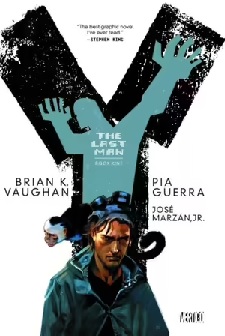
Book Review: Y: The Last Man (Book One) by Brian K. Vaughan, Pia Guerra & Jose Marzan Jr.

TL;DR – a plague strikes the world instantly killing every mammal with a Y chromosome except for Yorick. The last man on earth.

Summary (warning: spoilers)

In 2002, an unknown plague wipes every sperm, foetus, and mammal with a Y chromosome except for Yorick and his pet (male) Capuchin monkey. Approximately 2.9 billion men are now dead.

Welcome to the new world…

Review

Y: The Last Man is the winner of three Eisner awards and has a quote from Stephen King on its cover that simply states, “The best graphic novel I’ve ever read.”

High praise equals high expectations. Brian K. Vaughan has imagined an intriguing and gripping premise. The story begins in Brooklyn, New York where a mother runs up to a police woman saying her boys are sick. The police woman says it’s too late. She says the same thing has happened to her husband, and it’s happening across the entire city. All the men are dead. The police woman then pulls out her Glock and points it at her head.

The story then jumps to twenty-nine minutes prior to this cataclysmic event. We meet Yorick, an unemployed young man, hanging upside down in a strait jacket, talking on the phone to his girlfriend, Beth, who is on a holiday in the Australian outback. Yorick is a bit of a budding magician and manages to get out of the strait jacket before chasing after his pet monkey, Ampersand. Yorick applied for Ampersand from some group in Boston who are seeking to train the monkeys to help with quadriplegics.

As the countdown continues, we jump to different parts of the world and meet other characters including:

  • Yorick’s mother, Congresswoman Jen Brown who is in Washington D. C. She’s a Democrat, who has a heated debate with a Senator in her own party about amendment 1646. Senator Marty wants her to vote against the amendment which would prevent State Departments providing foreign aid to organisations that perform abortions. Jen doesn’t want to vote against it and is accused by Senator Marty of being pro-life.
  • Alter, a female colonel fighting in Nablus in the West Bank. She actually doesn’t know her first name (‘Alter’ is a nickname given to her by her friends). When two of her siblings died at birth and she came along, her parents decided not to speak her name out loud as a way of deceiving the angel of death from finding her.
  • Agent 355, an American female spy/assassin working in Al Karak, Jordan. She confronts a Dr Frozan Hamad and tries to convince Dr Hamad to escape with her. The doctor refuses stating that Jordan is her home, and she will continue to fight for the rights of women in her country. But Agent 355 tells her the threat against her is not because of her political beliefs but because of the amulet she wears around her neck. The amulet of Helene, which was given to her by her father. The story behind the artefact is that if the amulet was ever removed from Jordan then a catastrophe comparable to the Trojan War would take place. Unfortunately, Dr Hamad gets attacked and though Agent 355 manages to kill the assassins, the good doctor dies. Agent 355 takes the amulet and hops on a plane back America.
  • Bioengineer, Dr Mann, who has been rushed to hospital because she is in labour even though she is six weeks early. Michael Gilman is the doctor on site and happens to be one of Dr Mann’s previous students (he took her biotech class). In a weird exchange, Dr Mann reveals to Dr Gilman that she is pregnant with her ‘clone’.
  • Hero, a female paramedic in Boston, Massachusetts, who is having a quick romp in the back of her ambulance with a fire fighter named Joe. Seems Hero has a bit of a reputation and is sleeping her way through all the guys in the fire fighter department. There’s also hints in the opening pages that she is the daughter of Congresswoman Brown and brother to Yorick.

When the twenty-nine minutes expire, scenes all around the world are shown of men (and male animals) dying including Congresswoman Brown’s male aide, the male reporters working with Alter, the male pilot that Agent 355 is flying with, Dr Gilman and fire fighter Joe who dies in Hero’s arms.

A page of text is then presented outlining a number of statistics such as 495 of the Fortune 500 CEOs are now dead; in the US alone, more than 95% of all commercial pilots, truck drivers, and ship captains died… as did 92% of all violent felons. Internationally, 99% of all mechanics, electricians, and construction works are now deceased… though 51% of the planet’s agriculture labour force is still alive.

Of particular note, it states that only 14 nations including Spain and Germany, have women soldiers who have served in ground combat units. None of the United States’ nearly 200,000 female troops have ever participated in ground combat. Australia, Norway and Sweden are the only countries that have women serving on board submarines. And in Israel, all women between the age of 18 and 26 have performed compulsory military service in the Israeli Defense Force for at least one year and nine months.

And all of the above is only in part one (of five parts in book one) of this dystopian journey for Yorick Brown who seeks to find his mother and sister and reunite with Beth (who he proposed over the phone to before chaos erupted).

Craziness abounds as Yorick encounters a female ex-model who now drives a garbage truck and collects all the deceased males from houses and buildings in exchange for food; a group of women calling themselves Amazons who believe Mother Earth has rid the planet of the scourge that is man; wives of Republicans who seek to wrest the power of the White House from the Democrats; a small country town that is self-sufficient called Marrisville run by a group of women who are hiding a dark secret; and Alter and her Israeli soldiers who are being helped by an unseen ally trying to hunt down Yorick.

Plus there’s a huge surprise on the last page.

Crikey! This is brilliant stuff.

5 out of 5.

Anime Review: In This Corner of the World (2016)

TL;DR – a story of how war can shatter lives but not the human spirit.

Review (warning: spoilers)

On 6 August 1945, an atomic bomb was dropped on Hiroshima killing over 100,000 people, most of whom were Japanese civilians. Three days later another atomic bomb was dropped on Nagasaki, and six days after that Japan formally surrendered. Thus signalling the end of World War II.

In This Corner of the World (aka Kono Sekai no Katasumi ni) is the story of Suzu, a Japanese girl, growing up during a time of war and depicts the events primarily leading up to the bombing of Hiroshima.

War drama films are always going to be a bit of a hard slog. Japanese anime does not shy away from violent depictions and adult themes and explores genres on every part of the spectrum from real life events to complete fantasy worlds.

Having seen Graveyard of the Fireflies, another war drama anime film that left me in a puddle of tears and scarred me deeply, I had left In This Corner of the World on my to-do list for some time. When I finally watched it, I was surprised at how poignant and moving it was not just in a war torn horrific way but also in a ‘human spirit will rise’, hopeful way.

The main character, Suzu, is quiet and unassuming and has a passion and love for drawing and art. She’s a bit of a day dreamer, go-with-the-flow kind of girl and enjoys the simple things in life. Living in a small, seaside town called Eba (close to Hiroshima) in the 1930s, the beauty of the country is captured in a way that can’t help but move you. The people who live there are going about their lives in peace, and seeking to embrace the joys of their existence.

As the viewer, I raised the defences around my heart knowing this was the calm before the storm. I didn’t want to fall in love with the people or the place knowing the devastation that would come around the corner, but as the animation continued, I could not help but fall in love with Suzu, those close to her, and the town she lives in.

It is somewhat cruel that the animation style of the characters in In This Corner of the World look so cute. Even the adults look small. It reminded me somewhat of Charlie Brown & the Peanuts gang comic strips written and illustrated by Charles M. Schulz. A kind of anime version of it where every character is short and child-like even if they’re adults. When Suzu looks abashed for being caught day dreaming, her head turns and leans to the side in a way that you can’t help think she looks adorable. Like you want to pick her up and cuddle her.

This makes Suzu and all the people we see in her life look more vulnerable. As the air raids commence leading up to the Hiroshima bombing, and the food rationing comes into force, every moment they continue moving forward, there is a silent dread that eventually, the wave of war will come crashing down.

The bonds that Suzu develops shows she is always trying to do her best to be a good person and make the most out of a deteriorating time caused by war. An arranged marriage sees her move to Kure, an hour or so train ride outside of Hiroshima, and learning to be a responsible adult and good wife to Shusaku (who genuinely loves her and treats her with respect even if, at times, he seems like he doesn’t know how to connect to her). Likewise, Suzu learns to love her new family, even Shusaku’s sister, Keiko, who treats Suzu with a kind of tough love. Keiko’s daughter, Harumi, has an especially strong connection to Suzu and the pair enjoy spending time together and laughing. I think Suzu sees a little of her young, care free self in Keiko, and thus this is why they get on so well.

From an animated point-of-view, it is remarkable how well production company MAPPA is able to animate Suzu creating her art. One scene where she paints the coast of Eba and turns the white frothing waves into rabbits is stunning. Animating Suzu’s hands as she holds a pencil and does sketches of a building are seamless and inspiring.

You connect, even if you don’t want to, with everything Suzu experiences, and the movie succeeds in getting you to invest your emotion knowing full well what is to come.

But what surprised me is that even when the horrors happen, Suzu is still able to see the beauty in the world and the people in her life. Even if her heart breaks, and her mind tries (and fails) to process the tragedies of war, she continues to live her life.

Ironically, it is not the atomic bomb going off that struck me hardest. It was the moment when Suzu and Harumi are walking hand-in-hand down a road and see a crater. Suzu realises too late that there is a time-delayed bomb in the crater, and though she survives, Harumi is killed in the explosion and Suzu’s loses her right hand (which she uses to draw her art).

The ensuring scenes where Suzu has to learn to do everything with one hand; the anger, tears and accusations hurled at her by Keiko; and the pure strength of will that Suzu has to muster to continue moving forward are all heart wrenching as well as inspiring.

I am thankful that, even after the bomb is dropped on Hiroshima, Suzu survives with her husband Shusaku, and they lean on each other and strive to rebuild their lives. When a little girl, her mother died due to shrapnel shortly after the bomb, crawls up to Suzu seeking food and help, the pair don’t even question who the girl is or where she is from. Her physical state and expression says it all, and Suzu and Shusaku take the girl into their home and adopt her.

From the ashes of such immense tragedy, life goes on, not just with hope but with light. In This Corner of the World is essential viewing.

9.5 out of 10

Movie Review: Last Night in Soho (2021)

TL;DR – psychological thriller involving ghosts, psychic connections, and 60s music.

Review (warning: spoilers)

There is a scene in Last Night in Soho between Eloise (Thomasin McKenzie) and Miss Collins (Diana Rigg). Eloise is renting a bedsit in Miss Collins’s house, and after a number of surreal events, she asks:

“Did someone die in my room?”

“This is London,” scoffs Miss Collins. “Someone’s died in every room in every building in this whole city. Every street corner, too.”

Eloise has moved from her rural home to Ye Ol’ London to study to become a fashion designer at the London College of Fashion. Her bright-eyed and innocent exuberance starts taking a turn when the move is not all it’s cracked up to be. The student dorms she initially stays in is filled with passive aggressive cliques, and her roommate, Jocasta (Synnove Karlsen) has a particular predilection for putting her down. This leads Eloise to pack her bags and move to the rental.

That’s when things start getting real weird. Eloise’s first night transports her back to the 1960s where she appears to be in the body of Sandie (Anya Taylor-Joy), a beautiful blonde girl trying to break into the singing business. There she meets Jack (Matt Smith) who is an agent/manager for various singers and is immediately struck by Sandie’s confidence. Jack and Sandie dance in a club and share a passionate embrace where Jack kisses her neck in a mirrored room, and we see Eloise in the reflection also being kissed by Jack (as if feeling the moment being inside Sandie).

When Eloise awakens, she thinks it’s a dream. But inspired by Sandie’s determination to become a singer, Eloise dyes her hair blonde and designs a dress that is 60s inspired and impresses her teacher. It’s then Eloise notices that she has a hickey on her neck and starts to believe it wasn’t just a dream.

Eloise’s present life starts mixing with Sandie’s past, and the rabbit hole gets dark when Eloise realises that Sandie has been tricked by Jack who gets her to be an exotic dancer and later a prostitute. To Eloise’s horror, Jack has become Sandie’s pimp, and all her dreams of becoming a singer have disappeared.

The mental overload starts crossing over during the day when Eloise sees apparitions of Jack and all the men that Eloise was forced to sleep with. Her sanity holds by a thread when in one vision she sees Sandie being held down in bed with Jack looming over her with a knife. The camera zooms in on the knife to reflect Eloise’s horror as blood goes flying.

Though you’re given the impression that Eloise has been murdered, the twist is she managed to wrench the knife away from Jack and kill him instead. Eloise then goes on a revenge murder spree and killing every man that took advantage of her.

When Eloise uncovers the truth, she discovers that Sandie is actually the present day, Miss Collins, and all the dead bodies have been buried in under the floorboards and in the walls of her house (how Miss Collins aka Sandie managed to get away with all these murders and prevent the stink of decaying corpses from permeating her entire home is a mystery).

The final confrontation between Eloise and Miss Collins/Sandie ends in the house being burned down and Miss Collins/Sandie accepting her fate and dying in the fire. Thus ends the tragic life of Miss Collins/Sandie.

Though it is never fully explained, Eloise appears to be a psychic medium. Throughout the film there are references to her mother who came to London, suffered a mental breakdown that resulted in her suicide, which would indicate that Eloise’s mother may have also been a psychic. At the beginning of the film, Eloise sees her mother in her mirror, which initially you think might just be a memory but later realise is her ghost.

London is the perfect setting to be overloaded by all the murders that have come before, and Eloise manages to survive through luck and the faith and trust of her sole friend, John (Michael Ajao), who she meets at the college and perseveres by her side even though everyone around Eloise thinks she is going mad.

The film’s strongest elements are in its casting, McKenzie, Taylor-Joy, Rigg and Smith are excellent and the choreography of 60s Soho clubs along with a brilliant soundtrack, allow the viewer to become immersed in the story.

Unfortunately, the story itself and the thriller/horror elements are a bit pedestrian. Eloise’s classmates are shallow to a fault and their passive aggressive nature does little to add to the story. The character Jocasta is particularly one-dimensional, embodying a bully that is more suitable in a high school setting than a college one. The mystery and twist around Sandie’s past life is evident when you examine the fact that the stabbing scene is never revealed in its entirety (not until the twist is revealed). The close-up of the plunging blade becoming more and more bloody is artistically clever but it shouts out that not everything is what it seems. It also doesn’t make much sense that Eloise, who witnesses the killing, doesn’t see that it ends up being Jack who is killed. She’s not stuck like we are (as the viewer) by a camera close up of the blade, so she should have seen that Sandie successfully wrenches the blade from Jack and stabs him. Yet, after this vision, Eloise is of the belief that Sandie is the one who was murdered.

Last Night in Soho is stylish with not quite enough substance, but you can still enjoy it for the strong cast and excellent soundtrack.

6 out of 10

Book Review: Family Tree (Volume Three) “Forest” by Jeff Lemire, Eric Gapstur, Phil Hester & Ryan Cody

TL;DR – The final volume in a trilogy about the end of the world that is flatly disappointing.

Summary (warning: spoilers)

Click here for reviews of previous volumes and what has happened so far.

Meg has turned into a tree. Her ‘spiritual’ human form resides in a giant mystical world tree where other human spirits reside. These individuals have either also turned into trees, or they are those who believed the transformation had to happen and defended those who could not defend themselves from chain saws and axes.

The story jumps from past events soon after Meg’s transformation where she is defended and kept safe by Meg’s mother and brother, Loretta and Josh, to the present where much of the world has transformed into forest and the remaining humans are either looking to protect Meg (the first human-turned-fully-tree) or are trying to find Meg and destroy her.

In the present, Loretta and Josh are still alive though now much older. Josh has a wife and child, and together this small unit has kept the many remaining human hunters at bay from finding and tearing down Meg.

In the final confrontation, there’s plenty of death, destruction, blood and fire. But in the end, the world will live on.

Review

I enjoy short stories, and I enjoy shoestring stories where you’re thrown into the middle of something and you have to try and figure out why and what is going on. Graphic novels are a perfect medium for this type of writing because you have to be economical with your words and allow the pictures to help tell the story.

Family Tree started off in this way. An ordinary single mother and her two kids witness the beginning of the end of the world when the daughter starts having branches growing out of her and her skin starts turning into bark. There’s a mysterious group of people looking to destroy all humans-turning-into-trees, and the artwork conveys the body horror with enough oomph that you want to know where it is all going to go.

And the answer is: it all goes downhill.

There is nowhere near enough in the plot. If you’re not going to explain why people are turning into trees (which they don’t) then at least explain why certain people are affected by the seeds/pollen that come out of Meg. When inhaled, they instantly turn into trees. But do they explain this? No. If you’re unlucky enough to be susceptible (and the chances are you will be) then you better be wearing a hazmat suit, otherwise it’ll be instant bye-bye.

However, what makes things even more confusing is that certain people are not affected by the spreading seeds/pollen that come out of Meg. Both Loretta and Josh are somehow immune, which is interesting when you consider that both Meg and Meg’s father transformed into trees. So, why doesn’t Loretta and Josh? If it is somehow genetic from the father’s side then you’d think, at least, Josh would also succumb to the transformation but he doesn’t.

And then there are the other select few that remain human. Josh meets a man and his daughter while hunting for food at an abandoned grocery store. Josh and the girl eventually fall in love and have a child. Neither Josh, nor the girl transform, yet in the final pages we see that their baby has a small twig growing out of his hand. It’s all random and unexplained.

As for the “bad guys”, nothing is revealed in the final volume that explains their mission to destroy Meg other than they believe somehow the world will right itself once this happens. Their dedication is bizarre and futile given most of the planet has turned into forest and jungle. There is no real depth provided to these characters. Their leader, a woman in glasses, believes this is the right thing to do because her own father transformed and she killed him.

Even in the end, when Meg-the-tree is successfully put to the flame by a bunch of men with flamethrowers, and you see the spiritual version of Meg perish, it’s hard to feel anything. Because you know that even in Meg’s death, the world has reclaimed itself. An environmental coup to usurp power from humanity.

Flat and disappointing given its promising premise. Is Family Tree seeking to be a cautionary tale on climate change? Maybe, but I doubt writer, Jeff Lemire, had any intent to be that deep. To me, it seems he wrote this story purely for the body horror.

1 out of 5.

Anime Review: Ni no Kuni (2019)

TL;DR – there is a magical world connected to our own that has people who are similar to us, and when something happens to that person in the magical world it can impact the equivalent person in our world.

Review (warning: spoilers)

Haru, Yu and Kotona are friends. Kotona is outgoing and sporty and both Haru and Yu are clearly attracted to her. But Yu, who is a paraplegic and stuck in a motorised wheelchair, never expresses his feelings as 1) he feels Kotona doesn’t see him as anything other than a friend and 2) he can tell that Haru likes her.

One day after school, Kotona invites them to go to a café, but when they arrive, she sees that they have to ascend a long flight of stairs to reach the café, and Yu can’t get up there because of his wheelchair. Kotona is apologetic and suggests they go to a different place, but Yu feels like the third wheel and says they should go ahead without him.

Later, Kotona is walking home after parting ways with Haru and senses someone following her. She calls Yu for help (Haru isn’t picking up because his phone is in his bag, and he can’t hear it ring) and Yu rushes to Kotona only to witness her being stabbed by an unknown figure. Yu lunges from his wheelchair to attack the assailant who runs away. Holding a now stabbed Kotona in his arms (unable to do anything else because his legs are useless), Haru arrives on the scene and blames Yu for not stopping the attack. Haru lifts up Kotona and carries her to the main street looking to hail a taxi and get her to a hospital. In an attempt to flag down a taxi, Haru runs out into the middle of the road with Kotona in his arms. Yu sees that they’re going to be hit by a truck, so he rushes over in his motorised wheelchair to push them out of the way. They scream as automobiles race toward them and then everything goes white.

Haru and Yu wake up wearing medieval clothing in a town where humans and magical creatures co-exist. A world called Evermore. Kotona is nowhere to be seen, and Yu discovers his legs work and he can walk without any aid.

As events unfold, they discover that Princess Astrid at Evermore castle has been wounded by a curse. The boys discover that Astrid is strikingly similar to Kotona, and when Yu manages to remove the curse, the princess is saved. Yu develops a strong connection with Astrid, but Haru believes that everything they are experiencing is just a dream.

When they manage to return to the real world, the pair discover that Kotona is unharmed. Yu believes that by saving Astrid, they also saved Kotona and that there is a connection between the two worlds.

This leads to a conflict between Haru and Yu as to what is going on. When Kotona later reveals she has been diagnosed with an incurable disease, Yu believes that this means Astrid is in danger and that in order to save Kotona, they need to save Astrid.

However, Haru believes that it could be the opposite. That so long as Astrid lives in the other world, Kotona is fated to die in this one. This is confirmed in Haru’s mind when the pair are transported back to Evermore. Haru appears (separated from Yu) before a castle ruled by the Black Banners who are in opposition to the current king and father of Astrid. The Black Banners convince Haru that the only way to save Kotona is for Astrid to die. Meanwhile, Yu is appointed as Astrid’s protector and will fight in the king’s armies against the Black Banners where he will likely confront Haru.

Ni no Kuni examines the lengths a person will undertake in order to save the ones they love. Friends become reluctant enemies and the balance of two worlds appears to be at stake.

This anime had plenty of potential, but I struggled with how the story unfolded, identifying gaps that ultimately impacted my enjoyment and resulted in a flawed movie. Visually, Ni no Kuni follows the same style as Studio Ghibli films but is clumsy in parts especially with the action sequences and the animation is not nearly enough to alleviate from its other shortfalls.

The bond between Kotona, Haru and Yu is not developed enough. Three friends that apparently are close are too easily brought into conflict. When Haru blames Yu for Kotona’s stabbing, it is ludicrous because how is Yu meant to stop anyone when he’s in a wheelchair?

When Yu saves Astrid by pulling out the cursed shadow blade, he and Haru are later believed to be working with the Black Banners and are tested in an arena against a bunch of gladiators with the king and his advisors in attendance. The king’s main advisor posits that the two boys are responsible for the shadow blade and are working as spies; the removal of the blade by Yu being a means to gain the king’s trust. It makes no sense that the king agrees to this theory and wishes to test their fighting skills in gladiatorial combat. What a way to say thank you for saving the his daughter, the princess.

And then in the arena, somehow Yu and Haru are expert swordsmen who have the knowledge to fight against a dozen or more seasoned gladiators and defeats them?

Though Yu admirably stands by Haru in Evermore, and they work together to return home, Haru then loses it when Kotona reveals she will die soon from some illness and gets angry at Yu for theorising that they need to save Astrid again. Even though just a day ago they fought together as brothers in arms.

These are some of the examples that make for a flawed story, and took me out of their plight. By the end, I was no longer invested and struggled to see it through to its end.

4 out of 10

Movie Review: Love & Gelato (2022)

TL;DR – rom-com that tries for something a little deeper but only scratches the surface.

Review (warning: spoilers)

Love & Gelato follows the tried and true formula of rom-coms and attempts to throw you for a spin but with mixed and limited success.

The film has a number of strengths, but these are offset by some gaping problems. In the pros column we have the following:

  • a solid cast – the main character, Lina (Susanna Skaggs), along with an eclectic supporting cast are engaging and interesting enough to carry the story. Lina, particularly, has enough combination of quirkiness and introspection that draws you into her world, and Skaggs delivers this in spades even if she is unable to hide how stunning she looks under geeky glasses and baggy clothing.
  • choreography – the scenes of Rome and Florence spark the magic one would expect from a cultural icon of Europe. The camera work ensures that Rome is presented as one fascinating gigantic museum (which it is) where every road and cobblestone pathway leads you to something interesting and historical. The film never strays from its glamour which is a requirement of a rom-com and doesn’t reveal the rougher and seedier sides of big cities.
  • the story – based on the novel of the same name by Jenna Evans Welch, the journey of a young woman trying to navigate a world after the passing of her mother is poignant and rich with emotion.
  • the language – though I cannot speak Italian, from what I can tell, most of the characters are played by Italian actors and speak the language flawlessly.

Unfortunately, the above is offset by a cons column that requires a significant suspension of belief including:

  • Alessandro (Saul Nanni) – is the first love interest and spots Lina overlooking Rome and simply waltzes up to her with a bravado and interest that would never happen between two strangers. The fact that he is too good-looking is probably the only reason that Lina engages with him and doesn’t high-tail it out of there. Believable? I think not. He then obtains her phone number from a social profile that has been set up by Lina’s best friend, Addie (Anjelika Washington), without her knowledge and asks her to join him in a night at the opera. Not creepy at all. Totally believable. (Yes, I am rolling my eyes as I write this).
  • Lorenzo (Tobia De Angelis) – is the second love interest. Lorenzo is a budding chef and used to be best friends with Alessandro when they were younger (small world, yes?) Lina bumps into Lorenzo who is working in a kitchen cooking for the black tie party at the opera. Turns out Alessandro’s father is a rich snob who judges Alessandro’s date (i.e., Lina) as yet another girl he is dating that will be forgotten tomorrow. Lina is suitably mortified, rushes downstairs from the opera, into the kitchen and collides into Lorenzo holding desserts. Lorenzo being the good guy that he is, offers her a change of clothes and a lift back to her place on his moped. Lorenzo is also good-looking and cute, so he must be trustworthy even though he’s also a complete stranger. Again, really believable…not.
  • A weak mystery element that is meant to drive the story (see below).

“You never forget your first love” is spoken by Lina in the opening narration where it is revealed that Lina’s mother, Hadley, has passed away from cancer. In her final days, she made Lina promise to still go on their mother-daughter graduation trip to Rome even though all Lina wants to do is focus on preparing for college at MIT instead of a holiday that was meant to be with her mother.

The mystery element of the story lies in Lina’s (initially unwilling) attempts to unravel the experiences of her mother prior to her birth. This is presented to Lina in the form of a diary written by her mother and given to Lina by her self-proclaimed godmother, Francesca (Valentina Lodovini), when she arrives in Rome. The diary acts as a sort-of “life experiences” love letter and shows a part of her life that Lina never found out about. Until now.

The ensuing love triangle between Lina, Alessandro and Lorenzo is meant to build tension (who will she choose?) while she delves deeper into her mother’s diary and discovers that Lina’s conception happened in Italy and that her biological father (who Lina has never known) is now living in Florence as a successful photographer and art gallery owner.

When Lina hunts down her biological father, she discovers that he is a heartless bastard. She leaves furious and in tears. This isn’t really a twist because at the beginning, Lina has been told previously by her mother that if she ever met Lina’s biological father again, she would probably kill him. So, you know from the start that he used Hadley, and Lina simply confirms it in person.

Instead, the so-called twist comes in two forms.

The first is that Hadley’s true love is actually Howard (Owen McDonnell) who happens to be Francesca’s cousin. Howard went to a university in Rome and met Hadley in the summer she stayed with Francesca. Howard never confessed his feelings to Hadley (until it was too late), and she ended up falling for her photography teacher instead (aka ‘heartless bastard’ and Lina’s biological father).

Howard has stayed on in Italy as a teacher and is introduced to Lina at the beginning of the film through Francesca. Howard also happens to be one of Lorenzo’s teachers (yes, small world indeed).

The second so-called twist comes in the form that in the end, Lina discovers Alessandro is as messed up as she is, and they would end up being a car crash together. So, it appears that Lina has chosen Lorenzo, and she rushes to the train station when she finds out he is leaving for Paris to forge his dream of becoming a professional chef. She catches him before he leaves (as all good rom-coms do) and confesses in a roundabout way:

“Getting swept up in the wrong, or the right thing at the wrong time, it isn’t something that you can ever take back. I thought I had to make some choice between you and Alessandro, but she (my mother) really wanted me to come here to find me,” says Lina to a slightly befuddled but heart-in-mouth Lorenzo.

Thus, in the end, Lina chooses neither of them. Twist? Kind of.

In what is essentially an epilogue to the film, Lina finishes reading her mother’s diary and discovers that her mother loved Howard all along. Lina confronts Howard and they have a heart-to-heart and Howard asks if he can be her adopted father. She accepts and spends a gap year in Rome.

Fast forward a year and Lina has taken up photography and bumps into Lorenzo who has returned from Paris as a professional chef looking to open a bakery in Rome. And bingo, it is now the right thing at the right time.

Rom-com that isn’t terrible if you suspend belief in some of the plot holes and character encounters. At the very least, you’ll marvel at Italy’s beauty, and Susanna Skaggs portrays well the nerdiness of her character regardless of how stunning she is without glasses and baggy overalls.

A decent rom-com, if a bit saccharine.

7 out of 10

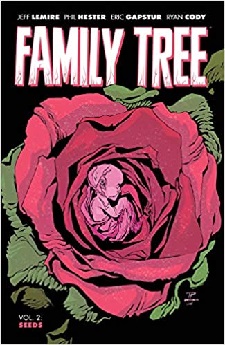
Book Review: Family Tree (Volume Two) “Seeds” by Jeff Lemire, Eric Gapstur, Phil Hester & Ryan Cody

TL;DR – the journey continues as Loretta tries to stop Meg’s transformation from happening. Pieces start coming together as the story jumps between past and present to unveil the full apocalyptic picture.

Summary (warning: spoilers)

Click here for my review of Family Tree (Volume 1) and what has happened so far.

Young Meg is fast turning into a tree. Leaves, bark, and branches. The full caboodle. Meg’s mum and brother, Loretta and Josh, are riding in a car with a doctor (who comes off like a voodoo witch) in the driver’s seat trying to outrun some pursuers looking to hunt down Meg and capture (or kill) her. They eventually stop on the side of the road, rain pouring down, and manage to move Meg to the edges of a forest. Her feet have transformed into roots and though she tries to tell her mum that she’s okay, Loretta watches in horror as her daughter turns into a full fledged tree.

The story then jumps to the future where the world has been overrun by vegetation and an adult Josh is wandering the wilderness trying to survive.

It then jumps again to the past prior to Meg’s transformation where we see the events of Meg’s father, Darcy, reuniting with Meg’s grandfather at a bar, and Darcy revealing to his father the same vegetative affliction (i.e., Darcy was also turning into a tree).

We are brought back to the present where Mr. Hayes (Darcy’s dad) is tied to a chair all beaten up after defending Loretta and the kids against a group of thugs seeking to hunt Meg down. Thanks to Mr. Hayes, he was able to provide enough time for Loretta and the kids to escape with the good witch doctor but was captured as a result. Here we learn, that the organisation hunting down humans-turning-into-trees is being led by a mysterious woman whose father also suffered from the same transformation. She believes she is protecting humanity from sort of disease, but Mr. Hayes believes that her mission is wrong because no matter how many her organisation has killed to date, the transformation keeps happening to others.

Review

The second volume of Family Tree goes deeper into a war between two opposing factions. There is the faction that is seeking to destroy the humans that have turned into trees, and there are those who believe the transformation is meant to happen.

While the second volume conveys the turmoil and horror being experienced by Loretta in seeing her daughter turning into wood and leaves (and the illustrations convey this horror very well), the story itself does little to progress from the first volume.

Nothing is revealed as to why or how this is happening. There is no explanation as to why the faction seeking to literally uproot and chainsaw all human-turning-trees is doing what they are doing. Do they perceive the transformation to be a disease? A curse? Or something else?

All we know is that certain people are experiencing it, and there appears to be no cure. So, while the story jumps between past and present, little light is shed on why the hell it is happening in the first place.

By the end of the second volume, Meg has turned into a giant tree and is able to communicate telepathically to her mother that everything is going to be okay, and she knows what is going to happen. To demonstrate this belief, when their pursuers appear on the scene with chainsaws in hand, Meg releases a pollen from her flowers and everyone not wearing a mask suddenly bursts into vegetation. Of particular note, none of Meg’s family is effected. Loretta and Josh get to witness first hand the instant eruption of more trees that were once human.

This is meant to be shocking but loses its lustre because the story hasn’t progressed enough to keep me engaged. For what it’s worth, there are only three volumes to Family Tree so it’s not like it’s being dragged out, but there isn’t enough in the story to make me think it is anything amazing. I’ll pick up volume three from the library only because I want to see how they explain the mystery, but I’m not expecting any monumental twist.

2 out of 5.

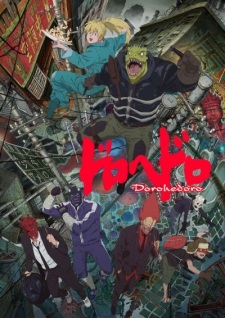
Anime Review: Dorohedoro (2020)

TL;DR – ultra violent mayhem between sorcerers and the denizens of the hole.

Review (warning: spoilers)

Caiman is hunting down the sorcerer responsible for casting a spell that transformed his head into a lizard’s. To make matters worse, he has no memory of his true identity and who he was before acquiring a reptilian head.

The above is the short plot description for what is actually a complex and possibly one of the most original animes I have seen in some time.

To add layers, Dorohedoro throws in the following craziness:

  • Within Caiman’s reptilian mouth (or more precisely his throat) is a human head, which later we find out belongs to a guy named Risu. Whenever Caiman hunts down a sorcerer, he chomps down on the sorcerer’s head and Risu emerges to tell the sorcerer trapped in Caiman’s mouth whether he is the one who transformed Caiman into a reptilian-headed human. Caiman then releases the sorcerer from his bite, asks the sorcerer what the guy in his mouth said, and when the sorcerer tells him that he’s not the one who cast the spell on Caiman, Caiman ends up killing the sorcerer anyway.
  • Caiman’s close friend is an ass-kicking girl named Nikaido who owns a gyoza restaurant. She helps Caiman hunt down sorcerers so he can get his memories and human face back. Caiman and Nikaido have a strong affection for each other especially since she is more than happy to feed him gyoza, which he demolishes by the dozen. Little does Caiman know, however, that Nikaido is also a sorcerer who sought to escape the sorcerer world. And not just any old sorcerer, she has the rare magical ability to manipulate time.
  • En is a powerful sorcerer and crime boss. His magic causes anyone who inhales his magical smoke to turn into a mushroom. For a long time, he has been searching for a sorcerer to make his partner, and he has one requirement of the sorcerer he is after. He or she must be able to manipulate time.
  • Shin and Noi are two of the most deadly enforcers / sorcerers that work under En. An incident in their past, tied the pair together resulting in Noi developing an attraction to Shin.
  • A large cast of supporting characters that includes a giant cockroach named Jonson, a sorcerer named Turkey that can create ‘living dolls’ of people out of food, and Kawajiri, a devil who has close ties to Nikaido.

This crazy collection of characters is set against the backdrop of three worlds:

  • The Hole, a sprawling district of slums where non-sorcerers reside including Caiman. The Hole is where Nikaido escaped to and set up her gyoza shop.
  • The Sorcerer’s world, a rich and vibrant land where En rules as crime boss.
  • Hell, an underworld where dead sorcerers go to and where devils reside.

The anime successfully mixes crude humour and brutal violence with a plot driven around the mystery of Caiman.

The animation is striking with a level a detail that makes you feel like you are constantly fighting against corruption. All three worlds are cut throat. The weak rarely survive, and the filth pervades through every episode. Blood is spilt in litres in every action scene and somehow the animators are able to animate blood that has spattered on clothing and skin with alarming accuracy. To emphasise the uncleanliness of it all, many characters wear jumpsuits and masks as if expecting bloodshed, guts and grime around every corner.

Based on the manga of the same name by Q Hayashida, how she imagined such a story and its worlds is both impressive and alarming (I wonder what she eats before going to bed).

I was captivated throughout the first season as we follow the motivations and drivers and the slow unveiling of backstories behind our main cast. Probably the only unsatisfactory thing about the first season is that it ends without you getting any closer to solving Caiman’s mystery. While it appears you do find out who was responsible for Caiman’s transformation, the more incessant question of why is left unanswered.

They better make a season two.

9 out of 10

Movie Review: Spiderhead (2022)

TL;DR – scientist wants to create the ultimate drug by experimenting on convicted felons. Darkly comic in parts, kind of a thriller in others. Overall, doesn’t deliver on the potential it has.

Review (warning: spoilers)

Steve Abnesti (Chris Hemsworth) is the owner and founder of Abnesti pharmaceutical. He runs a penitentiary and research centre called Spiderhead, situated on an isolated island, that houses individuals that have committed crimes that range from robbery to manslaughter.

The setting and name of the facility should be enough to make any criminal pause at the idea of being used as a guinea pig to trial a series of drugs that are administered through a device (called a “MobiPak”) that is attached to your lower spine. The reasons why they agree is that the facility allows greater freedoms than state prisons. Inmates are allowed to wear what they want (no prison uniforms), roam the interior of the giant facility that houses a kitchen, dining, lounge and games area and serve their time without the fear of prison violence (more on this point in a minute). Both men and women are housed within Spiderhead and apparently there is nothing stopping them from developing relationships (romantic, sexual or otherwise).

There are no prison guards, no jail cells and no barred windows. No locks except the one that prevents you from leaving Spiderhead, and no need to be part of a gang within the penitentiary in order to obtain some level of protection from other gangs.

Abnesti and his assistant, Verlaine (Mark Paguio), are the only ones who run Spiderhead, and if you’re wondering how they maintain law and order, it’s through the use of one of the drugs Abnesti pharma has created that instils a level of obedience in each person. Thus, circling back to the point about everyone inside not fearing prison violence.

However, as the film unfolds we discover that the individuals selected to reside in Spiderhead are not random and those that have been chosen have certain backgrounds, stories and circumstances that led them to be convicted of a crime that makes them suitable for the Spiderhead experiment. At least, the characters that are focused on are revealed to be people that have made horrific mistakes and have not chosen to live a life of crime.

We’re not talking mobsters, or serial killers, or psychopaths. We’re talking people who either misjudged their situation or were under some extreme emotional triggers that led them to act in tragic ways.

The main ‘inmate’ focused on is Jeff (Miles Teller) who was committed for manslaughter after driving his car (while intoxicated) at speed into a tree and killing the woman he loved and his good friend. Jeff now operates under a constant feeling of guilt and accepts being used as a guinea pig at Spiderhead because he thinks he deserves it.

Then there’s Lizzy (Jurnee Smollett) who plays a mother who left her baby in her locked car in the heart of summer while she did a three-hour shift at Walmart. She is now a shell of her former self, forever tortured for having killed her own baby daughter.

The “mad scientist” character, Steve Abnesti, believes he can create a drug that will ensure crimes will never be committed. However, the way he convinces those in Spiderhead to participate in the experiment is under the guise of creating the ultimate “feeling good, love” drug. If everyone loves each other then there would be peace on earth.

There are other types of drugs that he tests. For example, one that causes your fears to override your reason; another that causes extreme mental and physical distress; another that causes you to express your thoughts in a verbose way; and yet another that makes you hallucinate that everything is beautiful when in reality it might be horrific. And again, he does this under the guise of testing the limits of these drug-induced emotions to supposedly achieve the ultimate “love” drug.

In fact, Steve is so willing to back his experiments that he has one of the MobiPaks attached to his own spine. Mind you, he only ever administers the good feeling drugs on himself… never the bad ones.

In reality, what Steve is seeking to achieve is not a love-for-everyone drug that will end wars the world over. What he is trying to develop is a drug (called Obediex) that will achieve unconditional obedience from the person who receives the drug. This includes a level of obedience that goes against the individual’s inherent nature. For example, if a person genuinely loves and cares for another and is given Obediex, then Steve wants to order them to harm the one they love. This is meant to demonstrate the effectiveness of Obediex and be the ultimate drug to allow remote control of another person.

Of course, when Jeff finds out Steve’s true intentions, which involves having Obediex administered to him so he will hurt Lizzy (a woman he has found to be as damaged as him and falls in love with), he seeks to call in the authorities and have the whole mad scientist lab shut down.

Whether Spiderhead is meant to be a cautionary tale (i.e., we all need to accept the feelings we experience and acknowledge their existence rather than attempt to get rid of them through drugs) or a satirical examination of how people experience base emotions, the film never delivers the emotional impact it strives for.

Director Joseph Kosinski appears to waver between creating a film that is darkly comic versus a grim mystery thriller. Several situations are shown where the love drug is administered, or the characters think it will be administered, leading to some quirky, off-beat humour. Other times it unleashes blood and violence in a way that is meant to be shocking or cause you to be on the edge of your seat. But neither story mechanisms packs a punch and at most, you will perhaps raise an eyebrow or produce a wry grin.

In the end, Spiderhead never manages to be anything other than predictable. Even when Steve attempts to escape aboard his seaplane with the last drug samples while his MobiPak (damaged in a fight with Jeff) causes all the different types of drugs to flood his system, you know he’s not going to get far. And sure enough, the drug that makes him see everything as beautiful when really it’s not causes him to fly into a mountain.

The top notch cast do a good job of engaging you at the beginning. Chris Hemsworth and Miles Teller are both strong in their respective roles. But the movie flags by the halfway mark as you start questioning whether to see it through when you already know how it is going to end. If the movie went all-in as a black comedy, or all-in as a mystery thriller, it could have been far more engaging and riveting. Instead, Spiderhead meanders in a plot that doesn’t have enough meat on it and doesn’t know which way it wants to go.

5 out of 10