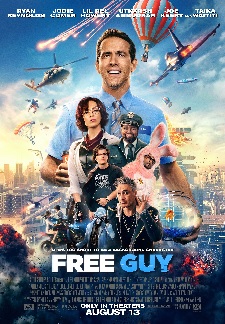
Movie Review: Free Guy (2021)

TL;DR – who knew the existential crisis of an artificial intelligent bank teller could be so much fun?

Review (warning: spoilers)

“Don’t have a good day, have a great day,” says Guy (Ryan Reynolds).

“In case I don’t see you, good afternoon, good evening, and good night,” says Truman (Jim Carrey).

It it not just with their catch phrases that there are similarities between Guy (in Free Guy (2021)) and Truman (in The Truman Show (1998)). Both characters do not realise that the world they reside in is not the real world. Both live a life of routine; they interact with real people who know the truth; their innocence and naivety are used for comic purposes; and their lives are turned upside down when they discover the truth.

The primary difference is that Guy is a non-player character (NPC) in a video game called “Free City” (i.e. he’s not real), while Truman is an actual living being in a reality show.

All NPCs in video games have programmed instructions on how they act and react to real life gamers who interact with them. They never deviate from this, as their code prescribes their actions. For Guy, he’s a bank teller NPC who serves customers, says his catchphrase and every day the bank is robbed by multiple gamers, he reacts like any good bank teller when they’re getting robbed by lying on the ground and being as little a threat as possible.

He lives in “Free City”, a popular massive multiplayer online role playing game, where players create characters that are as bad-ass as possible. Leveling up involves accepting any number of criminal tasks and acquiring a bat cave load of weaponry and vehicles.

However, Guy’s routine suddenly changes when he encounters Molotov Girl (created by gamer and programmer Millie Rusk (Jodie Comer)). It soon becomes apparent that Guy is not constrained by his underlying code, if anything his code base expands indicating he actually has artificial intelligence, and he undergoes the expected existential crisis when Molotov Girl reveals to him that he is inside a video game and is not actually a real person.

In parallel to this, Millie and co-programmer, Walter McKeys (Joe Keery), work together to find evidene that “Free City” is actually based on code they created for a game they made called “Life Itself”. Pathways intersect when Walter reveals to Millie that Guy is based on artificial intelligence code he created. Millie (as Molotov Girl) and Guy go on to discover that the game “Life Itself” is hidden beyond the boundaries of “Free City” and look to bridge the gap to find it.

Meanwhile, Antwan (Taika Waititi in hilarious form) plays the villain responsible for stealing Millie and Walter’s code and is now looking to destroy all evidence of “Life Itself” by shutting down “Free City” in order to release its sequel “Free City 2”. Waititi must of had a ball being part of this movie as he delivers his lines with comic vitriol and also gets to destroy an entire server room with an axe.

The balance between humour and drama struck a chord for me, and the overall roller coaster ride filled with geek references, cameos from YouTube gamers, great chemistry between the entire cast and solid story had me smiling from ear to ear. It’s always a good sign when I walk out of a cinema and feeling the desire to watch the movie again. For some viewers, it may all seem too geeky or silly (a pale imitation of The Truman Show), but I’m a geek so this is right up my alley. Thank you very much.

Free Guy also has the underlying positive message to go live your life and not get stuck in a loop. So, go do what you really want to do. Don’t have a good day, have a great day!

9 out of 10

Book Review: The Vegetarian by Han Kang (translated by Deborah Smith)

TL;DR – a South Korean woman who experiences terrible dreams about animal slaughter decides to stop eating meat. This decision leads to a descent into madness and examines the impacts on those around her.

Summary

Yeong-hye has been the dutiful wife to Mr. Cheong and living a life that is routine. This all changes when she decides to abstain from consuming meat after a series of graphic dreams involving killing animals. Her abstinence slowly transforms into the belief that she is actually a tree and soon refuses to eat anything entirely. The degradation of her well-being causes ramifications to those closest to her.

The book is told in three parts. The first part is told from the perspective of Mr. Cheong. The second part is told from Yeong-hye’s brother-in-law (his name never revealed). And the final part is told from Yeong-hye’s sister, In-hye.

Review (warning: spoilers)

The winner of the 2016 Man Booker International Prize is a difficult read. Not because of the translation from Korean to English (Deborah Smith does an astounding job) but because I didn’t encounter anything that I liked.

All my book reviews are rated on enjoyment, and that enjoyment comes from a multitude of factors including character development, writing style, plot and themes. I do not exclude books on genre, nor will I rate a book poorly because of its genre. As with all readers, I do have preferences. I’m drawn more to fantasy/sci-fi and crime/mystery than I am to other genres like sick lit or horror.

The Vegetarian falls into literary fiction and Asian culture genres. The exploration into one particular Korean family, the way they live, and how it all falls apart is insightful and, at times, both horrifying and fascinating. However, it is not so much a story, as it is an indictment on how Asian families fail to support each other when one of them suffers from mental illness. I have read in other reviews that this was not necessarily Han Kang’s intention and that she was thinking more about universal questions surrounding innocence, beauty and violence. However, the story presents a picture that shows clearly the failings of a particular culture and the fault lines that can occur in family units.

None of this means that the book cannot be enjoyable. In fact, the story is effective in evoking images that will stay with you long after you’ve read the last page. The characters are vivid, the extremes in behaviour haunting, and the three perspectives showing different facets of personalities and the choices they make are initially intriguing. All of this lends toward a piece of work that deserves the awards it has won.

The problem for me is that effective does not always equate to enjoyable.

Take Mr. Cheong, Yeong-hye’s husband, who lives an existence that is nothing short of plain. This is how he wants it. A life without troubles or exuberance. A life of staying in one’s lane and never wanting to experience anything (uplifting or otherwise) in another lane. He chose to marry Yeong-hye on the basis that he thought she would make a wife that would not cause trouble and would allow him to maintain his existence of ordinariness. So, you can imagine the upheaval that is caused to his life style when Yeong-hye stops eating and begins to think she is a tree. He has no sympathy for his wife’s plight (or I didn’t buy into any attempts of sympathy, if anything he wants to be pitied for his wife’s behaviour). He makes one feeble attempt at an intervention by inviting Yeong-hye’s family over, who then proceed to force Yeong-hye to eat, which leads to violent and destructive results. Yeong-hye is hospitalised and Mr. Cheong, now widely taken away from his own lane, decides to leave her and serves her with divorce papers. Real nice… not. I found him to be a despicable character with no redeeming values whatsoever.

Then we have Yeong-hye’s brother-in-law. He is a video artist who becomes obsessed with the mentally ill, Yeong-hye, and imagines creating an art video involving two people making love with their bodies covered in painted flowers. He convinces Yeong-hye to participate because she likes the idea of flowers being painted on her naked body (remember she thinks she’s a tree). The brother-in-law hires another artist who agrees to have his body painted in flowers for the video, but the artist leaves when he’s asked to have actual intercourse with Yeong-hye. This leads to the brother-in-law having flowers painted on himself and filming a sexually explicit video with Yeong-hye. It’s essentially rape of a mentally ill woman. Again, another character that has no redeeming values even though, from his perspective, he tries to convince you his actions are reasonable. Reality check, it’s not. Not even close.

This leads to In-hye, the sister, who discovers the video and calls the authorities to arrest her husband. In the process, Yeong-hye is placed in a mental hospital. In-hye is the only character of redeeming value. She is also the only family member that seeks to help Yeong-hye (none of the other family, not even the parents, visit her in hospital). In-hye is the suffering character, she is now a single mother, trying to take care of her son as well as her mentally ill sister. She experiences her own mental breakdown and the story ends with no resolution.

The no resolution ending is probably what you would expect from this type of story. Along with the first two parts told from the two male antagonists, I also struggled with the fact that at no time do we go deeper into Yeong-hye’s mind or view any events from her perspective. The mystery of her horrific dreams, the reasons she believes she is a tree, and her descent into mental illness are never told from her view. The mental illness is merely the trigger to how other characters unravel.

The Vegetarian is evocative, effective and elusive, but is it enjoyable? For me, no.

1.5 out of 5.

Anime Review: Tonari no Totoro (1988)

TL;DR – a father and his two daughters move to the country to be closer to their sick mother, who is in a hospital nearby. The two girls discover a world of nature, forest spirits and untold beauty.

Review (warning: spoilers)

Tonari no Totoro (translated to My Neighbour Totoro) is arguably Hayao Miyazaki’s greatest creation. Many subsequent films have garnered critical acclaim and awards including Princess Mononoke, Spirited Away, and Howl’s Moving Castle, but it is the magical creature that is Totoro that is Studio Ghibli’s flagship. The emblem of the Totoro represents all things Studio Ghibli has created and epitomises story telling and animation excellence among not only the anime-obsessed Japanese but also international audiences. This bulbous creature is instantly recognisable by all anime fans and is equivalent to Mickey Mouse for Disney, Spider-man for Marvel and Batman or Superman for DC.

The story of a professor and his two daughters, Satsuki and Mei, moving to rural Japan and into a post-war house that has seen better days is not the stuff of legend. It is merely a slice of life captured in animated form with rice paddy fields, lush forests, mountainsides and running creeks (the likes of which Monet and Van Gogh would be proud). There is beauty in every scene as we watch Satsuki and Mei explore their backyard and the various levels of their new house (which some of the local kids think is haunted). Miyazaki captures the curiosity that comes from being a child and everything is an adventure.

The introduction of the Totoro is pure magic, an “Alice in Wonderland” trip down a tree hollow into an underground cavern of greenery, flowers and butterflies where resides a very sleepy forest spirit named Totoro that is a cross between a very round, very large, egg-shaped bear and a cat. Only a child, in this case little Mei, would approach this creature without trepidation. The soft, pillow-like fur of the Totoro’s tail causing Mei to hug it like a plush toy before being lifted up on its belly because he turns over to sleep on his back. I imagine the Totoro is like cashmere, lying on his giant stomach, his warmth and breathing as you rise and fall, causing you to fall asleep as if you’re enveloped in soft down (which is exactly what happens to Mei).

How this movie has transcended cultural boundaries and become a cult phenomenon is beyond me because it doesn’t have the typical edge like Pulp Fiction, Blade Runner or Fight Club nor the so-bad-it’s-good cult status of films like Plan 9 from Outer Space or Who Killed Captain Alex? In this way, Tonari no Totoro, has achieved cult status in a unique way. There’s no twists, no violence, no shocks, and no complex plot. What this film does have is depth, or rather depth in simplicity. The ability to capture everyday life in a magical, non-ordinary way. Whether it’s walking home in the rain, or riding a bicycle, or exploring the attic of a house, there’s something about how Miyazaki presents these that keeps you spell bound.

The flourish of the fantastical is restrained and not done in a way that is heavy handed. Miyazaki’s other films like Spirited Away and Howl’s Moving Castle have the fantastical front and centre, but Tonari no Totoro moves because of its main two characters in Satsuki and Mei, and the relationship they have between each other. The scene where Satsuki has a sleeping Mei on her back (her hands giving her a piggy-back) waiting at the bus stop for their father to return from work, open umbrella over her shoulder as the light drizzle of rain persists, is animated magic. When the giant Totoro arrives with a big leaf on its head in a futile attempt to protect itself from the drizzle, it is nothing short of comical and engaging. The expression on Satsuki seeing the Totoro for the first time is priceless, and when she hands him a spare umbrella, which he manages to open and then finds the rain does not hit his head anymore is so moving, you will wish you had a Totoro at your bus stop too. The fact the Totoro is waiting for a cat bus needs to be seen to be believed.

There’s so much to fall in love with in this film that it warrants repeat reviewing. It’s a (cult) classic that is just as engaging decades on. And like I said, there’s a cat bus. If you ever want a movie to be elevated into greatness, then throw in a cat bus. For audiences of all ages, a must-see.

10 out of 10

Movie Review: The Half of It (2020)

TL;DR – a teenage version of Cyrano de Bergerac or Roxanne without the big noses.

Review (warning: spoilers)

Both Cyrano de Bergerac and Roxanne (both based on Edmond Rostand’s 1897 play) revolves around a male character (with a large nose) who is in love with a female character. He’s good with words and poetry but does not profess his love to the female because he considers himself physically unattractive. Enter a second male character (who doesn’t have a large nose and is considered physically attractive) who also has a crush on the same female character but is incapable of stringing two sentences together when speaking to her. First male helps second male by telling him what to say… comedy and drama ensues.

Now take the above and do the following:

– Make the male character (that’s good with words) be female (that’s good with words & has a normal nose).
– Turn them all into teenagers.
– Add all the joys and challenges that comes with being a teenager.

Ellie Chu (Leah Lewis) is the introverted and dutiful daughter who makes some extra money on the side by writing papers for other students so they can get good grades. She is the ‘Cyrano’ in the film but without any attempt to make her look like Pinocchio. In fact any attempt to make her like a character with self-esteem issues when it comes to her physical appearance is thrown out the window; I don’t care how much they try to make her look like a nerd with Harry Potter type glasses who is obsessed with drinking Yakult, you know she’s pretty underneath.

Paul Munsky (Daniel Diemer) is a football player that is a little slow and has a major crush on Aster Flores (Alexxis Lemire). Knowing Ellie helps other students with papers, he seeks her services in writing a love letter to Aster. The scenes where he chases after her on foot while she’s riding her bicycle home are genuine, funny and touching.

Additional tweaks to this story give it a fresh feel. For one, Ellie doesn’t have a crush on Aster, she doesn’t even know she’s attracted to her until they start communicating through letters and texts. The light dawning on Ellie that Aster isn’t just a pretty face, has her own inner struggles and dreams, and a depth of personality that draws them toward each other. Problem is that Aster thinks its Paul Munsky doing all the writing.

The second tweak is that Aster has an existing boyfriend, Trig Carson (Wolfgang Novogatz), who has his whole life mapped out with Aster (much to her dismay). His confidence and surety of what their lives will be like (i.e. they get married, have a family etc.) is a clear red flag for Aster who battles internally with the fear of being alone versus following her own dreams.

The last tweak is Ellie’s father, Edwin (Collin Chou), who works as a station master, or rather he did until his wife passed away and now Ellie picks up the slack and feels like she can never leave to live her own life because it would mean her dad would be alone.

There’s also the modern day splash of religious beliefs thrown in about homosexuality. So, there’s plenty to watch and follow in this engaging, more than a few times funny, poignant film about what is at its heart, two girls trying to discover their own identity and in the process identifying an attraction to each other. In truth, while it may start off as a Cyrano de Bergerac, it ends squarely as its own story, transforming into something else that has nothing to do with unrequited love but everything to do with living one’s own life to the fullest.

The scene where Ellie and Aster talk at the hot spring is beautifully done. A moment that captures their hopes and fears, sharing their loneliness, and desiring to be understood.

The Half of It is fabulous film by director Alice Wu, so grab a Yakult with your popcorn and enjoy.

8.5 out of 10

Book Review: State Highway One by Sam Coley

TL;DR – After a car accident causes the death of his parents, Alex returns home to New Zealand and embarks on a road trip with his twin sister, Amy, to seek reconciliation and ultimately redemption.

Summary

Alex and Amy’s parents are not exactly nurturing. Absorbed in their own careers, they often leave their children to fend for themselves, giving them a freedom that their friends are envious of but they view as empty and unloving. Alex hangs around for as long as he can stand; he has a passion for music and a good friend who keeps him company when his parents are not around. His twin sister, trying to be more positive, seizes her freedom to do what she wants and holds parties while their parents are away.

In the end, an incident occurs that has nothing to do with their parents, which drives Alex to pack his bags and move overseas to Dubai (as far away as possible from his home country, New Zealand). Three years later, he finds himself rushing home after receiving the news that his parents have died in a car crash. He’s in a daze, filled with regrets, haunting memories and attends a funeral that is mainly a blur. He can’t face returning home and having to deal with all the stuff left behind, so his sister convinces him to hop in the car and they go on a road trip along State Highway One, starting from the north of New Zealand going all the way down to the south.

Review

Sam Coley’s debut novel is a well-deserved winner of the 2017 Mitchell Prize for Emerging Writers. It’s a sweeping tale that showcases the beauty of New Zealand and the fragility of life through the strained connection between Alex and Amy and their estranged relationship with their parents. Coley captures the guilt and angst of Alex through every thought, speech and action he has with his sister and does so with words that make you feel like you’re in the car with them, watching them smoke, drink, argue over the music playlist, and the glimpses of need amongst all the anger and reckless driving.

The story moves between past and present as the puzzle pieces of Alex’s life comes together to burn deep in the reader’s mind. State Highway One was recommended to me because I enjoyed The Wife and Widow by Christian White. As a result, I confess I was keeping an eye out for a specific device that Coley uses in his story. When I identified it, the story seemed to drag a bit, and I felt a desire to jump to the end because I knew the reveal.

As with most creative works, especially stories, it is best to go in without any preconceived ideas. You’ll enjoy it all the more I promise you. Instead, I found the repeated desire of Alex to stop the road trip because his sister was driving him nuts and wanting to buy a ticket back to Dubai wears thin after about the halfway mark. Each time he contemplates this action, Amy reminds him that he promised to take her all the way south, to the end of State Highway One. The signs are there if you know where to look and once you do, you’ll know where it is all heading.

Still, it’s a poignant tale, if a little long-winded for me. A journey of self-discovery through all the stages of grief and self-destruction amongst the amazing scenery of New Zealand before finally reaching a destination that is so insignificant in time and place to anyone else, but means everything to Alex as he keeps his promise to his sister.

3 out of 5.

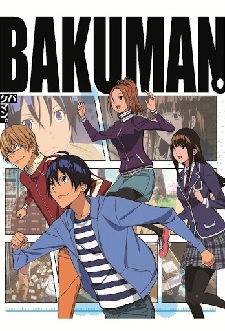
Anime Review: Bakuman Seasons 1-3 (2010-2013)

TL;DR – two high school students team up to try to break into the manga industry and discover making their dreams a reality is a large mountain to climb.

Review

Tsugumi Ohba and Takeshi Obata, creators of the highly successful Death Note series, teams up again to explore the manga and anime industry. It’s a far cry from the supernatural, suspense, cat-and-mouse Death Note and will be a surprise to fans expecting that Ohba and Obata would create another manga/anime in the same genre.

Instead, we have a slice of life anime that deals with the trials and tribulations of what it takes to set yourself apart in a market saturated by many other artist/writers looking to break into the same industry. This is a story that exemplifies that if you write about what you know then you can connect with your audience.

Moritaka Mashiro and Akito Takagi are the duo of artist and writer respectively that teams up. Moritaka is initially hesitant to undertake this endeavour because his uncle who was also a manga artist died from being overworked. But he commits to the idea when he discovers that Miho Azuki, the girl he has a serious crush on, reveals that she wants to become a voice actress for an anime series. Moritaka and Miho make a pact that only when they achieve their dreams will they then marry and until then they are not to see each other.

Yes, it’s far-fetched but a fantastical enough arrangement that still makes you cheer them on anyway.

More importantly, it then explores the machinations, meetings, deadlines, long hours, and the sacrifice required to have one’s manga serialised, and the challenges of what it takes to achieve enough popularity for the manga to then be turned into an anime.

The art is superb and the story engaging enough that the twenty volumes of Bakuman were then animated into three seasons. It won’t be everyone’s cup of tea, but if it does grab you, you’ll be drawn in completely. It’s inspirational, funny, and demonstrates the old adage about belief in one’s dreams and working hard to get there.

9 out of 10

Movie Review: Kajillionaire (2020)

TL;DR – a family of con artists live off the grid but face eviction unless they pay the rent. They figure how they can get the money by doing a travel insurance scam, and along the way bump into a woman who wants in on the act and in the process, changing the course of their lives. A quirky, comedy drama that will leave you thinking long after the credits roll.

Review (warning: spoilers)

Extremes in behaviour make for intriguing stories. The movie Nomadland, which won the 2021 Academy Award for Best Picture, revolves around a woman who makes the choice to live as a modern day nomad in her van after losing everything in the recession. It’s an intriguing story even if it doesn’t go anywhere, and it should be noted that ‘intriguing’ doesn’t always equal ‘satisfying’.

Kajillionaire is similar in that it’s about a family that chooses to live a life as grifters. They live frugally, doing small scams and cons, and exist largely off the grid. Unlike Nomadland, which for all its existentialism and great acting, I found largely unsatisfying because there isn’t much of a plot, Kajillionaire delivers a story that starts off quirky and funny, turns toward the disturbing, before rounding out to an ending that transforms the main character.

Robert (Richard Jenkins) and Theresa (Debra Winger) live a life as con artists. They have a daughter, Old Dolio (Evan Rachel Wood), who they have raised to be one of them. The why of it is largely because of Robert who has a paranoia about all forms of surveillance and tracking and ultimately believes that society is corrupt. Why Theresa goes along with this, I have no idea, other than she’s married to the man and must have the same beliefs. They have chosen this life, which frankly, requires more work than getting a normal job. Are they happy? Doesn’t seem like it, but maybe that’s not the point when you can stick it to “The Man”.

Old Dolio, on the other hand, born into this family, has had no choice in becoming a con artist. She does so in order to get her parent’s approval and some semblance of affection, which never happens. Robert mostly blames her when things go wrong and takes the credit when it goes right. Theresa will not win any award for mother-of-year as she exhibits not a modicum of love for her own daughter. They named their daughter ‘Old Dolio’ after a hobo who won the lottery in hopes he would leave his namesake some of his money. This sums up how they perceive their daughter, a tool to be used for a con.

There is a quirky comedy to how they go about their lives in the opening scenes of the film, but once this passes, I came dangerously close to switching it off because you come to realise that Robert and Theresa have no redeeming values and they treat their daughter like a robot with no feelings. However, Director and Writer, Miranda July doesn’t drag this out.

Enter Melanie (Gina Rodriguez) who meets the trio on a flight. A flight done purposefully as part of an insurance scam conjured up by Old Dolio in order to get some quick cash to pay their landlord, who has been chasing them for rent. Melanie ingratiates herself with the parents and gets Robert to start drinking, which leads to him divulging their plan and getting her on board.

Why Melanie does this is not clear to me, and why she does not see Robert for what he is was also somewhat baffling because later on he reveals his creepy intentions by trying to seduce her in a hot tub. The reason that Robert’s wife, Theresa, goes along with it is also baffling. Perhaps it demonstrates how base they both are. At the same time, there are ambiguities (purposeful) in their character that demonstrates that they stay true to their choice as grifters (for example, they always split their scams three ways with Old Dolio even at the bittersweet end).

Regardless, Melanie sees that Old Dolio has been brainwashed into thinking she has no choice but to live this life that her parents have raised her to be in. The transition from off-beat comedy to romance between the two is genuine (a lot occurs beforehand for the connection to be realised, so it does feel believable and not something that comes out of left field). Old Dolio’s transformation is not by any means smooth. Like a video she watches of a newborn baby crawling on her mother’s chest, to unlearn her behaviours is difficult, at times painful, and altogether uplifting. She is able to do this because Melanie does not give up on her and that is key to the film not drowning in despair. A worthwhile watch.

7 out of 10

Book Review: Chew (Volume Two) “International Flavor” by John Layman & Rob Guillory

TL;DR – Tony Chu, government agent and resident Cibopath (i.e. he gets psychic impressions of whatever he eats), finds himself journeying to a strange, tropical island where there is a fruit that tastes like chicken.

Summary

Chew (Volume One) book review provides introduction and background to the world of Chew. Volume Two follows agent Tony Chu to the island of Yamapalu where he hunts down clues in relation to a fruit called gallsaberry that looks like a cross between a pineapple and an octopus and tastes exactly like chicken when cooked. In the process he crosses paths with a covert operative named Lin Sae Woo who is hunting down an international mass murderer; uncovers a gambling ring involving cockfighting and a rooster named Poyo; stumbles into a business turf war over chicken substitutes between a rich Texan named Ray Jack Montero who is looking to scientifically modify frogs to taste even more like chicken and the Yamapalu governor seeking to sell gallasberry to the world and put his island on the map; and saves his brother chef Chow Chu and journalist Amelia Mintz who get caught in the crossfire.

Review

So much goes on in this graphic novel, both from the story written by John Layman and the art drawn by Rob Guillory that readers will enjoy going over Chew more than once. It’s always a sign of a great graphic novel when I revisit its pages and take in more details that I missed on previous readings.

As with the first volume, multiple threads develop. Some get tied off, while others are slowly being interwoven. The underlying mysteries indicating that the scope spans further than the boundaries of Earth.

What further draws me into the world of Chew are the individuals that exhibit culinary powers beyond the senses of smell and taste.

There are the three Cibopaths, individuals that receive images of the origins of what they eat. The first is our by-the-book and main character, Tony Chu, who finds himself having to bite into all manner of unsavoury things.

Next is the man of rhetoric and preamble, Mason Savoy, who has become Tony’s enemy. Sadly, Savoy does not make an appearance in Volume Two.

And lastly, the mysterious Serbian who pretends to be a vampire but is really a serial killer and targets other individuals that have culinary powers to try and absorb them through cannibalism.

Next there are Saboscrivners, individuals who can write down what they eat with such realism that whoever reads their words can taste the food also. Love interest, Amelia Mintz, is a Saboscrivner and is thrown into harm’s way in Volume Two much to Tony’s distress.

And then there’s Cibolocutors who can communicate written works (such as Shakespeare) and their own speech through food. The Great Fantanyeros is a Cibolocutor who becomes a target of the Vampire.

After reading Volume Two, I cannot help think that the reasons these people exist is tied to the mystery behind the ‘avian flu’ that wiped out millions of people and resulted in the global poultry prohibition. I’m eager to find out in future volumes if this is true.

Do yourself a favour, and take a bite into this fabulous graphic novel creation. I’m rating this half a point lower than Volume One only because my favourite character, Mason Savoy, is absent. He’s a terrific antagonist and was sorely missed. However, I’ve seen the cover for Volume Three and it’s clear that Savoy comes back!

4 out of 5.

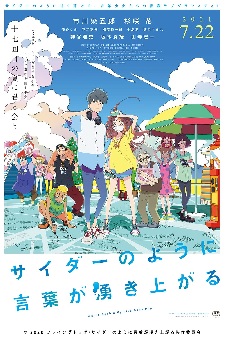
Anime Review: Words Bubble Up Like Soda Pop (2021)

TL;DR – a boy who only expresses himself through haiku and a girl who is a popular vlogger meet at a shopping centre over summer break. Slice of life, romance anime that follows a simple storyline that is well executed.

Review

Words Bubble Up Like Soda Pop has striking animation and colours that remind me a lot of the Great Pretender anime series also on Netflix. The introduction scene as the camera pans across a highway with endless fields of green on both sides and then onto a shopping mall within Oda city is so full of colour and life that I was instantly drawn in. The instrumental soundtrack that accompanies the opening scenes is light and bubbly like… well… soda pop and makes you feel like you’re floating in the sky looking down on the many lives going to and fro through the mall.

The story is straight forward. We have Yui Sakura (nicknamed “Cherry” because sakura means cherry blossoms), a teenage boy who constantly wears headphones as a means to not be overwhelmed by the outside world (and noise) and also signals to others that he doesn’t want to be disturbed because people think he’s listening to music. He has a passion for haiku as a way to express himself and posts the short Japanese poems he creates onto his social media platform. Cherry works at the welfare centre in the mall part-time in place of his mum who is recovering from back issues.

Then we have Yuki Hoshino (nicknamed “Smile”). She and her sisters uploaded a video based on the idea of cuteness and under the name “Smile For Me”. Yuki continues on as a solo artist and has obtained a substantial number of followers. The irony is she has self-confidence issues because of her buck teeth. When she was much younger, everyone thought her teeth were cute. But now that she’s a teenager, she doesn’t like her teeth and has undergone orthodontic work and obtained braces. As a result, she constantly wears a face mask so people can’t see her teeth. She continues to upload videos and streaming her adventures around the Oda city asking her followers to ‘like’ and ‘smile for her’.

Cherry’s headphones and Smile’s facemask are effective motifs to reflect the awkwardness and self-confidence issues of teenage youth. There is one particular scene where, after spending many weeks together, Smile discovers that Cherry is moving away. He had wanted to tell her earlier but every time he plucked up the courage, they were always interrupted. Cherry knows that he has hurt her and as she continues to walk home without him, his own heart breaks and the outside noise suddenly becomes too much and he puts his headphones on to block it out.

The supporting cast of characters are all eclectic and enjoyable to watch. The main story that pulls them along surrounds one of the elderly gentlemen at the welfare centre who owns a record store and has misplaced a record called “Yamazakura”, which contains songs from his deceased wife. Cherry and Smile go on a research hunt to try and find the record or details of where a copy can be obtained leading towards their growing affection for each other.

The climactic scene is nothing new, both boy and girl overcome their confidence issues to acknowledge their genuine connection. Counter to the headphones and mask motifs are the running themes of poetry and music that help Cherry and Smile evolve as individuals as well as a couple.

Unlike other more dramatic and heart-wrenching slice of life animes like Koe no Katachi (A Silent Voice) which deals with the bullying of a deaf girl or Tenki no Ko (Weathering With You) which tells a story of a runaway boy and orphaned girl struggling to survive in Tokyo, Words Bubble Up Like Soda Pop is effervescent with just enough emotional pull to make you stay on for the entire ride.

There’s nothing earth shattering here but it does not aim to be, which is perfectly fine to me when it still captures what is intended, a slice of life heart-warming tale that should appeal to all ages.

8 out of 10

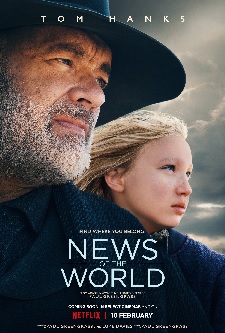
Movie Review: News of the World (2020)

TL;DR – an American Civil War veteran commits to returning a young girl raised by a Kiowa tribe to her last remaining family.

Review (warning: spoilers)

Having just written a book review on Lincoln the Unknown by Dale Carnegie, it was coincidental that I stumbled upon News of the World which follows Captain Jefferson Kyle Kidd (Tom Hanks), a Civil War veteran, who travels from town to town reading stories from newspapers in front of audiences who pay a dime a person. It’s a stark contrast to today where we can obtain the world’s news with a touch on our mobile devices.

Set in 1870, five years after the Civil War, the south has not recovered from the ravages of war and the nation is still going through reconstruction. The story follows Kidd on a road between towns, encountering an overturn wagon with a lynched black freedman hanging from a tree and finding a young white girl named Johanna Leonberger (Helena Zengel) hiding in the bush speaking in Kiowa. Kidd discovers that Johanna has been orphaned twice over; her birth parents killed in a Kiowa raid, and subsequently her Kiowa family releasing her from captivity to the black freedman. After a couple of attempts to unload Johanna and make her someone else’s problem, Kidd commits to taking her to her remaining family, an aunt and uncle who live near San Antonio.

Based on the book of the same name by Paulette Jiles, Director Paul Greengrass has created a movie rich in detail of a time when the aftermath of war has left many wounds; some open and unable to heal, others festering, and some that have scarred over and never forgotten. The film is ably supported by its strong cast led by Hanks in fine form and Zengel capturing well the lost look of a child trying to survive in a world of violence and hate. The cinematography is stunning and shows that it is not only the people you have to be wary of but also the weather itself.

At its heart though, this is a story about family, and how ultimately family is what is lost in war. What starts off as a lost girl being delivered by a war veteran, on a dangerous road to find home, ends with a war veteran who is just as lost and realises that home is with the ones you love. It’s a touching story with a heartfelt ending, and certainly in these isolating COVID times, it is a much needed reminder of what is important in life.

7.5 out of 10