Book Review: Chew (Volume Five) “Major League” by John Layman and Rob Guillory

TL;DR – Tony gets kidnapped by a crazed sports writer, who wants to use his psychic food powers to obtain the histories of famous baseball players… famous (dead) baseball players. Given he achieves psychic impressions of the past only from items he eats, you know this is not going to be a pleasant.

Summary (warning: spoilers)

Go to my book reviews page to see what has happened in previous volumes of this award winning graphic novel series. Volume Five focuses on Tony Chu, his working partner, John Colby, and his estranged daughter, Olive.

Tony and John have been fired from the FDA and are assigned new jobs. Tony ends up in Traffic division riding a motorised scooter dressed in what looks like a Scottish bagpipe outfit and issuing parking tickets. What starts off as anger and reticence in what he perceives is a demeaning role turns out that he can still uncover crimes and make a significant positive difference. This leads to his new boss in Traffic division lauding him a hero and making Tony realise it helps working in an office where he actually gets along with his team (at the FDA, his boss made his life a living hell).

On the flip-side, John is assigned to the USDA; an all female government agency where agents are partnered with cybernetic-enhanced animals. Every agent seems to hate men, so when John ends up working in their agency, he is an immediate outcast. His boss, Director Penya, makes his life a living hell (similar to how Tony was treated by his former FDA boss) but unlike Tony (who put up with the hate), John takes action by sleeping with her resulting in some hilarious consequences.

Meanwhile, Olive has partnered up with the infamous Mason Savoy. She is unaware of the previous fall out between Savoy and Tony. Together with Caesar, they continue to hunt down individuals with food-related powers. One such individual is Hershel Brown, a fugitive that has the power to sculpt chocolate into any item and mimic the exact properties of that item (e.g. he can carve a machine gun out of chocolate and it will work like a real machine gun).

Tony’s elevated joy at the Traffic division is short-lived when he is ambushed and kidnapped by Dan Franks. Dan works as a sports-writer at the Mercury Sun, the same media outlet where Amelia Mintz works (Tony’s girlfriend). Dan used to date Amelia but she broke up with him, and he has been scoping out Tony for sometime. His true motives revealed in this volume.

Review

Chew Major League is as brutal and gripping as all the previous volumes. Both story and artwork move at a pace that makes you want to turn each page as quickly as possible, but this would be a mistake as you will miss on the small details that often hint to what will happen in future volumes. Being a graphic novel, the story is told through both words and art, so the need to take your time and absorb each panel is worthwhile and a testament to what Layman and Guillory have created.

Seeing Olive’s character unfold and her food-powers develop opens up a world of possibilities of where the story will go. And John’s exile to the USDA and his desperate attempts to get a hold of Tony (who he doesn’t know has been kidnapped) is hilarious yet he still manages to do his job uncovering a counterfeiting ring responsible for creating life-like cash notes made out of vegetables.

But this volume is really all about Tony. The purpose of his kidnapping surrounds Dan’s belief that famous baseball players have sordid stories and skeletons in the closet that would allow Dan to write a killer book titled ‘Superstar Sluggers’ Untold Sex Tales’. Tony is force fed the corpses of deceased baseball players and while he receives the images and histories of them, none of them have anything sordid to tell. So, he makes up tales in order to buy time.

In the end, it’s Amelia who comes to the rescue when she becomes suspicious of her boyfriend’s absence. Her own investigative skills come to the forefront in locating Tony. She almost doesn’t succeed but Tony (having consumed a number of famous deceased baseball players) uses newly acquired baseball skills to stop Dan. It’s all pretty ghastly but will still keep you glued to the page. As Tony collapses into Amelia’s arms having been bashed and beaten by his captors previously, she calls for an ambulance and Tony is rushed to hospital.

I cannot get my hands on the next volume quick enough.

4.5 out of 5.
Anime Review: Kill la Kill (2013)

TL;DR – Ryuko Matoi is hunting her father’s murderer. In the process, she discovers a uniform that has an alien sentient mind, which provides her with superhuman powers.. Together they undertake a journey to not only defeat her father’s murderer but save the world from parasitic aliens that also appear as clothing known as Life Fibres

Review (warning: spoilers)

In fantasy stories, the idea of an inanimate object having a magical persona is not uncommon. Usually, the magical object in question can influence its owner in some way (and not always for the better). A couple of famous examples of this is Excalibur, the magic sword from King Arthur tales, and the one ring from Lord of the Rings. Normally these magical objects are a weapon of some kind.

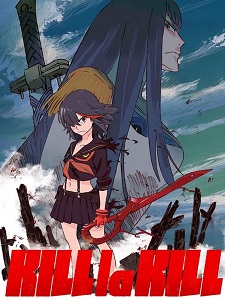
Kill la Kill takes this idea but applies it to clothing. In reality, they are actually aliens called Life Fibres but they appear as clothing and can be worn by humans giving them powers. It’s a unique take I haven’t seen before and cleverly done as this anime series has “clothing” related themes throughout. For example, the main character, Ryuko Matoi wields a sword that looks like one-half of a pair of scissors. Another example is the organisation seeking to stop the Life Fibres are known as ‘Nudist Beach’ (a clear message against those that wear the parasitic aliens as clothing, and the first time I’ve heard of a paramilitary organisation coined with such a name; a title that is both funny and meaningful).

The art is spectacular and creates a world that has a unique style in anime circles. It’s almost as if artist, Ryō Akizuki, combines traditional anime elements with Looney Tunes creating a funky hybrid that is appealing to the eye. Playful, comedic, complex, gripping, action-packed, sexy are all adjectives you could use to describe the art in Kill la Kill.

Ryuko is hunting for her father’s killer and attends a high school that has a social hierarchical structure based on what ‘Goku uniforms’ (uniforms made of Life Fibres) are won by the students. Higher rank comes with more powerful Goku uniforms.

The story is somewhat convoluted as Ryuko initially believes that the person responsible for her father’s death is Satsuki Kiryuin (the president of the high school student council). She challenges Satsuki and enters a battle royale against various elite students (wearing more and more powerful Goku uniforms). So far so good.

But later it is revealed that it is actually Nui Harime (a member of a global corporation known as REVOCS seeking to take over the world with the parasitic aliens and destroy Nudist Beach) who killed Ryuko’s father. REVOCS also happens to be run by Satsuki’s mother, Ragyo. Ragyo is the true mastermind here, her mission to become one with the primordial Life Fibre and take over earth with all humans being consumed by the alien clothing.

It also happens that Satsuki has a vendetta against her mother and has been scheming for Ragyo’s downfall. The reason for this is that Satsuki knows that Ragyo experimented on her father and younger sister and wishes to avenge their deaths. Do you see the connection?

Yes, Ryuko is actually the younger sister that Satsuki believes to have died. Both realise their goals are one and the same. That is, avenge their father’s death at the hands of Nui Harime who was ordered to kill him by their mother, Ragyo. See, I told you it was convoluted.

The story, while complex, will still have you wanting to binge the next episode. The characters are all unique and colourful, the art is killer, and it all comes together in a final scene to stop Ragyo from causing humankind’s extinction. Crazy and fun.

8.5 out of 10

Movie Review: Wrath of Man (2021)

TL;DR – a character driven film elevated by outstanding action sequences and a solid supporting cast but let down by a script and lead actor that doesn’t deliver on the depth required to elevate the film beyond what is essentially a straight forward revenge flick.

Review (warning: spoilers)

Patrick Hill (Jason Statham) is a serious fellow who looks capable of freezing hell over by just looking at you. It is the type of role that Jason Statham excels at and does not require a wide range of emotion. He is sadly typecast, so if you have seen his previous films, you know that his character will be one-dimensional. But then again, that is probably why audiences watch him. They know what to expect like ordering a burger from McDonalds.

When Hill applies for a job at Fortico Security (an armoured truck company based in Los Angeles) and he barely passes the training and tests, such as firing a gun at a target, you have no doubt that it is all a ruse because it is Jason Statham. Why he undersells his capabilities is the question that the viewers will ask themselves, but they don’t have to wait long before Hill unleashes his wrath in merciless precision by foiling a robbery.

The strength of the film is not in its lead actor. The stoic, no-nonsense character of Patrick Hill is revealed to be a tormented soul, but Statham takes on the role like he is half bored and making any sense of emotional turmoil bland.

No, the strength of the film comes from the supporting cast and Director Guy Ritchie’s measured approach to telling the story.

The supporting cast around Hill comprises of Haiden (the excellent Holt McCallany from TV series fame Mindhunter) who is Hill’s trainer; Dave (Josh Hartnett) who shows not everyone is cut out to be a security guard; Dana (Niamh Algar), the only female guard with an understandable large chip on her shoulder; Terry (Eddie Marsan), Fortico’s head of operations; and FBI Agent King (Andy Garcia). They all bring much needed depth to the film and show the risks of the job they do (driving around in armoured trucks and picking up and delivering money) is not necessarily worth the paycheck. Note: Garcia’s FBI agent does not work at Fortico but is an important ingredient in why Hill is allowed to go berserk in Los Angeles.

But the cast does not stop there. Ritchie tells a story that also examines the antagonists and provides their back stories also. In this case, it is the robbers, a bunch of ex-military veterans unhappy with eking out a living that barely supports their families, disgruntled at having served their country and getting nothing in return, and wanting to hit paydirt by conducting various heists. This group is led by Jackson (Jeffrey Donovan) and their robberies are meticulously planned beforehand showing a level of detail that is often glossed over in other films involving theft. Jackson instils a prerogative that their heists must not involve any killing. This, of course, is impossible when one of their members, Jan (Scott Eastwood), is clearly a loose cannon.

The story is told in four parts and jumps between past and present events to reveal who the enigmatic Patrick Hill actually is and what he is seeking to achieve as his end goal. In short, he’s a powerful crime lord, whose son is killed during a heist of a Fortico truck planned by Jackson and his team. Jan (the loose cannon) is the man responsible for killing the kid. The rest is all predictable as Hill goes on revenge mode piecing together the people responsible for his son’s death by going “undercover” and working at Fortico.

The action sequences are blood pumping and Ritchie has a real eye for detail and atmosphere. But for all its strengths, it is still let down by a lead actor that doesn’t bring enough gravitas for you to care about his plight (you know he’s going to get his revenge). I often wonder if they had cast an actor with more emotional range whether this could have turned into a far more existential crisis type film rather than a straight action movie. But perhaps that was all Ritchie was after. The film is also not helped by a script that lacks a level of dialogue that allows you to invest more fully in the lead. But again, Statham is not known for espousing long diatribes or waxing lyrical the consequences of choosing a life as a crime lord.

Still there is enough in here that makes the film enjoyable and a notch above other action movies.

7.5 out of 10

Book Review: The Nowhere Child by Christian White

TL;DR – mystery crime about a two-year old gone missing, a family with dark secrets and a religious fundamentalist snake handling group. Past and present revealed chapter by chapter until they collide.

Summary (warning: spoilers)

Kimberley Leamy lives in Melbourne, Australia and teaches photography. She is approached one day by a man who claims she is actually Sammy Went, a child who went missing twenty-six years earlier from Manson, Kentucky. The whole idea sounds absurd, especially when the memories of her childhood were generally happy, and she was raised by loving parents, Carol and Dean. However, when evidence is presented to her, she begins to doubt Carol and Dean are her biological parents and undertakes a journey to uncover her true origins.

Review

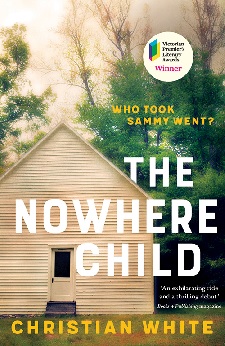
Christian White’s debut novel won the Victorian Premier’s Literary Award and is a gripping tale that alternates chapters between past and present to fill in the mystery behind the abduction and sudden disappearance of Sammy Went. It is a clever story if a bit convoluted, and White is adept at keeping the reader on course by tying you emotionally into Kimberley’s search for the truth and her own identity.

Travelling to America, she discovers a world completely different to the one she has lived for most of her life in Australia. And when it is revealed a Pentecostal fundamentalist group known as The Church of the Light Within is involved and part of their worship involves the handling of snakes, you know that things are going to get a little dark. The idea of snake handling is to demonstrate one’s faith and that you should be able to handle deadly snakes without being harmed. This also involves drinking snake venom and the individual not being poisoned.

Combining snake handling with the secrets being hidden by Kimberley’s biological family, you will find yourself turning the pages easily enough in a desire to see out Kimberley’s fate. It is a decent read though I would recommend The Wife and The Widow over this one. The last half of The Nowhere Child not delivering the thrills that the first half seeks to build up.

3 out of 5.

Anime Review: Kiki’s Delivery Service (1989)

TL;DR – A coming-of-age story about a witch looking to find her place and purpose.

Review (warning: spoilers)

Kiki’s delivery service delivers more than mail and packages by broomstick. It brings a lot of heart and charm. In a world where people accept the existence of witches, not as terrifying or evil creatures but as human beings that can perform magical feats, Director Miyazaki demonstrates his full capabilities in telling an engaging story without the age-old trope of good versus evil. In the world of Kiki, there is no Voldemort, or Sauron, or Maleficent. The ability to conjure magic or fly a broomstick is to serve humanity.

Kiki’s mother is an alchemist who can create potions which can heal or cure illnesses. Kiki bumps into another budding witch who has become a fortune teller. They live among the rest of us non-magical folk and seek to find their purpose. In this way, Miyazaki tells a story that is more akin to Tonari no Totoro rather than Howl’s Moving Castle. He weaves a film that is utterly enjoyable in its simplicity.

When Kiki comes of age, she sets out with her black cat, Jiji and settles in a bustling town trying to plant her own roots and obtain her own identity. For a witch, she doesn’t seem to exhibit any special magical ability other than being able to fly a broomstick (not very well) and communicate to her cat who talks back to her and gives droll observations about her attempts to achieve independence.

Eventually, she sets up a postal delivery service in a bakery, delivers packages small and large, and along the way meets a variety of people young and old. One of the people she meets is a boy named Tombo, who has a fascination with flying and wants to one day fly as a pilot. Initially, Kiki is not all that drawn to him and acts aloof. But his persistence slowly pays off, and they become friends.

I expected that, by the end, their friendship would grow into a stronger attraction, but Miyazaki subverts this, and the film is all the better for it. Instead, the climatic scene is one driven by Kiki overcoming her own inadequacies (including the fear that she is losing her magical powers) to save Tombo out of the desire that it is the right thing to do, and he is her friend. Nothing more. Again, it is the power of simplicity in the storytelling. The distinct artistic style of Miyazaki’s films combined with a European setting creates an atmosphere that is both familiar and beautiful. It reminded me a lot of the backdrops and landscapes used in Porco Rosso, which was set in Italy.

One particular scene where Kiki is sitting on the back of Tombo’s bike, which has been modified to have an airplane propeller connected to the front and spun by using pedals is truly magical without having an ounce of witchcraft involved (at least, not until they almost crash). It is one of those scenes that reminds me of the creative and imaginative powers of the young, which should be encouraged rather than stamped out as immature. It is as if Miyazaki is saying that we should all dream, think outside of the box, and find what we are truly passionate about.

Kiki’s Delivery Service delivers a heartfelt tale about perseverance and the transformative and challenging time of growing from child to adult. Watch it and be inspired.

9 out of 10

Movie Review: The Social Dilemma (2020)

TL;DR – you are the product, your time and attention is what you pay. What you choose to do with this currency is up to you, but certainly this film depicts a side of tech giants that shows they are very good at convincing you to use your currency on them.

Review (warning: spoilers)

There are two sides to social networking through technology. Two sides that present a picture to the pros and cons surrounding social networking tools such as Facebook, Instagram, TikTok, YouTube, Pinterest, Twitter etc.

On one side, there is this idea that this technology allows people to connect no matter where they are in the world. It allows people to share stories, to stay in touch, to provide information and to encourage each other on whatever journey they may be undertaking. There is a lot of inspirational contributions on social media that brings hope, joy, and a sense that we are not only connected but we can be there for each other.

On the other side, there is this corporate war being waged between tech giants to have your time and attention given only to them. Why? To make money. The longer and more frequent a social platform can consume your time, the more advertisements they can show you, the more chance they have in monetising your attention. And then there is the use of social media to tear down rather than build up. Dissemination of misinformation, the anonymity of trolls and hate speech, and the potential addiction from needing validation through social media “likes” or “hearts” or “shares” has seen an increase statistically in mental health issues resulting in self-harm or suicide.

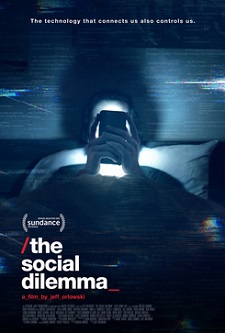
The Social Dilemma directed by Jeff Orlowski focuses on the negative side. It is a docudrama that, in my opinion, is essential viewing to at least get you to think about what social networks and platforms seek to do. It presents a convincing argument that there is a problem by conducting interviews of individuals that have held significant positions in these tech companies. The ways in which programmers develop algorithms to learn from what you like and then funnel you down a rabbit hole to keep you on that platform or application is alarming. The fact that The Social Dilemma was released on Netflix, which uses the same techniques to keep you watching their streaming service, is an irony not lost on me.

The ability to switch off is becoming more and more difficult especially for young, developing minds in the teenage bracket.

Suffice to say, like most things in life, anything done in excess is usually not a good thing. How you achieve a balance is key to a healthy life in mind, body and spirit. Note, I didn’t say “happy” healthy life. For facing sadness, anger, disappointment and the range of other human emotions is part of life. How we acknowledge our humanity and the spectrum of feelings is critical to growth. The Social Dilemma shows that like any addiction, being addicted to social media is unhealthy.

Where I felt the film falls short is providing ways to achieve balance. Many of those interviewed simply say to delete the app, and go outside and take a walk in a park. I don’t think it is that simple. It is like saying to an alcoholic to throw away all their liquor and never go into a bar, or a gambling addict to ignore poker machines and casinos. If it was simply a matter of will then addictions would never be a problem.

Still The Social Dilemma delves deep enough to present a case that addiction to social media (or even addiction to technology for that matter) is a real issue and can have deep adverse effects to a person’s mental well-being. In a world where we are surrounded more and more by technology, this film is a must watch.

And on that note, I’m going to hop off my computer and go outside for a walk.

8.5 out of 10

Book Review: The Elements of Eloquence by Mark Forsyth

TL;DR – no one ever talks about the language unless you are Mark Forsyth.

Summary (warning: spoilers)

An essential (I repeat essential) book for every writer, budding author, lyricist/songwriter, screenwriter or individual who is curious about what makes a phrase stand out from another. A writer without this book is like a pianist without a piano.

Review

Mark Forsyth has gone to the effort of demystifying how the greatest writers write. What makes a convincing argument? How did the masters of rhetoric (e.g. Greek philosophers, American presidents, famous musicians like The Beatles etc.) capture audiences and have them listening to their every word? Why is Shakespeare considered the greatest playwright in the English language?

Did they have angels (or demons) on their shoulders whispering turns of phrase into their ears? Did some higher power bestow upon them a gift greater than the gab? Or were they all individuals of destiny guided by a clarity of purpose that was beyond us mere mortals?

The answer is no.

It is none of these things. Forsyth not only breaks down the tools that makes a sentence eloquent, but he demonstrates that even, what the world considers, the greatest writer that ever lived in Shakespeare came about his creations through the in-depth study of formal rhetoric.

From alliteration to hyperbole to anaphora, Forsyth is able to summarise each and every one of these tools and provide a plethora of examples to demonstrate its effectiveness.

For example, an epistrophe is the repetition of words at the end of consecutive sentences for emphasis. The Pulitzer prize-winning Grapes of Wrath by John Steinbeck uses this technique:

“Wherever there’s a fight so hungry people can eat, I’ll be there. Wherever there’s a cop beating up a guy, I’ll be there. […] And when our folk eat the stuff they raise and live in the houses they build – why, I’ll be there.”

Forsyth does much more than explain these tools to the reader. One would think dissecting passages from great works would be a dry topic, and understanding the difference between polyptoton and antanaclasis would not aid in one’s writing but instead just give you a mild headache. But what Forsyth does is he explains these tools not only in an accessible way but also with humour.

It is a genius piece of work and actually gives hope to anyone looking to tell a story and get published. I cannot recommend this book any more highly.

5 out of 5.

Anime Review: Chihayafuru Season 1 (2011)

TL;DR – a friendship triangle turns somewhat into a love triangle and examines three childhood friends who enter high school connected by a card game called karuta. This is one to watch.

Review (warning: spoilers)

Quick history lesson. Playing cards were first introduced into Japan by Portuguese traders in the 16th century. The first incarnation of karuta was at the end of that century and since then there have been various transformations and versions of the game.

The version that is central to this anime, I believe, is called ‘Uta-garuta’ and involves two decks of one hundred cards each. One deck (known as the ‘reading cards’) depicts a person, their name and a complete poem. The second deck (known as the ‘grabbing cards’) only have the finishing phrase of the poem on it.

The basic way to play involves two people facing each other, who shuffle and lay out the grabbing cards face up in front of them. A third person uses the reading cards and starts reading out loud the poem. The two competitors attempt to locate the card that matches the poem being read out loud as quickly as possible and grabs it (they only need to touch the card first even if it is only with their fingernail). The player that removes all the cards on their side first wins. There are other rules involved such as if you manage to take a card from your opponent’s side, you can then give one of your cards to them on your side (thus reducing the number you need to clear on your side).

The main protagonist is Chihaya Ayase, an athletic, pretty high school student seeking to form a karuta club. She is a bit ditzy, still charming, who has a karuta obsession. Her obsession came about when she met Arata Wataya in elementary school and discovered the shy boy is an expert at playing karuta and dreams of one day becoming a grandmaster. The third main character in this triangle is Taichi Mashima, a talented, smart, and good-looking boy who also knows Chihaya since elementary school. Events transpire during the elementary school years that places friendships in jeopardy and Taichi on the outside looking in at the bond Chihaya develops with Arata. This spurs him into becoming good at karuta also.

Season one surrounds Chihaya’s goal to form a karuta club and the connection between her, Arata and Taichi. Having never heard of karuta prior to watching this anime, I was surprised at how exciting, tense, and beautiful the game is. Initially, I expected it to be like chess. A mental sport requiring each player to think ahead and achieve checkmate. But karuta requires elements of physical skill and speed that needs to be seen in order to fully appreciate. The anime is accurate in its depictions of how competitive karuta is played in real life, and the methods and movements to secure cards as quickly as possible is spot on. The fact the game also centres on the reading out of poetry and understanding the various inflections of words and memorising as well as hearing those inflections in order to get an advantage over your opponent raises the game’s intensity. Understanding card placement (and memorising that placement) is one skill, listening for the syllables to keywords in the poem is another skill, and then combining them to have the ability to swipe your hand first over the correct card is far more gripping than a lot of other sports I have watched (yes, cricket I’m looking at you).

The anime is interesting enough around the game, but it is elevated due to the characters and their relationships with each other. It is clear early on that Taichi’s feelings for Chihaya is more than friendship, and his actions initially to push Arata away from Chihaya backfires and makes him realise he is being a coward. He then spends much of his time trying to do the right thing and even sacrificing his own emotions to make Chihaya happy.

Arata also goes through changes and struggles, even at one point wanting to sever any friendship he has with Chihaya and Taichi because he gives up on his dream and stops playing karuta.

It is Chihaya and their love for karuta that brings them together.

Season one of Chihayafuru is fascinating slice-of-life/sports hybrid that I devoured in record time. Creator Yuki Suetsugu has done something special here. You will not regret putting this at the top of your anime to watch list.

9 out of 10

Movie Review: Cruella (2021)

TL;DR – the origin story of Cruella de Vil shows the apple never falls far from the tree.

Review (warning: spoilers)

Disney’s track record of doing real life adaptions of their classic animated films has been a sad endeavour in milking the cash cow for all its worth. On the rare occasion, they’ve achieved some semblance of distinction that separates the adaption from the animated classic. Kenneth Branaugh’s Cinderella, Tim Burton’s Alice in Wonderland and Jon Favreau’s The Jungle Book come to mind. But other real life versions such as Aladdin, Beauty and the Beast, Lion King, and Mulan were pale (and at times dreadful) imitations of their animated counterparts. There’s a reason why they’re considered classics in animated form, and I daresay that Walt Disney would be turning in his grave (or his cryogenic chamber) if he knew this was happening.

Disney achieved some level of success (and originality) by doing a real life adaption of an animated classic but telling the story from the view of the main antagonist. Maleficent (real life adaption of Sleeping Beauty) demonstrated the potential of this approach with Angelina Jolie as the title character. The movie achieved enough success that a sequel Maleficent: Mistress of Evil was made. Both films I enjoyed.

Cruella is meant to be a real life adaption of the animated film 101 Dalmations but told from the main antagonist, and while the focus is on Cruella rather than the dogs, the story is not at all like the animated version. In fact, Disney already did a real life adaption of 101 Dalmations using the same title, released in 1996 and starring Glenn Close as Cruella.

This 2021 release does not repeat the 1996 version and swap Glenn Close with Emma Stone. Cruella is an origin story and far better off doing so as a result.

The story begins with Estella Miller (Tipper Seifert-Cleveland), a precocious child with black and white hair, a penchant for fashion and a loving mother, Catherine (Emily Beecham). They move to London where Catherine attends a party of a wealthy woman simply known as the Baroness (Emma Thompson) and there Catherine seeks financial assistance. Things take a turn for the worse when Estella witnesses her mother attacked by the Baroness’s Dalmatians, who push her off a balcony overhanging a cliff into the sea. Estella believes it is her fault that her mother dies as she was told to stay in the car but instead snuck into the party and causing a ruckus that resulted her being chased by the Dalmatians.

Fast forward a decade and an adult Estella (Emma Stone) is making ends meet as a thief on the streets of London. She tries to turn her life around by working in fashion and eventually gets hired by the Baroness who turns out to be a haute couture fashion designer and considered the best in London. Under the Baroness’s employ, Estella discovers that it was actually the Baroness who was responsible for Catherine’s death. And thus Estella’s alter ego, Cruella is born.

Emma Stone is in fine form and provides layers for what was depicted as a one-dimensional character in the animated version. The switching between Estella and Cruella is fascinating to see and Stone embraces the role. One moment, she’s Estella, employee to the Baroness, plotting her revenge, giving strained smiles and hiding her anger. The next she is Cruella, fashion designer rival upstaging the Baroness and wanting to destroy the woman responsible for her mother’s death.

The movie, however, would be nothing without the other Emma. For Emma Thompson is nothing short of brilliant as the Baroness, a tyrannical figure, who takes narcissism to unheard of heights. Every word out of her mouth drips with venom. Her viper-like rebukes at her workers, her inability to give praise even to her most loyal subjects, and her uncompromising focus to be the dictator and ruler of the fashion design industry is both savage and funny.

It is Cruella versus Baroness, Emma versus Emma and lifts the film beyond the mundane and mediocre. Their desire to outwit each other, to outdo each other on the fashion stage is a delight to see, and when the reveal of the story finally unveils, it is not so much a twist as a small smile acknowledging that it all makes sense.

The only drawback is perhaps the film runs a little too long, but this is a small quip when you get to witness two actresses unleashing the peak of their powers on screen. A Disney delight.

9 out of 10

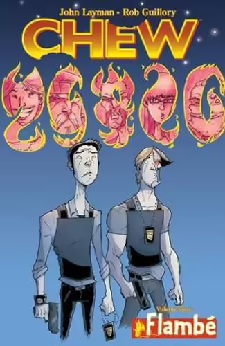
Book Review: Chew (Volume Four) “Flambe” by John Layman and Rob Guillory

TL;DR – In the aftermath of fiery alien writing appearing in the sky, the prohibition on poultry no longer seems a priority, but Tony Chu still has a job to do.

Summary (warning: spoilers)

Go to my book reviews page to see what has happened in previous volumes of this award winning graphic novel series. Volume Four begins with a flashback of a thriving chicken fast food industry and then the events of an avian flu that wiped out millions and resulted in the subsequent prohibition on cooking/dining/eating poultry.

Moving to present day and the appearance of fiery alien writing encircling the globe, and the population is no longer concerned with a poultry prohibition. Instead, everyone is focused on what the writing means. Is it first contact with an alien species? Is it an act of God indicating the end is nigh? Or something else entirely? The general agreement is that whatever the writing means, it isn’t good.

FDA Agent Tony Chu is still doing his job, investigating crimes related to food, but with government funds all now being poured into NASA to try and figure out the alien writing, enforcement of the poultry prohibition is taking a back seat.

Review

Chew Flambe begins to reveal more of Tony’s family, and building upon the introduction of the Chu household seen at the end of Volume Three (Chew Just Desserts). Specifically, Olive Chu (Tony’s estranged daugther) and Toni Chu (NASA special agent and Tony’s twin sister). The mystery of the alien writing is now at the forefront of this story arc and triggers many to react in different ways.

Chapter 1 has Tony hunting down an FDA agent that has gone AWOL by the name of Daniel Migdalo, who is a Voresophic (an individual with the power to look at pictures and give detailed historical profiles of the individuals in the pictures. He also needs to consume large amounts of food to fuel this cognitive/psychic power). Since the appearance of the alien writing, Daniel has gone off grid. When Tony finds him, he’s become ridiculously obese and has gone mad, continually spouting mathematical formulas, which one would have to think is reaction to seeing the alien writing. Whatever Daniel is trying to say is never understood as he attacks Tony only to lunge at a pack of mints which Tony throws out the apartment window. This results in Daniel going splat on the street below and killing himself.

Chapter 2 focuses on a nerd student (who has experienced constant bullying) at a school that Olive also attends. Said nerd has concocted some sort of drug that he puts in food and makes the person who consumes it do what he says. This results in the nerd getting revenge on the students who bullied him by inciting a food fight that ends in a blood bath of thrown cleavers, stabbing of forks and knives, and smashing of metal chairs over heads. Tony comes in to apprehend the nerd from blowing up the school.

Chapter 3 sees Tony and his partner, John Colby, joining a suicide mission to stop a mad General who has developed a bio-weapon that mimics what the avian flu did three decades ago. The reintroduction of the killer rooster Poyo is both hilarious and alarming.

Chapter 4 has Tony working with his twin sister, Toni, as they investigate Area 51 and bust a scientist making bullets from the metals of meteors. And the final Chapter involves Tony and John going undercover to get information on a cult that worships eggs and foretold the alien writing would come.

Throw in Mason Savoy who kidnaps Olive and a chunk of the earth disappearing (yes, literally going poof) and you can see there’s plenty to read in Chew Flambe. Lots go on and nothing is revealed as to the mystery of the alien writing that pervades in the sky. It’s a collection of stories of how people have reacted to it and how the world is devolving. The cliff hanger ending has ensured I will continue reading on in this excellent and weird series.

What has Savoy got in store for Olive? What is the explanation behind the alien writing? The various individuals that have powers connected to food still appears to all tie into this underlying mystery. Bring on the next volume!

4 out of 5.