Movie Review: Unhinged (2020)

TL;DR – we have all felt that tipping point while driving on the road. Someone cuts in front of you, or changes lanes without indicating, or drives slowly when you are running late for an appointment. You boil over, honk your horn, and/or start swearing at the other driver. Now imagine you do that to a driver who turns out to be a psychopath…

Review (warning: spoilers)

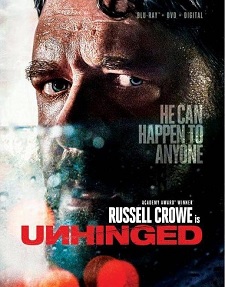
Nothing complicated or deep about this film. Tom Cooper (Russell Crowe) is introduced at the beginning of the film sitting in his truck outside his ex-wife’s house. It’s night time, he lights a match and stares at it as if trying to decipher the meaning of the universe when in reality he’s only thinking about how much he wants to see the world burn. And burn it does…

He gets out of his truck with a hammer and a gasoline tank and proceeds to barge into his ex-wife’s house murdering her and her husband before lighting the whole place up.

Dawn of a new day? You can hope but you know deep down this will not be the case.

Instead, the next day, we follow single mother, Rachel Flynn (Caren Pistorius) and her son, Kyle (Gabriel Bateman) stuck in gridlock. Rachel is running late for work and has to drop his son off at school. Things go downhill when she receives a phone call from a client and is fired for her tardiness. When they reach an intersection and the light turns green, Rachel is astounded that the truck in front of her is not moving. She honks her horn and you know it will all escalate into bloody mayhem from there.

It is a by the numbers thriller that does not deviate from what it seeks to deliver: car chases, brutal violence, tense stand-offs, manipulative actions and a climatic final scene where Tom wants to drag Rachel and Kyle into hell with him.

The main cast are all on par, especially Crowe who plays the psychopath with that restrained fury that makes you wonder when he’s going to blow and how. He does it well with the less is more and there are brief moments where you might actually feel sorry for his character, Tom. For example, after being honked for not moving at the green light, Tom drives up alongside Rachel and asks if they can ‘reset’ and seeks to apologise. In turn, he asks her to apologise but Rachel refuses saying she did nothing wrong. Bad decision, Rachel, very bad decision.

Bodies fly, loved ones are kidnapped, and there is plenty of gruesome, bloody action. This is a film that delivers on atmosphere and thrills rather than provide any meaningful insight. The only message being the next time you feel road rage, take a deep breath.

6.5 out of 10

Book Review: Thunderhead (Book 2 of Arc of a Scythe Series) by Neal Shusterman

TL;DR – The Scythedom is experiencing internal politics between two groups; one that wishes to move away from the old laws surrounding how they glean and the other that seeks to uphold the established principles. There is much afoot including Citra who is causing quite a stir with her revolutionary approach to gleaning and the ongoing hunt for Rowan who is targeting Scythes he deems as corrupt. All the while, the Thunderhead seeks a way forward for humanity.

Summary (warning: spoilers)

For my review of Scythe (Book 1 of Arc of a Scythe series) by Neal Shusterman, and what has happened previously please click here.

When last we read about Citra and Rowan, they both started journeys down different paths. Citra is now Scythe Anastasia. Though she does not see herself as any kind of revolutionary, her approach to gleaning is a significant leap outside of how scythes normally operate. While most scythes execute their duties in efficient and no warning type fashion, Citra gives those she chooses to be gleaned one month to get their affairs in order and to express how they wish to be gleaned. This causes quite a stir among the Scythedom and is of particular interest to the Thunderhead (the all-seeing artificial intelligence in the cloud), who monitors closely all of Citra’s movements.

Rowan’s path is less one that he has chosen and more one that has been forced upon him. Calling himself Scythe Lucifer, he seeks to weed out corrupt scythes and is a ‘most wanted’ figure by the Scythedom. Going rogue is tough business and as such he has to stay under the radar. But Thunderhead sees all and is also monitoring Rowan’s actions too.

Enter Greyson Tolliver, a person essentially raised by the Thunderhead, who wants to give back not only to humanity but to the Thunderhead himself… herself… er… itself. He feels compelled to become a Nimbus agent (the Thunderhead’s human counterparts that operate out of the Office of the Authority Interface (OAI) in regions all around the world and who help maintain a state of order). He enrols in the Nimbus Academy as a student to go through all the necessary courses and training to become an agent. His life is mapped out and on track. That is, until he gets called into the OAI headquarters and has a strange conversation with an Agent Traxler. A conversation that will change his life.

Review

Chapter 8 of the Thunderhead makes it clear in black and white: “The Thunderhead was power without hubris”. It is an interesting idea given we, as humans, have been designed with an instinct that centres around fight or flight. Our existence has survived the centuries because we are built with a defence mechanism. When confronted with a potential danger, our survival instinct will kick in and assess the situation that will drive us to either fight or flight.

To varying degrees this extends to how we live today. From crossing the road at a busy intersection to making business deals or buying/selling stocks to living in a country torn by war, our mind and instincts assess risks and make choices based on accepting or not accepting those risks.

When it comes to technology, there are many people who have a genuine fear of it. Aptly named ‘technophobia’, some have an inherent mistrust in advanced technology; the reasons are varied and complex. So to imagine an artificial intelligence that has achieved consciousness that has no guile, no malice, and no agenda other than to care for humanity sounds like an impossible idea. But that is what Neal Shusterman imagines when he refers to the Thunderhead in the ‘Arc of a Scythe’ series.

It is an impressive achievement for the Thunderhead becomes an integral character that is explored in book two of this stunning trilogy. The world is without death and disease and everyone can rely on the Thunderhead to serve and help them. In fact, at any point in time, the Thunderhead can communicate to a billion people simultaneously and it will not tax its resources (to the individual, it will feel like the Thunderhead is only talking to them). There is no ability for the Thunderhead to be corrupted by the power it wields.

Even those individuals who wish to rebel against the establishment, who want nothing to do with the Thunderhead, and seek to disrupt the Utopian society (and/or break the law) are unable to do anything significant because the Thunderhead is aware of such plans ahead of time and are caught. The Thunderhead labels these individuals as ‘unsavory’, who meet with human peace officers weekly and are unable to communicate to the Thunderhead.

The Thunderhead is not so much a ruler as it is a facilitator to assist humans in living their lives. However, there is one area that the Thunderhead cannot intervene and that is in relation to the Scythedom. An organisation with the responsibility to cull human population to ensure overpopulation does not become a problem.

This is the trigger that drives the story in book two because when the Thunderhead becomes aware that there is a plot involving the assassination of Citra and her teacher, Scythe Curie, it cannot intercede as it has no jurisdiction over Scythe affairs. In fact, the Thunderhead goes to great lengths by instructing Nimbus Agent Traxler to meet with Nimbus Academy freshman Greyson Tolliver and reiterate the rules between the Scythedom and the Thunderhead. Agent Traxler goes so far as to say that even if the Thunderhead became aware of a plot to murder Citra and Curie, it would not be able to do anything. Further, should a Nimbus agent (or even say an Academy freshman) were to take matters into their own hands and meddle with Scythe affairs then the Thunderhead would have no choice but to impose penalties on such an individual.

In this way, Greyson is informed of a potential plot and being (indirectly) asked to act without being (directly) asked to act. The Thunderhead has done nothing to breach its laws, but it understands who Greyson is and how he will react. In the end, it is Greyson’s choice whether to act on this information. And we, as the reader, knows he will.

Much to his dismay, even though Greyson saves Citra and Curie from being killed, he is marked unsavory for his actions by the Thunderhead and can no longer converse with it.

What follows are a series of events surrounding all the main cast from book one and now including Greyson, the Tonists (a post-mortal religious group), and the search for an island that supposedly contains a fail-safe in the event the Scythedom go off the rails.

The middle book in trilogies can sometimes be challenging, but Shusterman has somehow written a second book that exceeds the first. The ending of book two blew my mind.

And I am not talking about the climactic scene at Endura involving the wiping out of a whole heap of Scythes including the leadership in the Grandslayers.

I am also not talking about the eventual death of Scythe Curie and what appears to be the final curtain coming down on Citra and Rowan.

I am talking about the Thunderhead’s reaction and what happens to Greyson at the very end. I know this review has spoilers, but I cannot bring myself to spoil that by revealing what happens. You will have to read it yourself.

Mind… blown…

5 out of 5.

Anime Review: Great Pretender (2020)

TL;DR – a group of con artists work together undertaking heists all around the world, and in the process, revealing pasts that seek to catch up with them.

Review (warning: spoilers)

Wit Studio is on a roll. One would think that being a relative newcomer on the anime scene (they were founded in 2012) they would need some time to build an audience. However, they have a significant leg up because they are actually a subsidiary of IG Port and producers from their other subsidiary anime studio, Production I.G, founded Wit Studio. Production I.G was founded in 1987 and has a long history of churning out quality anime series, OVAs, and films.

So, when Wit Studio, released their first anime series in 2013 and it turned out to be Attack on Titan, it should have been no surprise that the series was a local and international hit. In between generating the first three seasons of Attack on Titan they also released several other series including Vinland Saga and After the Rain.

In 2020, Wit Studio released two new anime series – GARUGAKU. Saint Girls Square Academy and Great Pretender. I have not seen GARUGAKU but from the limited reviews it appears to have rated poorly. It may be because the series is aimed at young children and each episode is only three minutes long.

On the other hand, Great Pretender has been a critical success and lauded for its animation style and music. But what about the plot?

The story revolves around a group of con artists and is broken up into four arcs:

  • Case 1 – Los Angeles Connection (episodes 1-5)
  • Case 2 – Singapore Sky (episodes 6-10)
  • Case 3 – Snow of London (episodes 11-14)
  • Case 4 – Wizard of Far East (episodes 15-23)

The four main characters are Makoto Edamura, Laurent Thierry, Abigail Jones, and Cynthia Moore. Edamua is a small-time Japanese con-man who gets roped into working with Laurent, a French con-man who masterminds the group’s heists. Abigail is Laurent’s right-hand, physically skilled and guarded about who she is. Cynthia was a stage actress and works in Laurent’s team using her feminine wiles and acting skills to win over and influence targets.

While the heists themselves are interesting and introduces a cast of colourful individuals ranging from a movie director who is actually a drug lord, to a pair of Arab oil-tycoon brothers who operate a rigged racing airplane tournament, to a dodgy English art appraiser, and finally a Shanghai mafia boss that are all targeted by Laurent, it is the four main characters that lift the story.

This is done cleverly by exploring the pasts of each one during each case. Case 1 focuses on Edamura, Case 2 on Abigail, Case 3 on Cynthia and Case 4 on Laurent (Case 4 also progresses Edamura’s story-line as it crosses over with Laurent’s).

It is this exploration that is fascinating and leads to an understanding for the viewer as to how each one came to be a con-artist. Tragedy, heartbreak, betrayal, and violence all feature to varying degrees, and it is their histories combined with the present day tie-in to the heist they deal with that makes Great Pretender a notch above other anime series.

Case 3 – Snow of London which focuses on Cynthia is a particular standout for me. I thoroughly enjoyed her character and her backstory is fascinating.

However, for all its strengths (i.e. music, character development, animation (the colours and artistic style are outstanding) and intriguing back stories) the series trips over at the end.

Yes, it is the final act surrounding Laurent where things unraveled for me. While the Edamura storyline concludes in a satisfying way, Laurent’s story (which arguably is the most intriguing) turns a bit silly. Each heist has a bit of twist. The final heist involves twists that turn into knots that ruin the sense of harmony and integrity of the group

Firstly, all the ‘villains’ in the previous cases end up assisting Laurent. In fact, we find them sitting on a luxury yacht (when they should all be serving time in prison) playing cards and drinking. These ‘villains’ now apparently helping the group of con-artists and are friends when logic dictates that each ‘villain’ would want revenge and has a serious vendetta against Laurent and his crew. This leap in the story was totally illogical to me.

Secondly, the final case involves staging a con that requires a fake building on a remote island that collapses when the con is revealed. Not so much far-fetched as it is less sophisticated than what the twists/reveals are in previous heists.

Lastly, it is revealed that a critical event in Laurent’s past is actually not completely true. This event is so pivotal that it is the sole reason why he is sent down the path he takes of being the ultimate con-artist. The event surrounds a woman named Dorothy, the woman responsible for teaching Laurent the skills to be a con-artist and who he falls in love with (they eventually get engaged). However, she gets killed during a con in front of Laurent driving him into depression with only the ring she wore around her neck to remember her by (the ring is a motif used periodically throughout the entire series).

Once the final case is over, Laurent throws the ring into the sea as a way of closure and satisfying himself that he has avenged Dorothy’s murder. However, in the epilogue it is revealed that Dorothy is alive, has amnesia, and finds the ring after it was swallowed by a fish and caught by fishermen. She then puts on the ring and the series ends.

I have mixed feelings about this final reveal, on one hand it allows for a sequel to the Great Pretender to be developed. On the other hand, the story was far more effective and emotionally moving if Dorothy actually was killed.

Still, even with the flawed final act, the series is plentiful in many other ways that makes it a must-watch on your anime list.

8 out of 10

Movie Review: Shang-Chi and the Legend of the Ten Rings (2021)

TL;DR – origin film of the first Asian superhero in the Marvel Cinematic Universe.

Review (warning: spoilers)

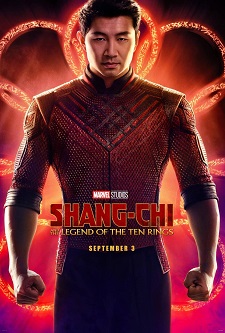
Arguably the first Asian superhero is Wong (Benedict Wong), a powerful sorcerer of the mystic arts who we first see in Doctor Strange. But Shang-Chi (Simu Liu) is the first Asian superhero that is the main character of the film.

The film opens introducing Xu Wenwu (the excellent Tony Leung) who discovered the mystical ten rings thousands of years ago, granting him immortal life and tremendous powers. The narrator reveals that the rings could have been used as a force for good but instead Wenwu uses it to create a criminal organisation called the “Ten Rings” and is the actual force that resulted in governments collapsing throughout history and becoming a god-like figure ruling over a global criminal empire.

Unlike other crime lords, Wenwu appears happy to remain in the shadows and reaches a point where he seeks to simply acquire more power. This leads him to search for a legendary village known as Ta Lo that is supposed to harbour mystical beasts. The year is 1996, and he confronts Ying Li (Fala Chen) the village guardian and the pair face off in a martial arts duel. Li is able to defeat Wenwu even with his ten rings and in the process the pair fall in love. It is a love that causes Wenwu to change his ways and give up his criminal and power hungry life. Together they have two children – Xu Shang-Chi and daughter, Xu Xiliang (Meng’er Zhang). The duel between Wenwu and Li is masterful and the choreography a fantastic combination of martial arts and CGI.

Things appear to be all ‘happily ever after’ until Wenwu’s past catches up to him and Li is murdered by the Iron Gang (an enemy of Wenwu). Wenwu turns back to the dark side and seeks revenge on all those responsible for her death. In the process, he trains Shang-Chi to become an assassin and tasks him with terminating the leader of the Iron Gang. Shang-Chi achieves his mission but is guilt-ridden and instead of returning to his father and sister, he leaves to start a new life in San Francisco.

The rest of the film follows Shang-Chi’s journey centred primarily on stopping his father from unknowingly freeing an evil monstrous force held in a prison by the guardians of the Ta Lo village. The outstanding action scenes (the battle in the articulated bus an absolute highlight) are balanced with solid story and character development as we uncover Shang-Chi’s history and his current relationships with friends and family.

Fans of the comics will identify the differences between comic story and MCU story. The biggest difference being Shang-Chi’s father who is depicted as a far more human character in the film when compared to the comic. In the comic, Shang-Chi’s father is Fu Manchu (or Zheng Zu if you follow through the comic book timeline which shows that Fu Manchu was just an alias). Fu Manchu is single-minded in seeking world dominion and (to my knowledge) there is no love interest. In fact, Fu Manchu chooses an unnamed woman in the comics based on her genetic suitability to be the mother of his progeny.

The differences, however, do not detract from the overall story that has been created for Shang-Chi to fit in the MCU and it is an enjoyable ride from beginning to end. Movie watchers should also stay behind for a cut scene during the credits where Captain Marvel and Bruce Banner/Hulk make an appearance attempting to dissect the mysterious origins of the ten rings and for a post-credit scene involving Shang-Chi’s sister.

Speaking about fitting into the MCU universe, Shang-Chi occurs after Avengers: Endgame but before The Falcon and the Winter Solider television series. Working backwards, Wenwu and his ten rings are active since roughly 2004 (when Li dies, and Wenwu takes up the rings once more for revenge) to 2017 (where Thanos clicks his fingers and half the population of the universe disappears). This means, Wenwu and his criminal army are around through the events of Loki, Ultron, Captain America: Civil War, Black Panther and Wakanda and Infinity War. By all accounts the immensely powerful ten rings are not linked to any of the infinity stones yet the ten rings grant longevity and power on a scale that rivals the stones. It will be interesting to see if there is any historical reveal between the two as I cannot help wonder what Wenwu was doing when the likes of Loki’s attack on New York and Ultron’s decimation of Sokovia were happening.

One of the other great potentials of introducing Shang-Chi to the MCU is that he crosses over into other Marvel Comics and has interactions with many other characters including Captain America, X-Men and Iron Fist. But there is one particular crossover that has me chomping at the bit. It turns out that at one point, Shang-Chi trains Spider-man in kung-fu and Spidey develops his own fighting style known as the “way of the spider”. And to add some additional spice, at one point, Shang-Chi gets infected by a virus that gives him the same powers as Spider-man. The potential twists to this on the big screen are many. This would be totally awesome, and I hope they seek to join these two characters together in upcoming MCU story-lines.

8 out of 10

Book Review: Chew (Volume Six) “Space Cakes” by John Layman and Rob Guillory

TL;DR – With Tony Chu out of action, the story turns to his twin sister, NASA special agent Toni Chu. Her story is one to die for.

Summary (warning: spoilers)

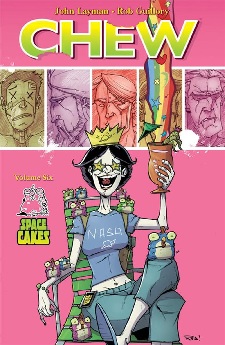
Go to my book reviews page to see what has happened in previous volumes of this award winning graphic novel series. Volume Six revolves around Toni Chu, a Cibovoyant and NASA agent who has the power to see certain bits of the future by taking bites out of living people.

Her story involves being roped in by her chef old brother, Chow Chu, to investigate Barnabas Cremini, a collector of food art where the depictions are so real that if you lick the painting, you can taste the food; hunting down D-Bear who has stolen psychedelic chogs (genetically engineered combination of psychedelic frogs and chicken) and has been serving them in an underground restaurant; her on again off again relationship with her boss Paneer; stopping Professor Angus Hinterwald who has found a way to trigger a gene within beef to cause them to explode at the first sign of decomposition; and uncovering the murder of Judy Heinz-Campbell who had the ability to craft face masks out of food that transforms a person’s appearance.

Volume 6 also has an interlude chapter on Poyo, the killer rooster, whose resurrection from the depths of hell is pretty darn funny.

The final chapter sees Toni preparing to marry Paneer only to conclude in shocking fashion.

Review

John Layman and Rob Guillory know how to turn on the afterburners, propelling you along and engaging your heart in the exuberant and gregarious life of Antonelle “Toni” Chu and then thrusting you skyward without a parachute causing you to crash to the earth in a bloody mess. Your heart will never be the same.

Toni is the fraternal twin of Tony Chu (who we follow in the first five volumes). She is almost the antithesis of Tony. She is happy-go-lucky to Tony being always serious. She is full of life and energy while Tony is often gloomy and down. She enjoys a party while Tony probably prefers reading a book. She has a positive relationship with her family while Tony does not.

It is a fresh contrast and I was gripped in its pages from the get go. Splattered between the various plots that Toni gets involved in, she bumps into Ceasar Valenzano (FDA agent and sometimes partner to Tony Chu) several times. Each time, Ceasar believes Toni looks familiar and flashbacks occur that reveal they have in fact met before on different occasions and settings (once at a party leading to some drunken sex in the janitor’s closet). But Toni flat out denies they know each other every time (even though she does remember and it gives her the giggles). This laissez-faire attitude summarises Toni’s character.

She’s charming, adorable, loves her family, and can kick ass when the moment requires. One could not have a cooler twin.

And then Layman and Guillory decide to rip your heart out. Yes, dear readers, they make you care and then they laugh in your face. The first hint that something is not right comes at the end of chapter 4 where Paneer confesses his love to her, proposes marriage and allows Toni to bite his shoulder to get a glimpse into their future. Her ‘food power’ showing her that Paneer genuinely loves her and so she agrees to marry him. But when they hug, you see her expression (Paneer doesn’t see it because they’re hugging) and it is one of horror. I wanted to ignore this panel in the graphic novel. Almost doing a double take and thinking Guillory has illustrated her incorrectly, why does she look so sad and horrified when just a moment before she was happy to say yes to Paneer?

All is revealed in the final chapter when Toni goes shopping for a wedding dress with Paneer and is kidnapped by the Serbian cibopath known as The Vampire (an enemy of both Tony and Mason Savoy who is seeking to cannibalise and absorb all individuals that have ‘food powers’. Toni has already foreseen this happening and she allows it to happen because she knows it will lead to her brother eventually stopping The Vampire. In horrifying illustrations, Guillory depicts Toni tied to a chair but both her legs and one arm already amputated by The Vampire. The Vampire attempts to feed on her limbs but is unable to absorb her seeing-into-the-future powers (the reasons for this are revealed in flashbacks, and you understand that Toni has been preparing herself to be kidnapped and to thwart The Vampire’s plans). Toni does not give an inch and taunts The Vampire saying she has already seen the future and it is one where Tony will hunt him down to the ends of the earth, beating him to a pulp, before finally killing him. In a rage of frustration, The Vampire breaks Toni’s neck.

In the final panels, we see a flashback of Toni and Ceasar as little children, meeting at a playground. They begin to talk and Toni reveals her powers. Ceasar asks to know his future (not realising that Toni will need to bite him in order to see it). Toni does just that and reveals to him that he will be part of a team of special agents that will save the world. This flashback finally clicks in Ceasar’s memory and he remembers her but this happens after he breaks the news to the Chu family that Toni is dead.

John Layman and Rob Guillory… I hate you.

Yet I must concede that Volume 6 of Chew is story-telling and art at its finest.

5 out of 5.

Anime Review: Jujutsu Kaisen Season 1 (2020)

TL;DR – fans of shounen series such as Naruto or Bleach will enjoy this too-cool-for-school anime. High school student Yuji Itadori discovers the world of Curses (creatures that come forth from people’s negative energy) and changes his life forever when he swallows the finger of a powerful Curse known as Ryomen Sukuna in order to save his friends from being killed.

Review (warning: spoilers)

In the world of Naruto, characters manipulate ‘chakra’ (a substance of lifeforms on other planets) with their own spiritual energy to perform powerful techniques or jutsu. In the world of Bleach, characters use ‘reiryoku’ (raw spiritual power a soul possesses) and manipulates through ‘reiatsu’ to manifest physical pressure.

Generally there is a sense that both ‘chakra’ and ‘reiryoku’ are positive forms of energy. ‘Positive’ in the sense that when channeled properly, can assist/protect the individual utilising the energy.

In the world of Jujutsu Kaisen this is not necessarily the case. The anime spins the idea by focusing on energy generated from negative emotions. And it is a double-edged sword because for normal people who cannot control the flow of negative emotions, this leads to it manifesting in the form of Curses (i.e. spiritual monsters seeking to destroy humanity).

Certain individuals known as sorcerers can harness Cursed energy and perform techniques. This includes the ability to create a pocket dimension over a certain area that allows the sorcerer to amplify their attacks within that dimension.

This is the backdrop in which we follow Yuji Itadori, an athletic high schooler who is a bit of a loner and visits his grandfather on his deathbed. His grandfather’s final message involves the idea of helping others and being surrounded by loved ones when your life is near its end.

This has a profound effect on Yuji and when he encounters Megumi Fushiguro (a sorcerer) and is told that his friends are in danger because they have discovered a Cursed talisman that attracts Curses that start attacking the school, he is spurred into action to help.

The cursed talisman turns out to be the finger of Ryomen Sukuna, a Curse so powerful that it overwhelms Megumi and even other Curses fear him. With the lives of Megumi and his friends on the line, Yuji does the only thing he can think to help and swallows the finger becoming the host body of Ryomen.

Ryomen briefly takes over Yuji’s body and dispenses with the other Curses, but to his surprise, Yuji is able to regain control and suppresses Ryomen.

Technically, it is every sorcerer’s mandate to exorcise Curses, which would mean Yuji would die in the process if Ryomen was exorcised. But Satoru Gojo, Megumi’s teacher, comes up with a plan to stay Yuji’s death by using him as the vessel to consume all of Ryomen’s fingers (once found) and then exorcise him in his entirety. Mind you this would still mean Yuji dies… it would just be later.

There is enough background to entice anime fans to find out more as to the lore and world that has now unfolded in Jujutsu Kaisen. The characters are typical shounen characters and though their powers are interesting, I could not help laughing (unintentionally) at how similar they are to other anime/manga characters in this genre.

For example, Satoru is almost the spitting image of Kakashi in Naruto. Both are teachers, both have spiky white hair, both exhibit insane powers with their eyes and have them covered (Satoru wears a blindfold, don’t know how he sees anything, and Kakashi has one eye covered), both are extremely intelligent and only unleash their full power in dire need.

What also drew me to this anime was the idea of cursed energy and how it can be channeled and if left unchecked can unleash Curses that seek to devour humans. This led me to believe that sorcerers who are taught to use cursed energy can run the risk of some sort of corruption (e.g. they might get consumed and become Curses themselves). Having not read the manga, I do not know if this is the case or if there are any other consequences or repercussions to using cursed energy excessively. However, in season one, there does not appear to be any backlash to any of the sorcerers using cursed energy. This was a bit of a let down.

The only real struggle is between Yuji and Ryomen internally as they battle for control, and when Ryomen comes into play it is always exicting to watch.

The action sequences are also adrenaline pumping and you get to see enough of what is happening behind the scenes with intelligent Curses that makes you want to keep watching. In season one, the target is not so much Yuji and unleashing Ryomen as it is taking Satoru out of play. The intelligent and high-powered Curses clearly have had previous experiences with Satoru and know what he is capable of. He is like the queen on a chess board, take the most powerful piece off the board and you’re chances of capturing the king (i.e. Yuji/Ryomen) multiply exponentially. I eagerly await for season two.

8 out of 10

Movie Review: Worth (2020)

TL;DR – what is a life worth? In the wake of 9/11 terrorist attacks, the lives lost and the lives left behind are examined in terms of dollar value and what compensation can be given. Based on the true story of Kenneth Feinberg, the man tasked to do this impossible task.

Review (warning: spoilers)

Should the family of a CEO who died in the September 11th attacks be worth more in terms of monetary compensation than a janitor who also perished? Where does one draw the line in terms of first responders (e.g. fire fighters) who suffered asbestos inhalation and health problems months or years after the tragedy? What is their worth (and compensation) versus those who came to help three days after the event trying to help recover anyone who might still be alive under all the rubble?

Kenneth Feinberg (Michael Keaton) is the man who sets out on determining the monetary value of a person’s life. He is appointed the Special Master of the September 11 Victim Compensation Fund and works with his law partner, Camille Biros (Amy Ryan). The formula that Feinberg comes up with to determine compensation is primarily based on a person’s income. Feinberg is genuinely looking to help those devastated by the attacks and serve his country because he knows that if the estimated 7000 victims were to file a lawsuit, the process will drag out for years in court, and the victims and their families potentially losing and not receiving a cent. However, when he presents his formula, he’s viewed as insensitive and aloof.

In reality, Feinberg knows that he cannot achieve any level of objectivity if he becomes emotionally involved. In terms of law, and the application of the law, he does not (and cannot) view the question – what is a life worth? – as a philosophical question. He has to draw lines in the sand, apply what current state laws stipulate, and is instructed to get at 80% of the 7000 victims to commit to the fund otherwise the fund falls through.

The outcry from victims to Feinberg’s formula is understandable. Feinberg, Biros and their team experience an onslaught of pressure both political and emotional that is not short of titanic and like the ship of the same name, they are in fear of drowning and losing their own sense of self.

The interviews of the victims and their stories is wide ranging and emphasises the impossibility of the situation. Class, race, culture, and state marriage laws are all wrapped in the tragedy and causes endless debate on how they factor in the fund’s formula.

But it is Charles Wolf (Stanley Tucci) who lost his wife in the 9/11 attacks that has the greatest impact on Feinberg. He confronts Feinberg calmly and respectfully, and states in no uncertain terms that he finds the formula completely offensive and will seek to gather others in protesting the fund. Wolf sets up a website called “Fix the Fund” and gathers a large following, which inhibits Feinberg and his team in getting victims to commit to the payouts. It should be noted that Wolf does not hate Feinberg, but instead wants him to step up and achieve more than what he is doing.

Michael Keaton, Amy Ryan and Stanley Tucci are outstanding in their roles and carry the movie. I was deeply moved by not only those impacted by the 9/11 attacks but by what Feinberg and Biros were seeking to achieve. Again, an impossible situation, yet in the end, they were able to get 97% of the victims to commit to the fund resulting in billions being distributed by the government. For better or worse, the world operates around a giant economic machine and money is a tool and method to exchange for food and services. Every individual life is worth innumerably more than this, but this is the world we live in.

This film does not dig deeper into the wider range issues of the terrorist attacks, but it does promote thinking and emotional contemplation of what it means to get along, the value of each and every one of us, and the importance of family and community. It never presumes to look at the question – what is a life worth? – through a philosophical lens. But there is one message that is clear, a person’s life is not a number and it never will be.

7.5 out of 10

Book Review: A Slow Burning Fire by Paula Hawkins

TL;DR – when Daniel Sutherland is found murdered on his narrowboat in Regent’s Canal, North London, the locals are naturally shocked. Those linked to Daniel and those who were last to see him alive are all interviewed by detectives. What is uncovered is a history of family tragedy and how preconceptions can lead to false assumptions of just who holds the power to the truth.

Summary (warning: spoilers)

Laura makes bad choices. The latest involving hooking up with Daniel Sutherland who is later found murdered in his narrowboat and she becomes the primary suspect.

Miriam lives on a narrowboat next to Daniel and witnesses Laura, blood on her face, limping away on the towpath. People see Miriam as a hermit, an old spinster, who sticks her nose in other people’s business. She is the one who finds Daniel’s body.

Carla is Daniel’s aunt. Divorced to Theo with a history of tragedy. First she lost her three year old son, Ben, then her sister Angela (Daniel’s mother) dies in a horrible accident, and now her nephew Daniel has been murdered. She is haunted by her past, can barely function in the present, and does not know how to look forward to the future.

Theo is a somewhat successful author. His novel – The One Who Got Away – achieved success but has received controversy as well as a claim by Miriam that Theo based key events in the novel on a memoir she wrote and shared with him. Theo, like his ex-wife Carla, has never managed to move on from the death of his son.

Irene lives next door to Angela, an eighty year old widower who never managed to have children of her own. She has her own personal demons and remembers quite well the arguments Angela and Daniel used to have, which carried through paper thin walls of their neighboring homes.

Questions of who killed Daniel and why leads to uncovering truths about the past, both horrifying and tragic for all those who had links direct and indirect with Daniel.

Review

A Slow Fire Burning is Paula Hawkins third novel published in the mystery thriller genre and examines the effects of neglect and the assumptions people have of others by their appearance and mannerisms.

Hawkins does an admirable job in depicting a cast of characters that are all deeply flawed in some way. On the surface, these flaws are unlikeable as opposed to interesting. I was in danger of losing empathy with practically all the main characters in this novel.

Generally, characters must have flaws in some manner otherwise the story will be dead boring. It is neither believable nor interesting when a character is perfect. Flaws create layers and demonstrate humanity that allows a reader to connect and become invested in that character’s plight. But Hawkins dares to create a bunch of characters that are all unsavoury in a way that will make you feel you don’t care what happens to them.

However, Hawkins manages to walk this tightrope and slowly reveal that there are deep seeded reasons to their behaviour. Not all of them pleasant but at least understandable, and you can see why they act the way that they do.

A Slow Fire Burning is not so much a mystery thriller as it is an examination of how the seeming powerless seize power, and the method by which they do so is not always altruistic or just. In fact, for many, it is power for selfish reasons only.

Surprisingly, what helps carry the story is the main detective, DI Barker, which one of the main characters, Laura, calls “Egg” because he has a head shaped like a cue ball and is completely bald. Barker is intelligent (not Sherlock Holmes intelligent but smart enough at his job) and he exhibits a level of empathy that was needed in this story.

The mistake that the main characters make when they interact with each other is judging who they are and what they are like from their appearance and external habits. Even Theo and Carla who were previously married and have a deeper understanding make false assumptions about each other. The reasons for these assumptions lead to igniting the slow burn to obtain power or revenge or justice (depending on whose eyes you look through) and stems from complex and tragic past events experienced by each of them.

Barker, on the other hand, is not burdened by their past. He was not part of any of the tragedies experienced by each of them. At the same time, he’s not presumptuous nor a cold-hearted fact finder focused only on the evidence to determine Daniel’s murderer. He is as human as the rest of the cast even if he is not so deeply flawed. Hawkins wisely uses him sparingly, but when he appears, he enhances the story and thankfully brings another dimension of humanity that is usually missing from law enforcement characters in these types of stories (unless the law enforcement officer is a main character, they are usually relegated to the background to indicate a crime is being investigated). Barker is a supporting character but is not left as a plot device in a crime mystery to indicate that the police are doing something. His interactions with Laura are particularly well done.

For the most of it, I found this book to be reasonably compelling, but one plot device is used near the end that deflated my enjoyment. The device is used on Miriam to allow progression of the plot between her and Theo. Unfortunately, the device is too convenient. It was like Hawkins was not sure how to put out one particular slow burning fire that was occurring between Miriam and Theo, so she threw in a series of last-minute scenes that would explain it and lead to a resolution between the two. I found it far-fetched because Hawkins does not give any hint that this is going to happen. She just inserts it at the end of a chapter, and you’ll be asking yourself, “Who the hell is this character? Why does she suddenly mention him after 32 chapters?” The remaining seven chapters plus epilogue explain the sudden appearance of this character, but it is all too coincidental and convenient. A shame really because the rest of it is decent read.

2.5 out of 5.

Anime Review: Yuru Camp Season 1 (2018)

TL;DR – Rin Shima is slightly unusual for a girl her age. She likes going camping by herself and soaking up the tranquility at various camping sites near Mount Fuji. When a small group of girls set up a camping club at the school Rin attends, she unexpectedly receives attention in helping the club get off the ground and in the process creating new friendships.

Review (warning: spoilers)

Rin is a soft-spoken, quiet girl that loves camping out in winter at various grounds near the base of Mount Fuji. Along the way she meets other girls who become interested in camping also. That is pretty much the entire story, but the basic premise of slice-of-life animes is generally simple.

I have yet to figure out what makes a slice-of-life anime work over other slice-of-life animes. Personal taste obviously comes into play, but certain animes are more effective than others. What I found quite curious about Yuru Camp is that I am not a big camper myself. In fact, if I am on holiday, I much prefer the comforts of a rental house or a hotel than the idea of sleeping on the ground. But Yuru Camp somehow makes me want to buy a sleeping bag and tent and go find some isolated place in the woods or by a lake and be one with nature.

Elements that made this slice-of-life better than others include:

  • Camping locations are based on real ones in Japan
  • The scenery during the day and night is beautifully captured
  • They capture the joys of cooking in the great outdoors and make every meal look delicious
  • The characters are funny in their obsession to go camping and working part-time jobs to afford better equipment
  • It demonstrates the use of actual camping equipment and the many varieties

All of the above combined make for a series that had me smiling. More subtly, it shows how some of the greatest joys are the smallest ones. For example, cooking curry ramen over a campfire; staring as the sun rises over Mount Fuji; exploring new places; riding a scooter; soaking in a hot spring; the company of friends. It also contains the message that life should be savoured and there is nothing wrong with slowing down especially when we live in a world where it feels like we should be cramming in as much as possible.

Since the airing of season one, there has been an increase in tourism in the campgrounds depicted in the anime, this shows the positive influence Yuru Camp has had. There is a serenity in Yuru Camp that will lift your spirits. And that’s the most important element I could receive from a slice-of-life.

10 out of 10

Movie Review: Mortal Kombat (2021)

TL;DR – reboot of the popular video game of the same name. Mortal Kombat pegs Earth’s fiercest fighters against Outworld’s warriors in a battle royale. Expect plenty of action, solid CGI effects, and a thread of a plot that isn’t necessary to enjoying the film.

Review (warning: spoilers)

After the critically panned Mortal Kombat: Annihilation was released in 1997, further films based on the iconic video game stalled for decades. A quarter of a century on, and we see its return as a complete reboot of the martial arts fantasy film franchise.

Basing a movie on a video game is always a bit of a tall ask, and expectations should be measured on a different scale when the source material is a bunch of characters fighting one-on-one in a massive blood splattering, UFC-type event. Building any sense of a solid plot on such slim pickings should not mean an expectation of Academy Award nominating potential.

There are video games that have extensive lore. The movie Warcraft released in 2016 is based on the hugely successful video game series of the same name, and has tons of fantasy lore from which to create stories that arguably rival established fantasy novel classics like ‘Lord of the Rings’. Warcraft managed to be the first video game film to break $400 million in ticket sales. However, this did not stop critics from giving out derisive reviews.

Mortal Kombat does not have the luxury of backstory that Warcraft has but in a way that is something that should be commonly known. What you should be expecting from this film are outrageous but exciting action sequences, some corny but still laughable one-liners, more action, a slim thread of plot, more action, a solid sound track, and more action.

From this perspective, Mortal Kombat goes leaps and bounds above its 1997 predecessor, Mortal Kombat: Annihilation.

Aussie actor, Josh Lawson, is probably the pick of the cast, transforming himself into the hulking, back-stabbing fighter named Kano. He delivers lines both foul-mouthed and droll that are downright laugh out loud.

Hiroyuki Sanada as Scorpion and Joe Taslim as Sub-zero are the ones that bring surprising emotional gravitas to what is essentially a turn-off-your-brain film.

The plot, for all its attempts at depth, can be summarised in one sentence. Selected fighters of Earthrealm (i.e. Earth) must battle selected fighters of Outworld (i.e alien world) in order to save Earth. That’s it. Enjoy the ride.

6.5 out of 10