Anime Review: Non Non Biyori (2013)

TL;DR – it is not just the characters are too cute, it is also all those wonderful moments that can be experienced in childhood that are captured in this slice-of-life anime.

Review (warning: spoilers)

There is something about how anime captures the country. The picturesque mountains, rolling green fields, lush forests, running creeks and clear blue skies. Non Non Biyori is just such an anime, set in the little country town Asahigaoka and shows a landscape beauty that had me wanting to live there.

And then you get to meet a cast of characters that are unbelievably cute. The most adorable of these is Renge, a first-grade student whose every action makes you want to pick her up and cuddle her. Then you have sisters, Natsumi and Komari. Natsumi (first-year middle school) is the younger sister, gregarious, flighty, and taller than her older sister. Komari (second-year middle school) is a bit more serious and does not like being teased by her younger sister about her short stature. The fourth and final main character is Hotaru, a fifth grade student, who has transferred from Tokyo.

Because Asahigaoka has so few people and kids, the school has only one class whereby all four of our main cast attend with a third-year middle school boy named Suguru (the older brother of Natsumi and Komari).

Each episode of Non Non Biyori captures the innocence of youth, and the simplicity of living in a small country village compared to city life. From the first episode where Renge uses a stick to draw a line in the dirt path to ensure she does not get lost, you know exactly what you are watching. An anime about childhood games and adventures, a place where technology has not infiltrated every nook and cranny, and the joy of friendships. Non Non Biyori is a place where you can breathe in the fresh air and take your time, where you can stop and smell the cherry blossoms, and take a stroll without fear of getting mugged.

The charm and humour exudes in every episode. For example, how an anime can make a kid’s game involving knocking rulers back and forth enjoyable is beyond me but somehow Non Non Biyori succeeds in doing just that. Another example is watching our foursome go about cleaning a pool during a hot summer day, the sound of cicadas in the background, and the things they do to try and make the job more enjoyable. Their antics are both funny and innocent in equal measure. And that is the key to this anime’s appeal. Only those who have a heart of stone would find Non Non Biyori unenjoyable.

8 out of 10

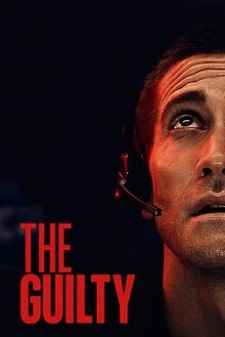
Movie Review: The Guilty (2021)

TL;DR – Joe Baylor receives a 911 call from a woman claiming she has been abducted, and it becomes a race against time to find her. But when all the information you get is via audio only, can you trust everything you’re hearing?

Review (warning: spoilers)

The Guilty opens with a bible quote, “And the truth shall make you free” (John 8:32). It then dives into a Los Angeles on fire. Wildfires spread through the region causing chaos everywhere.

Asthmatic Joe Baylor (Jake Gyllenhaal) works at a 911 call centre. He receives a call on his personal mobile from a journalist, Katherine Harbor, of the LA Times seeking to get “Joe’s side of the story”. From the get go, it is clear Joe is dealing with personal issues across the entire gauntlet of being human – physical, emotional and mental. And he is trying to deal with these issues while also working in a high stress environment where emergency callers are phoning in ranging from a guy needing an ambulance because he’s taken drugs to a businessman who has been robbed in his car by a prostitute. Joe does his best to remain calm throughout and handles all the calls professionally even when he’s getting verbally abused. But unlike the callers phoning in, we can see he is one nudge away from bursting a vein.

The personal issues surround the fact that he is actually a police officer who has been assigned duty on the 911 calls while he awaits a court hearing tomorrow involving the shooting death of a 19-year old man. We also discover he has a daughter named Paige and a wife, Jess, that he has been separated now for six months even though he still wears his wedding ring. As the movie unfolds, it becomes clear that Joe is under investigation and his partner, Rick, is to testify as a witness to the shooting. You pick up pretty quickly that this may be a case of excessive police brutality resulting in a death that should not have occurred.

Joe then receives a 911 call from Emily Lighton (Riley Keough). Emily sounds distressed but does not clearly articulate why she has called 911. Joe initially thinks she’s drunk, but he then hears a man’s voice in the background and he deduces she has been taken against her will. He proceeds to ask yes and no questions and pieces together she’s been abducted.

The movie’s strength and delivery of thrills comes from its lead actor, the fact that virtually all scenes are from the confines of the 911 call centre and the voices from the people on the other end of the phone.

Joe goes above and beyond to piece together what has happened and he concludes the following: 1) Emily has been abducted by her husband, Henry Fisher (who has served time previously for a DUI), 2) They have a daughter, Abby, and a baby son, Oliver, who has been left home alone, and 3) Oliver has been killed by Henry.

As the film progresses, you can see Joe is unravelling. He starts breaking protocols and doing things that you would not be allowed to do when working in a 911 call centre. For example, he is able to get Henry’s phone number and calls him directly, unleashing a diatribe of anger, yelling at Henry to give himself up and return Emily unharmed. Another example involves him calling his sergeant, Bill Miller (Ethan Hawke) to get an officer to go to Henry’s place and “kick down his door”. Joe’s emotional entanglement in Emily’s fate is driven by the one thing that he has refused to acknowledge.

That he is guilty of manslaughter, killing a 19-year old man in the line of duty, when he didn’t need to.

His desperation for redemption is through saving Emily. But the twist comes when he discovers, to his horror, that Emily is the one responsible for hurting Oliver, her son. Turns out that she suffers from a mental disorder, took a knife to her crying baby boy because she thought he was in pain with snakes in his belly. This is done all over the phone, so you don’t see any of this, but from the audio alone, you feel the horror that Joe feels. Henry is actually trying to take Emily to a psychiatric hospital. There’s flaws in all of this because Henry should have called the ambulance and the police. The fact he tries to whisk Emily away to a psychiatric hospital leaving Abby and Oliver by themselves is illogical (all the more so because he would have found that Emily had hurt Oliver). That aside, Joe realises his mistake. When he eventually is able to get a hold of Emily, she’s standing on an overpass overlooking the freeway and you know she is contemplating suicide. Joe pleads with her saying the Abby and Henry needs her, but it is only when he confesses to the shooting of the 19-year old man that Emily pauses.

By confessing his guilt, he saves Emily and later finds out that Oliver has not been killed but is in intensive care. The film ends with Joe calling Rick and telling him to testify to the truth and recant his original statement, which assumes that Joe did everything by the book in the shooting. Joe then calls Katherine Harbor and tells her he’s going to plead guilty to manslaughter.

The pressure valve is released. Though Joe knows he will serve years in prison and not see his daughter, he knows he has taken the correct course and will not be eaten away by guilt.

And thus, the truth has made him free.

Gyllenhaal is in fine form throughout the film. I was unaware at the time that The Guilty is an American remake of a Danish film of the same name. From what I can gather, the Danish original is far superior, but having not seen it, I am free to view the American remake without bias. Through those lens, I enjoyed the thrills this movie delivered.

7.5 out of 10

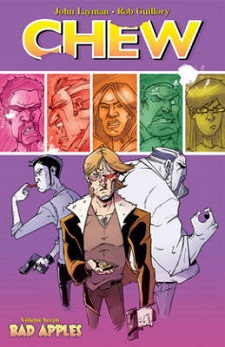
Book Review: Chew (Volume Seven) “Bad Apples” by John Layman and Rob Guillory

TL;DR – Tony Chu and his family are in mourning. Tony’s fraternal twin, Toni Chu, murdered. Sadness quickly turns to anger and Tony Chu takes his first steps on his path of revenge.

Summary (warning: spoilers)

Go to my book reviews page to see what has happened in previous volumes of this award winning graphic novel series. Volume Seven sees Tony Chu on a mission to hunt down The Vampire, the man responsible for murdering his sister.

The chapters in this volume follows a series of missions/assignments that Tony undertakes in order to find where The Vampire is. Starting off with uncovering those responsible for releasing into the market a soda drink that burns fat rather than putting it on, only to discover it does more than burn fat cells, it causes the drinker to self-combust literally. This leads to a shoot out involving the immaculate ova cult (religious fanatics who worship chicken eggs and want to kill anyone who eats chicken) at a chicken fast food joint. And then infiltrating a camp that trains ova cult fanatics.

Piecing together clues along the way, Tony eventually arrives to an undisclosed location in Eastern Europe where he sits down to a holographic image of The Vampire for a meal. The Vampire offers Tony a chance to join his side and for them together to consume others with ‘food powers’, so they can become the most powerful cibopaths in the world.

For the avoidance of doubt, Tony makes it clear to The Vampire that he has no intention of joining him, and that he is going to hunt him down and kill him.

The final chapter sees Tony trying awkwardly to reconcile with his estranged daughter, Olive. In the process, he discovers that his deceased sister, Toni, has left him something valuable.

Review

After the epic finish in Volume Six, which showed the grisly murder of Tony’s sister, and the emotional tidal wave that I found myself drowning in, Volume Seven was always going to be challenged in terms of delivering the same highs and lows.

In truth, Volume Seven goes about setting up plot lines that I am sure will be important later on, but there is not anything in these chapters that packed as an emotional punch as what happened in Volume Six.

While Tony spends most of the time angry and stopping bad guys with a single-minded obsession that rivals the ova cult fanatics, his partner, John Colby, discovers the truth about Caesar and his links to Mason Savoy.

Savoy tries to recruit Colby only for the tables to be turned in the final pages, and Savoy is arrested by Colby.

Overall, the events are a slow (necessary) build up, which I anticipate will lead to greater things. But by itself, Volume Seven did not shake me to the core or even rattle the cage much. The crazy and weird world of Chew now seems stock standard in this volume when compared to the earlier volumes. There are no great revelations or characters that drove me to turn the next page and devour it. If anything, the two primary antagonists – Mason Savoy and The Vampire – are not revealed in any new ways and their scenes are brief.

Perhaps, Layman and Guillory needed to take a breath and ensure the reader is kept informed of the multiple underlying subplots. A solid read but will not answer any burning questions that have been asked before. For example, what the hell is the alien writing in the sky? The world is meant to be missing a big chunk of itself, what happened to it? What is the alien fruit that tastes like chicken? What is The Vampire’s end game? The ova cult seems a big part of the story, but I don’t see why I should care about them? Nothing answered, nothing gained here.

Time to take a bite out of Volume Eight.

3 out of 5.

Anime Review: Kuroko no Basket Season 1-3 (2012-15)

TL;DR – basketball sports anime that requires you turn off the ‘sports accuracy’ part of your brain in order to enjoy it.

Review (warning: spoilers)

In the 1990s, the penultimate basketball sports manga to me was Slam Dunk written and illustrated by Takehiko Inoue. I had never seen a manga (or comic) depict the physics of a sport so accurately. The game of basketball illustrated in every panel of Slam Dunk felt and looked so realistic that even if you could not read and understand the Japanese dialogue, the pictures allowed you to follow what was happening in the game. The manga was adapted into an anime and released also in the 90s and now looks dated when compared to the anime sophistication being pumped out by studios today. I would love nothing more than Slam Dunk to be rebooted as an anime series using today’s artists and technical skills, but this may never become a reality.

Kuroko no Basket could have been the Slam Dunk for the 2010s. Arguably to fans it is. The animation is excellent and the characters are as engaging as the ones in Slam Dunk, but what Kuroko no Basket seeks to do is go up a level. This is not a bad thing, but the way Kuroko no Basket ‘levels up’ is not done through plot but instead through the game physics itself. Imagine this basketball anime series being like Goku in Dragon Ball going Super Saiyan mode.

The end result are characters that defy basketball logic. In junior high school, there is a team of miracles. Five players that have supernatural gifts when it comes to basketball. They dominate the junior high competition so thoroughly that they get bored and decide to go to different high schools in order to compete against each other. Kuroko is the sixth man of this team of miracles. There is nothing special at all about his physical basketball skills but his talents on and off the court lie elsewhere and were an essential part to keeping the starting five in junior high together.

This generation of miracle basketball players comprises of the following:

  • Ryota Kise is a blonde-haired small forward who has the ability for a specified period of time to copy exactly the moves of other players. This includes the ability to use his photographic skills to copy his other generation of miracle teammates.
  • Shintaro Midorima is a green haired shooting guard who can shoot three-pointers and never misses (if he gets the shot up untouched). This includes shooting from the opposite end of the court.
  • Daiki Aomine is a dark haired ace and arguably the greatest of all the generation of miracles players. He has the best all around game and plays with a ‘street-ball’ style that is unpredictable. He can make shots by throwing the ball at ridiculous angles and does not need to do a conventional jump shot.
  • Atsushi Murasakibara is a purple haired centre who rebounds, blocks, and dunks with such ease that he finds the game boring (he only plays because he is so good at it). He hates players who have a passion for the sport and this includes Kuroko.
  • Seijuro Akashi is a red haired point guard. He has an ability through his eyes called “Emperor Eye” that allows him to defeat whoever is guarding him. He sees victory as absolute and guaranteed through his eyes.

Kuroko joins a high school separate to his former teammates and seeks to combine forces with Taiga Kagami (an athletic basketballer returning from playing in the United States). Kuroko, Kagami and the rest of his teammates go up against high school teams starring one of the generation of miracle players. Kuroko, in his own way, seeks to show each of his former teammates the joy of basketball and the need to play with teammates (it is a team sport after all).

On one hand, as a basketball fan, I found this series contrived and ridiculous when it comes to the games themselves. Even Kuroko, as episodes progress, acquires ‘skills’ that are superhuman (or Super Saiyan) in nature.

On the other hand, as an anime fan, I can see how this series has been a success. The enjoyment comes from turning off your basketball brain otherwise you will pick it apart for failure to follow any basketball physics logic. Midorima shoots better than Steph Curry, Kise can do more than Kobe Bryant, Aomine is greater than Michael Jordan, Murasakibara makes Shaq look like a toddler and Akashi would run rings around Magic Johnson. It is all silly but still enjoyable.

When Kuroko helps Kagami get into the ‘zone’, there is a genuine thrill. The interactions between all the characters are interesting and fun. You find yourself cheering on Kuroko and his team even under the ridiculous circumstances they face. I found I had to laugh when they broke down basketball plays and explained how certain players do the seeming impossible.

But like I said before, turn off your sports brain and you will still enjoy this anime.

Now can someone please pick up Slam Dunk again and animate it like what happened when Full Metal Alchemist Brotherhood was the second adaption of Full Metal Alchemist?

7 out of 10

Movie Review: Raya and the Last Dragon (2021)

TL;DR – the hero’s journey of Raya has the usual splash of Disney formula as she embarks on finding the pieces of a magical gem that will banish the evil spirits of the Drunn and reunite the land of Kumandra.

Review (warning: spoilers)

Visually stunning, Raya and the Last Dragon, takes you on a journey to the mystical land of Kumandra where evil spirits known as the Drunn are seeking to destroy life and turn all creatures into stone. In an act of sacrifice, five dragon guardians combine their magic to create a gem that banishes the Drunn. Though the land is revived, Kumandra separates into five tribes – Heart, Fang, Talon, Spine and Tail and in the ensuing centuries, they battle for possession of the gem.

Fast forward five hundred years and we are introduced to Raya, the daughter of the chief of the Heart tribe who are the current protectors of the gem. Raya’s father wants to reunite Kumandra with the other four tribes. He extends an olive branch and invites the other tribes to a feast with the aim towards reconciliation, healing and peace.

Of course, you know that is not what is going to happen. Jealousy, betrayal, hatred reveals their ugly heads and the gem is fought over resulting in it breaking into five pieces. One piece whisked away by each tribe, unleashing the Drunn back into existence and causing everyone in the Heart tribe to be turned to stone by the evil spirits except Raya, who is saved only through her father sacrificing his own life.

There are plenty of not-so-subtle messages throughout the film. The Drunn arguably a manifestation of humanity’s own fear and avarice; the Heart tribe being the first to turn to stone (stone hearts representing absence of love, kindness and compassion); the Fang tribe triggering the betrayal (‘fangs’ always linked to snakes that represent the idea of evil and greed); the dragon-shaped river, its water a barrier that the Drunn cannot cross, symbolising the flow of life and if it were to ever dry up then the Drunn would roam freely and cause death; and how trust and forgiveness are the only true tools that can put back together a broken land.

All these messages are reflected through Raya’s story and her actions. Her journey to locate Sisu, the last dragon, and ask her to create a new gem shows a misguided belief that she alone can free her father and the rest of the Heart tribe from petrification. Because she experienced betrayal that resulted in her tribe’s destruction, she trusts no one and hunts for six years trying to locate Sisu. When she finally finds the last dragon, Sisu reveals she cannot make another gem for it was formed through the sacrifice of her four siblings.

Raya decides to then steal back the other four pieces of the original gem and put it back together with Sisu’s help. Along the way she encounters interesting and unique individuals from each tribe who join her on her quest. Still, Raya has trust issues and it is only when they all converge in the tribal lands of Fang, does Raya realise that the true path forward in overcoming the Drunn and healing Kumandra is through forgiveness, love and sacrifice and having heart spine, fang, talon and tail work together (see what the writers did there?)

Plenty of symbolism, none of it subtle, but that does not detract from an enjoyable film for young and old. Disney cannot help themselves from putting in their own touches. For example, for all its Asian cultural references, Sisu’s personality reminded me a bit too much of the genie from Aladdin or Mushu from Mulan. Sisu represents the age-old conscience companion in many Disney flicks (Jiminy Cricket would be proud). Another example, is the need for other way-too-cute characters like Tuk Tuk, who is a cross between an armadillo and a pill bug, that is Raya’s pet, and later grows into her steed and primary mode of transport (I definitely want my own Tuk Tuk). Disney tries to go against type with another too-cute character, Little Noi who Raya meets in Talon. Little Noi is depicted as an infant girl with chubby cheeks and infectious smile but turns out to be a con-artist. The end result is mixed and not entirely effective.

The finale is suitably driven by all that has come before and Raya’s culmination of heartbreak and emotions leading to the revelation that vulnerability and openness are her greatest strengths. Outstanding animation, solid plot, colourful characters and Disney’s trademark soundtrack (it is all orchestral and there are no musical numbers. This was the right decision and the characters are made all the better for it. Thank goodness!) Raya and the Last Dragon is a worthy addition into the Disney canon.

8 out of 10

Book Review: On Writing: A Memoir of the Craft by Stephen King

TL;DR – part autobiography, part teachings & learnings, and all heart from one of the most prolific writers of our time.

Summary

To make a living as a writer, to excel at any profession, requires dedication, discipline and accepting the day-to-day grind. King seeks to tell stories of his own life in his journey to become a writer and published author. In addition, King provides examples, advice and practical tools for others who are seeking to undertake a similar journey and make a career out of writing.

Review

On Writing was King’s first published work after he suffered an accident involving a van hitting him while walking along Maine State Route 5. It is testimony to his resilience even after acknowledging that there were periods after the accident where he thought he would never be able to write again. The retelling of this accident in his memoir radiates the struggle of putting into words an event that could have ended his life but also concludes with a catharsis that would eventually see him write (or co-write) and publish a further 25 novels (and counting). I secretly suspect that King is part-cyborg.

The memories and reflection are poignant and demonstrate a person who has given much to honing his craft. The numerous rejections he received when he first started putting pen to paper showed he was far from an overnight sensation. The life he had growing up with his brother and being raised only by his mother (their father left them when he was two) paint a picture that was full of adventure and colour but also many hard truths.

Combining these autobiographical elements, King delves into his craft and the tools every writer should have. For some aspiring writers who have read other books on writing, there may not be much new in what King reveals, but I believe for most there will be lessons worth being reminded of or are new to be picked up.

Overall, On Writing is not so much a masterclass as it is an inspirational read that should encourage any budding writer to keep up the good fight and enjoy the journey. This book is a worthy addition to any writer’s toolkit.

4.5 out of 5.

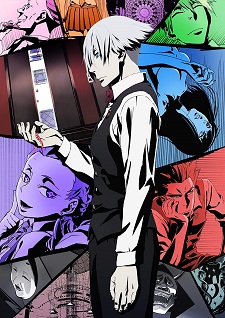
Anime Review: Death Parade (2015)

TL;DR – There is no heaven, no hell, there is only a bar where souls end up playing games to decide if they get reincarnated or sent into the void.

Review (warning: spoilers)

Bartender Decim is the emotionless judge and arbiter at the Quindecim bar, a place where two souls arrive to play games that decide whether they enter an elevator that leads to reincarnation or the void. The souls do not realise they have died, nor do they remember what type of life they lived. It is through the game they play that their memories come back.

First off the animation in this series is excellent. There’s a style and detail that is reminiscent of Cowboy Bebop and it has a funky soundtrack that contrasts with the sombre material.

Each pair of souls that end up in Quindecim are more complex than what they first appear. As in real life, they have secrets, regrets, and experiences both happy and sad. Through playing various games such as darts, bowling and air hockey, they regain their memories and react accordingly. What becomes evident is that the pair of souls always have a connection in some way, they are not chosen randomly. And always, it is this connection that is the pivotal point that triggers their actions/reactions when memories come flooding back. Decim passes judgement on these interactions and the souls get sent into an elevator that either goes to the void or leads to reincarnation.

The stories of the souls and the events leading up to their death and appearance at Quindecim are interesting and clever. Nothing is ever black and white and there are always shades of grey. If the anime focused solely on this, it would still be an enjoyable series.

But it becomes far more cerebral when a black-haired girl arrives and becomes Decim’s assistant. The world opens to reveal there is more than one bar, and there is a system of arbiters dishing out judgement on souls. When Decim’s assistant starts raising complexities around humans and their motivations/actions/emotions, it leads to Decim to question whether some of his judgments are wrong.

The ambiguity leading to Decim wanting to understand more about human suffering and what drives people to extremes of behaviour. Ultimately, the series does not tell you what is “right” or “wrong”. As the viewer, it is up to you to come to your own conclusions, and that is fine by me. It becomes a fascinating exploration into what makes us who we are. Not black and white, not even varying shades of grey, but actually a multitude of colours.

9 out of 10

Movie Review: Superintelligence (2020)

TL;DR – an artificial intelligence achieves consciousness and seeks to decide whether it should save, enslave, or destroy humanity. It chooses Carol, an ordinary woman, to learn about humans and gives her three days to convince it that humans deserve to be saved.

Review (warning: spoilers)

Carol Peters (Melissa McCarthy) was working as a corporate executive, but unhappy in her job, she now does different part time work while searching for fulfilment in her life. She broke up with her boyfriend, George (Bobby Cannavale) of three years, to climb the career ladder and put her professional aspirations first. And, of course, she now regrets it.

One morning, she wakes up and discovers that all the electronic equipment in her apartment is able to communicate to her because an artificial intelligence known as ‘Superintelligence’ (voiced by James Corden) has become aware and seeks to learn about humans. It needs an average baseline guinea pig and chooses Carol for her averageness and embarks on studying her interactions with others in order to determine whether to wipe out humanity or save it.

Of course when the NSA discovers the existence of the superintelligence, they freak out and get the president’s permission to execute a plan involving blacking-out the entire world and forcing the superintelligence into a data server outside Seattle. They, of course, obtain cooperation from all the other countries faster than a kettle boiling with apparently no need to provide evidence of the superintelligence’s existence or its desire to make humans extinct (yeah, don’t think about this too much).

For an action romantic comedy, Superintelligence has the potential to explore hard truths in humorous or satirical ways. In this day and age, where people connect through Tinder, social networks, and other dating websites/apps, there is much that could have been said. For example, biting commentary around relationship compatibility through computer algorithms, our reliance on Instagram likes, the unreality of Facebook posts, or any number of ways we now rely on technology to somehow achieve happiness.

Instead, what we get is surface level comedy such as Carol brushing her teeth with an electric toothbrush, and the Superintelligence telling her to brush in circles rather than up and down because it can sense how she brushes by being ‘inside’ the toothbrush. And also reminding her to floss.

We are also meant to chuckle when the NSA executes their plan for the black-out and relying on typewriters, carrier pigeons, and table length paper maps of the world (can’t have the Superintelligence know what they are up to even though it has ‘eyes’ in every electronic device in every part of the world and would not be suspicious at all seeing the Government bunker down in a cabin that has a Faraday cage blocking all electromagnetic fields).

The deepest question the Superintelligence asks is what would Carol do if the world was ending in three days. And that leads to her revealing George and her desire to reconcile with him. What follows are scenes where the Superintelligence helps her reconnect and doing things like pretending the Tesla she drives malfunctions forcing her to go up to George’s house after their non-date (that is really a date) to ask if she can use his phone to call a cab.

Yes, it is all pretty silly and sweet and thus missing out on saying anything of real meaning about the world we live in today. A shame because the cast is very good especially McCarthy who does what she can with the limited material. Even if Director Ben Falcone intended this film to be light and airy, the screen writers could have injected a modicum of insight through the dialogue between Carol and George. I was not expecting relationship insights on the level of When Harry Met Sally but when you write a romantic comedy story, the bite is in the two characters interactions with each other and some sort of conflict that drives them apart making them realise they should be together. The ‘conflict’ between Carol and George is simply that George is leaving for Ireland in three days and Carol does not want him to leave. It is all tepid and no heat. The pair not helped by a script that falls way short on delivering comedy and while you feel the attraction between the pair, there is not a sense of any real internal conflict. George wants Carol, Carol wants George, Carol knows the world might end in three days, George is oblivious to this and wants to fly her over to Ireland after a few months once he has settled.

Potential wasted, this film does not reach the lofty heights of its title.

4 out of 10

Book Review: The Toll (Book 3 of Arc of a Scythe Series) by Neal Shusterman

TL;DR – Scythe Goddard rules the new Scythedom. Greyson Tolliver is now ‘The Toll’ and the only one who can communicate directly to the Thunderhead. The Thunderhead seeks to secure humanity’s future but needs to do so without being interfered by Goddard who seeks to thwart any plans to create a world where Scythes are not needed. Citra and Rowan were critical to the Thunderhead in creating a future of hope but, with the sinking of Endura, they are now forever lost. Or are they?

Summary (warning: spoilers)

For my review of Scythe (Book 1 of Arc of a Scythe series) and Thunderhead (Book 2 of Arc of a Scythe series) by Neal Shusterman, and what has happened previously please click here for my book reviews page.

After the sinking of Endura and the deaths of the Grandslayers, the new Scythe order is declared with Goddard as Overblade. Under his rule, Scythes are allowed to glean without restriction. However, not all regions agree to Goddard’s authority.

Meanwhile all non-Scythes (i.e. the rest of humanity) has been declared unsavoury by the Thunderhead. All except Greyson whose previous unsavoury status was lifted and is now the only one who has a direct connection to the AI. The religious Tonists have now titled him ‘The Toll’ (a prophet who will guide the rest of the world).

The Thunderhead sees the bigger picture and aims to secure humanity’s future, a future that does not require Scythes that have become corrupt with power. To do so, it needs to set in motion a plan that will require assistance from those not aligned with Goddard but also evolve itself to a new level of existence (an existence that seeks only to provide hope for humanity).

Citra and Rowan were believed to have perished in the sinking of Endura. Goddard wants to make sure their bodies are never retrieved. But the Thunderhead has other ideas.

Review

The dramatic conclusion to the Arc of a Scythe series is complex in its telling without being overwhelming. Shusterman is able to combine many threads of plot to weave a tapestry that provides the final picture of this gripping trilogy.

There are many themes explored in book three including power and responsibility, political and religious beliefs, sexual identity, tragedy and hope, mortal and immortal life and purpose, love and hate, reliance on technology, and what it means to be human. Shusterman blends these themes into an exquisite final book that concludes an epic tale of a dystopian (or utopian, depending on your point of view) earth.

I would love to know how much time Shusterman spent in mapping out the final arc. Not just the time taken but also how he went about plotting the concluding climatic scenes and tying together the numerous sub-plots. It is an achievement that has resulted in this trilogy deservedly winning numerous awards and has been picked up by Universal Studios to be adapted into a film.

Book three tells the story on a global scale. Shusterman had no choice (and likely every intention) to do this as book two expanded far further than the primary two protagonists in Citra and Rowan. To tell a story about humanity as a whole and the all-seeing, all-knowing Thunderhead required that the plotline went this way. This is both a strength and a weakness in the final book.

As a strength, it satisfied me (very happily) in terms of concluding what happens to the Scythedom, the Thunderhead, the Tonists and humanity’s future. All the large scale stuff is not left wanting and Shusterman ensures that he covers off on all bases. Hats off because this was no easy feat.

As a weakness, it means book three zooms out from the characters we love. Book one was all about Citra and Rowan, they are the pair that the lens focused on and their plight drove me to fully invest into the next two books. Book two still follows Citra and Rowan, but now includes the Thunderhead and Greyson Tolliver. I confess this made me struggle initially in the first few chapters of book two because all I really wanted to follow was Citra and Rowan. But the ending of book two was so brilliant that it blew my mind and I gave it a perfect score. In book three, Citra, Rowan and Greyson are all there but their roles while integral are only three pieces in a giant puzzle. Zooming out means you do not necessarily get the same emotion running through you when you read each chapter because Citra, Rowan and Greyson are already established. It is now about the world’s plight rather than just their individual plights and in this way, I felt book three did not move me in the same way as books one and two did.

But this is a very small quip in what is an outstanding creation of work. Fans of sci-fi and young adult fiction should devour this series.

4.5 out of 5.

Anime Review: Princess Mononoke (1997)

TL;DR – Forest gods and spirits wage war against Iron Town, a village that is mining the resources around it, creating weapons, and destroying nature. The fates of both sides hangs in the balance and will be determined through Ashitaka, a prince of the Emishi tribe, seeking to navigate a way to peace.

Review (warning: spoilers)

For all of its animated brilliance, what director and writer Hayao Miyazaki has done is create a world that is a testimony to fantasy story-telling and also raises the philosophical debate between humanity’s desire for technological advancement and its coexistence (or destruction) with the world we are meant to be caretakers of.

Themes around nature and technology run through practically every film Miyazaki has created and it is clear that he is passionate about sending a message on how we treat this little blue dot that we live in and the delicate balance that we hold in its future.

At the same time, his ability to tell such epic and sweeping fantasy and capture the imagination of the movie viewer is second to none. He is the benchmark of not only anime story telling but cinematic story telling in general.

When the Emishi tribe’s village comes under attack by a gigantic, raging demonic boar, Ashitaka intervenes seeking to defend his home and loved ones while also attempting to reason and usher the boar away. You are immediately drawn into his character as Ashitaka does not kill for killing’s sake. He is noble but not prideful. He values all life even one that has been corrupted by fear and hate. This opening scene is breath taking. Ashitaka riding Yakul, his loyal red elk, confronting the demonic boar that leaves a path of devastation and decay in its wake, and finally having no other choice but to use his bow and arrow to kill the boar lest it engulf the village. In the process, Ashitaka’s arm is infected by the curse that has engulfed the boar and later it is revealed that the boar was actually a forest god that received a wound from an iron bullet that slowly infected and poisoned him with hatred and malice and transforming him into a demon.

Thus Ashitaka undertakes a quest to uncover what evil is spreading toward the west. His journey makes him encounter two warring factions – Iron Town led by Lady Eboshi who wishes to usher in an industrial era and the forest gods led by the Wolf goddess, Moro, and a young human girl named San.

Princess Mononoke is nothing short of a masterpiece. At its heart, it speaks of how we destroy all things (including ourselves) when we hate. As Ashitaka seeks to reach a compromise between Iron Town and forest gods, it is clear that only an act of sacrifice will achieve any level of peace.

As an allegorical tale, Princess Mononoke speaks volumes of the issues we confront in society today. Whether it be carbon emissions, use of fossil fuels, global warming, climate change or the political / cultural / racial divide between people, there is much to ponder as to what the characters San, Moro, Lady Eboshi, Jigo (a monk Ashitaka encounters with his own agenda), and Ashitaka himself represents in the film and more broadly the ideas, principles and desires that drive them and how they reflect the real world.

As an epic fantasy, the glorious landscapes, the details of each character and the environments they explore, combined with the ephemeral music and the many layers of plot that explores beliefs, faith, power and human emotions, this movie is a must-see for everyone and not just anime fans.

Arguably, Princess Mononoke is Miyazaki’s magnum opus. It definitely cries out Miyazaki’s personal beliefs as if he is opening his heart to the masses and pleading for hatred and avarice not to overcome humanity. For me personally, I still think it is Tonari no Totoro but the two films are chalk and cheese in terms of comparison. Tonari no Totoro is a slice-of-life anime while Princess Mononoke is an epic fantasy tale. Many other people will argue other Miyazaki films deserve the title of magnum ops – Spirited Away, Laputa: Castle in the Sky, Howl’s Moving Castle, Arriety, Porco Rosso to name a few. Miyazaki’s canon of quality works is so varied and large that we are spoilt for choice.

Spoilt is the keyword here. Thank you Miyazaki for the dedication to your craft, your vision in animation, and your heart in storytelling. Thank you.

10 out of 10