Book Review: Saga (Volume 4) by Brian K. Vaughan & Fiona Staples

TL;DR – Just when Marko and Alana look like they have a chance to raise their girl, Hazel, in peace, they self-destruct.

Summary (warning: spoilers)

Go to my book reviews page to read reviews of previous volumes of this Eisner award winning series.

Marko, Alana and their family are hiding out on Gardenia. Marko is the stay-at-home dad while Alana is the working mum at a theatre broadcasting centre where she has secured an acting gig. They struggle to find time for each other while juggling their responsibilities and trying to stay under the radar of their pursuers (Prince Robot IV, The Will & Gwendolyn). Little do they know that their pursuers have huge problems of their own.

Prince Robot IV has amnesia and ends up on Sextillion. Back home, his princess wife gives birth to their son. While she holds out hope that those who serve the Robot kingdom will eventually find her husband, she consoles herself with her newborn. However, her bliss is short lived when a vengeful employee at the palace named Dengo murders her and kidnaps the baby. When Prince Robot IV finally gets his memory back and is told the news, all thoughts of the fugitives disappear as he focuses on getting his son back.

The Will is still out of action in a coma lying in hospital. Gwendolyn teams up with The Brand to find an elixir that will heal The Will’s wounds.

Marko and Alana’s relationship comes to a crossroads when Marko discovers Alana has been doing drugs, and Alana finds out Marko has become close to another woman, Ginny, a dance teacher who has been teaching Hazel. Their confrontation leads to Alana throwing Marko out.

The timing of their fight couldn’t be worse as Dengo appears on the scene. His intention was initially to take over the media airways where Alana works to broadcast his message to everyone watching including his Robot royal oppressors, but he then finds out that Marko and Alana are on Gardenia and have had a love child. Dengo realises that if he can show to the masses that a Landfallian and Wreather can overcome their hatred and have a child together then the endless war and bloodshed can stop. Dengo breaks into Alana’s rocket ship home and seizes Hazel. In a desperate move, Alana launches the rocket ship, the sudden take off causing Dengo to let go of Hazel, but he manages to get a hold of Marko’s mother in the ensuing tussle and threatens her at gun point.

At the same time, Prince Robot IV hunts Dengo down to Gardenia but bumps into Marko instead. Together the pair realise that their goal is the same. They both want to rescue their families.

Review

Artist Fiona Staples has been given the freedom to be as graphic as she wants in Saga. She does not shy away in depicting sex and violence, which are not introduced merely for effect but are central themes that dictate the story of the seemingly endless war between Landfall and Wreath.

Volume four opens with Prince Robot IV’s wife giving birth to a son. The Robot kingdom is an alien race made up of humanoid figures with televisions for heads. Biologically, this alien race functions just as humans do except they have a TV where a human head would be. Thus, the first page showing a robot baby coming out of her robot mother’s womb is both bizarre and confronting.

A quick history lesson shows that the Robot kingdom resides on a dwarf planet that has sided with the Landfallians. Like the name suggests, not everyone on this planet is considered royalty and we are thus introduced to Dengo, a Robot janitor, working at the palace where said princess just gave birth. Calling Dengo a disgruntled employee is putting it mildly as he is asked to clean up the mess in the birth suite and displays on his TV head the image of an angry skeleton face. Suffice to say, I don’t think it’ll take much for Dengo to get pushed over the edge.

We then switch over to our fugitive family. Marko wraps his face up in bandages to hide his features while he takes Hazel out to play. Alana is the bread winner and working at a theatre called Open Circuit. The characters she plays always wear masks, so she is less likely to be recognised. We follow their daily struggles while an “older” Hazel does a narrative over the top of what we see in the pictures. Everyone seems quite happy but “older” Hazel says this is the story of how her parents split up.

Writer Vaughan makes the story relatable by introducing elements that would make any relationship pull apart at the seams. The key triggers are the threat of a potential affair (i.e. Marko becoming attracted to another woman) and the use of drugs to cope with a stressful job (i.e. Alana working in a theatre company as an actress performing roles that she hates).

This would be ho-hum if not for the fact that it happens against a backdrop of galactic war, and that Marko and Alana are wanted fugitives. The cleverness comes in the form of saying that relationship challenges are universal regardless of race (alien or otherwise), colour and creed. That Marko and Alana were able to see past the hatred instilled in them by their political leaders, war propaganda, and conditioning, yet still be undone by the very common temptations that a committed relationship face is both astute and compelling. Self-destruction can happen in any form. As the reader, we want our fugitive pair to overcome the immense obstacles presented to them but when the obstacles are of their own making then that flips things on their head. Gripping in unexpected ways.

4 out of 5.
Anime Review: The Garden of Words (2013)

TL;DR – two lost and lonely souls meet during the rainy mornings at a national park in Tokyo. There they learn from each other how to grow. A visual feast of a film that doesn’t deliver on the potential depth required of its two main leads.

Review (warning: spoilers)

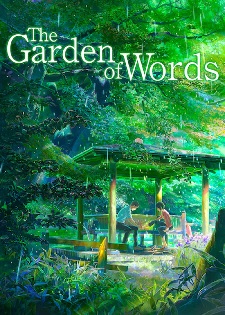
The Garden of Words is an ephemeral story surrounding a student and teacher who meet several times at Shinjuku Gyoen (a national park in Tokyo) during the rainy season. It is an atmospheric tale about life, love, and loss. It is as much about the trials of navigating being a teenager as it is about navigating adulthood, and how both periods of time can feel similar.

For Akizuki Takao, he has identified his passion already even though he is only 15-years old. He wants to be a cobbler and design shoes for a living. He skips class and ventures to the park to sit under a gazebo doing sketches while the rain falls.

For Yukino Yukari, she has already found her lot in life as a 27-year-old teacher of classical Japanese literature. But she is ignoring her job responsibilities and spending time at the park drinking beer and eating chocolate. Why she is shunning her teaching duties is revealed later in the film.

Both are lonely and feel isolated in their lives. Through their encounters, Takao becomes drawn to Yukari in a way that a young teenage boy would towards an attractive older woman. The fact she shows interest in his sketches and allows him to design shoes for her transforms Yukari into Takao’s muse.

Yukari’s time with Takao makes her forget of the demons she is facing at work. Turns out that she is being bullied by students who are jealous of her beauty. Instead of standing up for herself, she flees to the park with beer and chocolate in hand.

Their connection grows with each rainy morning that passes until eventually Takao confesses his love for her. Yukari, initially, does not return his feelings stating she is a teacher (and inferring their age difference) but she also realises deep down their connection and tells him that the time they have spent together has saved her.

In terms of story, The Garden of Words had the potential to delve into the myriad layers of what constitutes intimacy, connection and love (forbidden or otherwise). It could have transcended romantic drama tropes and shown connection without a confession of love. It could have examined the idea of how two disparate individuals (not just in age but in overall outlook on life) could impact each other in unexpected positive ways.

Attempts are made to do this. Yukari communicating to Takao through Japanese poetry, the way Takao does his sketches using Yukari and the park as his muse, the breaks in conversation leading to the pair absorbing the moment and the beauty of the ongoing motif of rain. However, there is an over reliance on the animation and setting to convey its messages. More on the visuals in a bit.

The story lacks the drive required for a plot that is dependent on its two main characters. I don’t mean that Takao and Yukari need to be emotional thunderstorms, I mean that their personalities, backgrounds and how they came to be in the position they find themselves is never explored beyond scratching the surface. In terms of depth, Takao is probably captured better when arguably Yukari is the more tortured soul.

In the end, The Garden of Words relies heavily on the stunning animation. And let me just say that the combination of hand drawing and CGI is truly exquisite. However, we are meant to draw symbolic meaning behind what we see. For example, the rain (uncontrollable like love), creating shoes (teaching how to walk), and drinking beer and eating chocolate (an odd combination representing Yukari’s emotional instability).

There is nothing wrong in the subtle and using visuals to convey messages is a tool that allows filmmakers to subvert expectations. But the visuals need to complement not carry the main characters. In the end, the emotional bind being experienced by Takao and Yukari lacks depth because we only catch glimpses of who they are deep down.

Like a passing shower on a sunny day, this film will largely be remembered for how beautiful it looks but the story won’t leave behind any significant impression.

6 out of 10

TV Review: Foundation (2021) – S01E01 – The Emperor’s Peace

TL;DR – Advancements in film, technology and CGI bring Isaac Asimov’s quintessential sci-fi series to life. This is the new standard in sci-fi cinematic experience. Episode 1 introduces us to Trantor, the capital of the Galactic Empire, ruled by Emperor Cleon for four centuries through cloning himself.

Review (warning: spoilers)

Let me stress something from the start. Isaac Asimov’s Foundation trilogy was published from 1951 to 1953. He actually did the writing of this series in the 1940s. Apple bought the rights to produce the series in 2017 and filming commenced in 2020. It has taken over six decades for a production company to attempt adapting this story to film. Prior to this, Foundation was considered by most as ‘unfilmable’.

The fact that it has now come to our screens is not the point (though this accomplishment is in itself ground breaking). What I want to stress is Asimov is a sci-fi writing genius. Not only did it win the 1966 Hugo Award for Best All-Time Series (a year where Lord of the Rings by J. R. R. Tolkien was also nominated), but the complex ideas and concepts have stood the test of time and have translated remarkably well when adapted to film. My mind is blown when it thinks that Asimov imagined Foundation in the 1940s.

Star Trek was written in the mid-1960s and Star Wars was written in the late-1970s. Neither of those sci-fi undertakings are as intelligent and epic as Foundation.

And therein lies the rub.

If you come in expecting Apple+ TV’s offering of Foundation season one to have clear archetypes and a plot that revolves around good versus evil, you will be sorely disappointed.

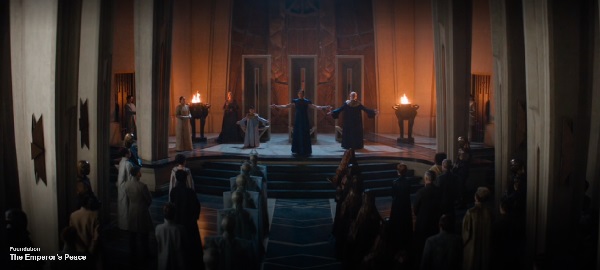
Foundation revolves around two schools of thought. We have the established Galactic Empire that has been ruled for 400 years by Emperor Cleon XII (Lee Pace) who is known as ‘Brother Day’. The line of emperors began with Cleon the First who cloned himself thus securing his existence in perpetuity. While Brother Day is the established ruler, there is ‘Brother Dusk’ (Terrence Mann) and ‘Brother Dawn’ (Cooper Carter). Brother Dusk is the Cleon clone who is now in his twilight years and Brother Dawn is the Cleon clone that will ascend to be the next emperor. Thus, the cycle is maintained as Dawn grows to become Day, Day grows to become Dusk, and Dusk eventually grows to be ‘Brother Darkness’ (later in the series we see that once a Cleon clone becomes ‘Brother Darkness’ they are turned to ash in a blink of an eye by entering some sort of pulsing laser furnace). The ‘new’ Brother Day gets cloned to create a newborn Brother Dawn. Cleon’s school of thought is to maintain stability throughout the Galactic Empire and allow kingdoms under his rule to flourish. Arguably, the system has worked because we see Trantor (the planet that is the capital of the Galactic Empire) as a hub from which races from all other planetary kingdoms come to.

This system becomes challenged when mathematician and psychohistorian, Hari Seldon (Jared Harris) presents a picture that foretells the Galactic Empire’s destruction and he states that this destruction is a mathematical certainty. Psychohistory was developed by Seldon that incorporates history, statistics and sociology to predict future events of a large group of people. Seldon posits that you can’t foresee the actions of an individual, but future events can be predicted over a general population mass.

As you can imagine, the Cleon trinity are not impressed with Seldon’s prophecy.

Episode one sets this all up and introduces Gaal Dornick (Lou Llobell) who lives on Synnax (a world that shuns any pursuit of science). Turns out Gaal is a science prodigy and she is whisked away at the bequest of Emperor Cleon and brought to Trantor to debunk Seldon’s psychohistorical forecast.

Seldon’s inquisition by the Cleon trinity is a brilliant sequence of events culminating in Gaal’s honest proclamation that Seldon’s calculations are correct. This coincides with a spectacular scene where the Starbridge (a station that acts as a flight terminal and connects new arrivals to Trantor by a giant space elevator that exceeds the Tower of Babel; it takes 14 hours to get from the Starbridge terminal down to Trantor ground level) is destroyed by terrorists.

This leads to a conundrum for the Cleon trinity. It appears that the downfall of the Galactic Empire has begun, and Brother Dusk’s initial reaction is to execute Hari Seldon as he perceives the scientist as creating a movement against the Empire. However, Brother Day is not so brash and questions Seldon and Gaal further. Gaal manages to convince Brother Day that Seldon represents hope and if you destroy hope then you will accelerate the Empire’s destruction.

Brother Day then questions Seldon and asks him if the downfall can be accelerated then can it not also be slowed? Seldon answers in the affirmative and states it can be slowed by a few centuries if imperial cloning is stopped. He goes on to say that the dynastic line of Cleon offers nothing different, nothing new that all it offers is “a younger grape from the same vine destined for the same old bottle.” He then declares, “You can’t save yourselves, but you can save your legacy.”

After deliberation, the Cleon trinity decides to stay Seldon’s execution and instead allows him to proceed with building a second foundation (in the words of Seldon, he calls it an ‘encyclopedic galactica’) but that this will not occur on Trantor. Instead, Seldon and Gaal (along with Seldon’s followers) will establish this new foundation on Terminus (an uninhabited ice rock of a planet on the outer reaches of the galaxy). Essentially, they are being exiled.

The emperor’s strategy is thus, the galaxy will know that he has sent Seldon to fight the fall of the Empire and if it proves that psychohistory is fraudulent then the foundation will simply wither and die. If the foundation proves to be true then the emperor will be seen as co-opting in saving the Empire and bolster its regime. To Brother Day, it is a win-win.

All this in the first episode. Epic does not do justice to describe this jaw dropping opening act. Asimov, you would be proud. It is worth noting that Robyn Asimov (Isaac’s daughter) serves as executive producer. I wonder if Isaac used psychohistory to predict that one day his Foundation series would lift off the pages and shoot into the stratosphere and beyond.

9.5 out of 10

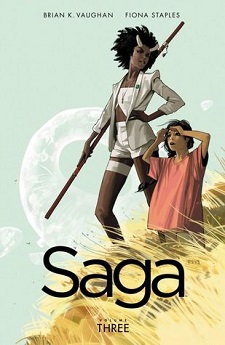
Book Review: Saga (Volume 3) by Brian K. Vaughan & Fiona Staples

TL;DR – Prince Robot IV finally catches up with Marko and company as does mercenary The Will and Marko’s ex-fiancée, Gwendolyn. There’ll be casualties and a bloody mess galore.

Summary (warning: spoilers)

Go to my book reviews page to read reviews of previous volumes of this Eisner award winning series.

Volume three sees Marko, Alana and baby Hazel arrive at planet Quietus to meet author, D. Oswald Heist. Accompanying them is Marko’s mother, Klara, and the child ghost, Izabel (now bonded with Hazel). Marko is mourning the loss of his father who sacrificed himself in volume two to save them.

On their trail is Prince Robot IV, who we know arrives on Quietus and confronts Heist at the end of volume two. Volume three rewinds events to show how Marko, Alana and company arrive before Prince Robot IV and end up hiding in Heist’s attic.

Also on their trail are The Will, Gwendolyn, and Sophie who are having spaceship troubles and are lagging behind.

The story jumps between that and a pair of tabloid journalists back on Landfall investigating into the story regarding Marko and Alana’s illicit relationship.

Review

Volume three takes a different route from previous volumes and comes out with mixed results. Sharing the lime light of our fugitive couple, we are introduced to the tabloid press who interview a sergeant involved in a conflict with Marko and Alana.

Upsher is a blue-skinned alien journalist and Doff, his green-skinned photographer. Together they start digging into the forbidden relationship between Marko and Alana and their love child, Hazel. Scenes jump between Marko and Alana and our investigative journos.

The introduction of these two new characters is meant to broaden the scope and impact of Marko and Alana’s relationship, but it felt like filler to me when all I wanted was to find out what will happen when Prince Robot IV finally confronts our fugitives. And as expected the confrontation does not happen until the end of volume three.

What is good about the build up is that Vaughan continues to reveal more of the history and personalities of the main cast. For example, Klara makes it known that she thinks Heist’s novel is complete trash and not some sacred text that is meant to transform the minds of Landfallians and Wreathers that will end the conflict. Her interactions with her son and Alana while being a loving grandmother to Hazel are spot on.

Another example is The Will, who is shown to have more layers than a mere mercenary for hire. Haunted by the murder of The Stalk (his ex-girlfriend) at the hands of Prince Robot IV, he is now out for revenge. However, he can’t go anywhere because his ship needs repairs and he has an epiphany imagining a conversation with The Stalk who advises he should drop his revenge trip and settle down with Gwendolyn and adopt Sophie. It’s these little developments that add extra dimensions to the characters.

Author D. Oswald Heist is also quite the character. His trashy novel “A Night Time Smoke” turns out was written with the intention of having a hidden message surrounding the idea that sex (yes, ‘sex’ not love) can conquer all including a galactic war. He’s also a drunk cyclops who wears slippers and a dressing gown and ends up puking all over Hazel when they first meet. I’m not sure how much of writer Vaughn is reflected in Heist, but I imagine he had fun creating the character.

The ending sees the confrontation between Prince Robot IV and Marko and company unfold but with the added complication of Gwendolyn thrown into the mix. Not everyone makes it out alive. Prince Robot IV becomes seriously damaged and reboots resulting in what one would call ‘robotic amnesia’. Heist gets killed by Gwendolyn, and Gwendolyn gets shot by Alana. The Will is on death’s door due to the unexpected twist of Sophie (high on hallucinogenic fruit) stabbing him in the neck, and Marko’s mother seriously injured.

In the aftermath, Marko and company escape. Gwendolyn manages to get The Will to a hospital and save him. Prince Robot IV wanders off into the fog on Quietus with robotic brain damage, and Heist being the only fatality. The volume concludes with a narrative from Hazel explaining they continue to flee from planet to planet on their wooden rocket ship and showing a passage of time leading to Hazel now a toddler able to walk.

As for our budding tabloid journos, they get silenced by The Brand (The Will’s sister). The Brand breaks in to Upsher and Doff’s home and injects them with a poison that will only activate and kill them if they breathe word of the story regarding Marko and Alana. Like I said… filler. Not as progressive as the first two volumes but gives deeper insight into the war ravaged galaxy Marko and Alana are seeking to raise Hazel in.

3 out of 5.

Anime Review: Mary and the Witch’s Flower (2017)

TL;DR – When Mary discovers a flower that gives her witch powers, she begins an adventure that will see her grow from shy sapling into a beautiful blossom.

Review (warning: spoilers)

Mary and the Witch’s Flower is Studio Ponoc’s first feature film. From the movie poster, you would be forgiven for thinking this is a Studio Ghibli film. The art and style are similar, and Studio Ponoc happens to have been founded by Studio Ghibli lead film producer Yoshiaki Nishimura.

The film opens with a series of buildings, built atop a giant tree, on fire. A red-haired girl is trying to escape with a pouch that contains flower seeds. Her pursuers wear masks and use purple balloon-like weapons that look like they contain magic. She runs to the end of a tree limb and is trapped until a broom comes whipping by that she has summoned and jumps on. She flies away, but the masked pursuers transform into weird silver flying dolphins and chase her.

A devastating bluish explosion destroys the buildings and envelops the flying dolphins. The explosion’s shock wave causes our red-haired witch thief to fall unconscious. She topples off her broom, her red hair turning brown (as if to indicate she has lost her powers) and releases the pouch containing the seeds. They land in a forest and immediately activate causing plants and trees to grow at lightning speed, the foliage enveloping and hiding the broomstick.

We then meet Mary, who has come to visit her aunt in the countryside. Full of energy and always wanting to help, we discover she is a bit of a klutz and tends to break things. She tries to help with the gardening but ends up with a basket full of leaves dropping on her head. This happens in front of Peter, a local boy from the town, which causes significant embarrassment. Feeling somewhat useless and bored, she wanders to a spot overlooking the countryside and eats some lunch. There she is visited by a black cat and laments that she can relate to being viewed as ‘unlucky’.

She follows the cat and finds a glowing blue flower known as the ‘fly-by-night’ which bestows temporary witch powers and only appears once every seven years. Mary’s world then opens to unexpected adventure involving the discovery of a witch college run by Madam Mumblechook and Doctor Dee. But all is not what it seems. The Madam and Doctor have been seeking the ‘fly-by-night’ and wish to unlock its magic by transforming a human into an unlimited source of power.

Everything comes full circle as it is revealed that Mary’s aunt was the red-haired witch at the beginning who stole the ‘fly-by-night’ seeds from the Madam and Doctor. She wanted to stop the experiments on animals and humans concluding that the seeds were too powerful to be harnessed in such a way. When the Madam and Doctor kidnap Peter to use for their experiment, Mary is spurred into action to save him along with all the animals that have been transformed into strange and mystical beasts.

Visually, the film is a feast for the eyes. The attention to detail warrants repeat viewing. And the story is based on “The Little Broomstick” by Mary Stewart. However, I can’t help but feel that Mary and the Witch’s Flower falls short.

It took some time for me to figure out while I felt this way. And then it dawned on me. Many of the of the story elements and the way they have been adapted in animated form comes from a range of Miyazaki (Studio Ghibli) films.

Mary’s interactions with flying a broomstick, and the broomstick itself displaying a personality is similar to Kiki’s Delivery Service, where the main character is a young witch who isn’t that great at flying a broomstick. Both Mary and Kiki have a black cat involved as their familiar, which is a common trope of witches. Further Mary is not initially enamoured by Peter and the same happens in Kiki’s Delivery Service between Kiki and the main male character, Tombo. However, as the story progresses Mary comes to like Peter and wants to save him from Madam Mumblechook’s clutches just as Kiki comes to like Tombo and rushes to save him (the climax involves Tombo holding on for dear life from a crashing airship, and Kiki is trying to use a broom to fly over and save him).

Then we have this discovery of a magical world which reminded a little of Spirited Away. The main character in that film, Chihiro, is also a young girl, who is awkward and lacks confidence, not dissimilar to Mary. There’s even a scene where Mary attempts to climb some stairs attached to a cliff face leading up to the college of magic, the stairs don’t have any railing so Mary clings for dear life against the cliff as she slowly makes her way up the stairs. A similar scene is in Spirited Away, where Chihiro has to descend a rickety wooden staircase attached to the side of a mountain with no railing.

And then there is a point where Mary doesn’t ride a broomstick and instead finds herself riding an elk among all these other animals that she has freed from magical transformation. This reminded me of Princess Mononoke, where the main male character, Ashitaka, rides Yakul, an elk mount.

Having not read “The Little Broomstick”, I am unsure what elements have been faithfully adapted from the book and what has come forth as story telling mechanisms by Studio Ponoc. But in the end, it felt like they had taken a bunch of different elements from Studio Ghibli films and mashed them together in Mary and the Witch’s Flower. What worked for Studio Ghibli will surely work for Sudio Ponoc too right?

Perhaps, if I had never seen any Studio Ghibli films, I would not judge Mary and the Witch’s Flower so harshly. As it is there was nothing fresh in Studio Ponoc’s debut feature film and the main character, Mary, lacked a certain level of depth. Hopefully, Studio Ponoc will dare to explore beyond their comfort zone in their next project.

6.5 out of 10

Movie Review: Eternals (2021)

TL;DR – Eternals are immortal beings that reside on Earth. Their purpose is to destroy Deviants, giant monsters that devour humans. The Eternals have eradicated the last of the Deviants and as a result the human population grows for thousands of years. That is, until a Deviant that exhibits powers not seen previously emerges in London...

Review (warning: spoilers)

In the Marvel Cinematic Universe (MCU), beings known as Celestials existed before galaxies were born. Fully evolved, they are larger than the size of planets. Arishem (voiced by David Kaye) is known as the Prime Celestial, and in Marvel Comics, his purpose is to judge whether a planet’s civilisation should live or die. In MCU, Arishem is slightly different. He uses planets to plant Celestial seeds, the planet’s population provides energy into the seed and eventually gives birth to new Celestials. Arishem refers this as the ’emergence’. Unfortunately, the emergence results in the planet cracking like an egg and all life on that planet is destroyed.

The Eternals (super powered beings that do not age) were created by Arishem to destroy Deviants (creatures that hunt and destroy life). By eliminating the Deviants, it would allow that planet to produce intelligent life.

The ten Eternals that are sent to Earth are led by Ajak (Salma Hayek) and they arrive in 5000BC. We get to see the group use the full range of their abilities against the Deviants over time:

  • Ajak has the ability to heal
  • Thena (Angelina Jolie) can conjure shields and weapons out of cosmic energy and battles like a warrior supreme
  • Ikaris (Richard Madden) is the only eternal that can fly and shoots lasers out of his eyes;
  • Sersi (Gemma Chan) can manipulate the composition of materials (for example, change a rock to water)
  • Druig (Barry Keoghan) can take over the minds of masses of people
  • Gilgamesh (Don Lee) has superhuman strength and can create gauntlets out of cosmic energy
  • Sprite (Lia Mchugh) is an illusionist, her appearance is the youngest of the group looking like a pre-teen girl
  • Makkari (Lauren Ridloff) has superhuman speed
  • Kingo (Kumail Nanjiani) can shoot cosmic energy projectiles from his hands
  • Phastos (Brian Tyree Henry) is an inventor/engineer.

Eventually, the Eternals believe to have eliminated the last of the Deviants, and Ajak allows them to go off to lead their own lives until such time as Arishem calls them to return home. Fast forward to present day (i.e. in terms of MCU timeline, we follow the Eternals post-Thanos and Avengers: Endgame) and we find out that Sersi and Sprite now live in London; Gilgamesh and Thena are in the Australian outback; Kingo in India; Druig in the Amazon; Iakris and Phastos in the United States and Makkari making her home in the spaceship they used to travel to Earth that is now buried in Iraq.

Sersi has gotten herself involved with a human named Dane Whitman (Kit Harington) and is at the point where she either needs to end the relationship or tell him the truth that she is an Eternal (cause he’s going to notice that as he gets older, she isn’t aging). When Sersi reveals her secret, Dane is not all that surprised given humanity has experienced alien invasions and sentient AI (Avengers: Age of Ultron), the vanishing of half of earth’s population (Avengers: Infinity War), Asgardian visitors in Thor and Loki, the revelation that magic does exist (Doctor Strange), the emergence of Wakanda and their superior tech (Black Panther), and the climatic war between Earth’s Avengers and Thanos and his army. Instead, Dane’s first question is why didn’t the Eternals help when Earth’s mightiest heroes faced off against Thanos?

Sersi’s answer is that their mission was to remove Deviants only and not to interfere in human affairs. This ends up being a minor point of contention for me because the Eternals do influence humanity’s evolution through the course of history. For example, Phastos the inventor/engineer Eternal creates technology that leads to the invention of the atomic bomb, and Druig halts the Spanish invasion on the Aztec Capital of Tenochtitlan by mind-controlling both sides. Regardless, Sersi’s answer is the only insight as to why we have not seen the Eternals previously.

The inciting incident comes when a Deviant charges into London with the express purpose of hunting Eternals. Not only does this Deviant go against its modus operandi of only killing humans by targeting Sersi and Sprite, it exhibits healing powers, which no Deviant has been capable of previously. Sersi and Sprite survive the attack with the help of Ikaris who flies in like superman without the cape.

What unfolds are several revelations that propel the story along. We discover Ajak and later Ikaris are the only Eternals that know the truth behind Arishem’s intentions (i.e. the Earth is a mere incubator for a new Celestial, and all life on the planet will be destroyed through the emergence). Ajak is found dead, killed by the Deviant who absorbed her healing powers but later we find out it was Ikaris who sent Ajak to her death. The reason for this is Ajak, having spent all this time with humans, now feels humanity should be allowed to live while Ikaris holds on to Arishem’s mandate. Ikaris doesn’t want Ajak to rally the others to try and stop the emergence, so he sends her plunging onto a frozen lake where awaits several Deviants.

The Eternals become split into two groups: those that believe humanity is worth saving (Sersi, Gilgamesh, Thena, Phastos, Druig and Makkari) versus those who hold to Arishem’s intention to birth a new Celestial (Ikaris and Sprite). Kingo opts out, he believes humanity is worth saving but that they can’t defeat Ikaris (who is basically superman without any kryptonite weakness).

The final battle between these two sides is epic. Makkari’s speed powers versus Ikaris was the absolute highlight for me.

But importantly, it’s not simply action that is worth the price of admission, it’s also the inner conflicts within each Eternal. While Ajak and Ikaris already know, the rest receive the revelation that they are mere copies of other Eternals, and their memories are wiped by Arishem when they are tasked to go to another planet to kill Deviants. The Deviants themselves were created by Arishem to exterminate apex predators on the planets they are sent to, but the Deviants evolve outside of Arishem’s control and start killing all life not just apex predators. The Deviants themselves are looking to survive the emergence by preventing population growth feeding into the Celestial egg.

I had to turn off my brain on this (another point of contention) because Arishem appears so powerful that he could easily wipe out the Deviants that he created in the first place. Instead, he creates Eternals to wipe out the Deviants, who themselves then rise against him. This reminded me of how humans try to introduce biocontrol to wipe out pests but end up replacing the pest with another pest. For example, in Australia, they introduced cane toads to wipe up cane beetles to prevent the beetles from destroying sugar cane crops. The toads did the job, but they are now the pests. But I digress.

Each of the Eternals struggle with their own lives and the revelations presented to them. Sersi (like Ajak) comes to love humanity, and she also falls in love with Ikaris. And while he loves her in return, it conflicts with his belief in Arishem’s mandate. Then we have an interesting relationship between Gilgamesh and Thena. Thena suffers from Mahd Wy’ry which causes mental instability and results in her attacking the other Eternals. It appears as a form of dementia but is actually Thena recalling memories of past missions that were meant to have been wiped by Arishem. Gilgamesh loves Thena and helps her through these periods. His death by the Deviant that killed Ajak puts Thena on a path of revenge. Sprite having the appearance of a young girl envies the lives of others who have the appearance of adults. She has an unrequited love for Ikaris but knows he will never look at her like he does Sersi because she presents like a young girl.

It’s not all doom and gloom though. Phastos ends up in a relationship with a human man and they adopt a boy as their son. Kingo becomes a Bollywood star and has some of the funniest scenes. And Druig is the communal leader of a small tribe living in the Amazon (it is a bit cultish given he can mind control the people, but he mostly chooses not to because he knows by mind controlling them they lose their free will and thus are less human).

The finale opens up many other questions that will see the Eternals return to our screens in the future and tie in with new threads of the MCU. Though the emergence is prevented, Arishem takes Sersi, Phastos and Kingo away to examine their memories and judge whether Earth should be spared. Thena, Makkaris and Druig fly off in their spaceship to find other Eternals and tell them what they have experienced. Their ship gets an unexpected visitor in the form of Eros (Harry Styles) who is introduced as Thanos’s brother. And then there is Sersi’s human boyfriend, Dane, who has his own secret which is revealed post-credits involving a sword in a case with the inscription ‘death is my reward’. For Marvel fans, this is the first reveal of the Black Knight.

Great popcorn flick with plenty to digest.

8 out of 10

Book Review: Saga (Volume 2) by Brian K. Vaughan & Fiona Staples

TL;DR – Marko and Alana are on the run in search of somewhere to hide so they can raise their newborn daughter, Hazel, in peace. You would think that when you have a galaxy of planetary systems to choose from, it would be easy. But when you have two sides of a war trying to hunt you down and that war is raging across the entire galaxy, hiding turns out to be harder than expected.

Summary (warning: spoilers)

Go to my book reviews page to read reviews of previous volumes of this Eisner award winning series.

Volume two focuses on backstory between Marko and Alana; how they met, Marko’s parents and childhood, Alana’s change in perspective of the war, their eventual connection and relationship, and conception of Hazel.

This is mixed in with current events that revolve around their journey to visit author D. Oswald Heist’s home. Marko’s ex-fiancée, Gwendolyn, makes her first appearance and joins forces with The Will as they track down Marko and Alana. Along the way, The Will and Gwendolyn rescue Sophie (the young girl trapped on Sextillion in the first volume) that The Will attempted to free.

Also, hot on the scent of our fugitive couple is Prince Robot IV, who figures out that Alana and company are heading to Heist. He has read Heist’s novel that Alana believes is revolutionary. Prince Robot IV also believes that there is a hidden message within Heist’s text that talks about how love (and sex) can conquer war and thus two opposing sides can achieve peace (or at least stop from massacring each other).

Volume two ends with Prince Robot IV confronting Heist who says he wrote the novel simply for a paycheck and that there is no hidden message within. Prince Robot IV is unconvinced and sits down to wait for Alana and Marko to come to him with a gun calmly pointed at Heist. Little does the prince know that Alana and company are already there hiding in the attic.

Review

The end of volume one saw Marko, Alana and their newborn child, Hazel, blasting off in a tree-like rocket ship that appears partially sentient. Their destination is the location of D. Oswald Heist, author of Alana’s favourite novel, ‘A Night Time Smoke’. Why does Alana want to visit Heist? Because she believes his writings can unlock the never-ending war between Landfall and Wreath. In her mind, somehow Heist’s trashy romance novel equates to a message from on high.

Joining their journey are Marko’s parents, who magically appear aboard the rocket ship when Marko intentionally shatters his sword. He does this in an act of penance for breaking his vow to never unsheathe his sword and dish out violence. The sword was a family heirloom and magically bound. As soon as Marko broke it, his parents knew and homed in on his location, magically teleporting inside their ship.

Also along for the ride is Izabel, an innocent victim of the war, who is now a fluorescent pink ghost with only her upper body and entrails exposed. She convinces Alana to allow her to magically bond with Hazel in exchange for showing them how to start the rocket ship.

While volume one sets the scene, volume two delves much deeper into the impacts of the galactic war especially from an emotional and psychological stand point. At its epicentre is our daring couple, Marko and Alana, but their relationship ripples to all other parties linked to them.

Marko’s parents, his ex-fiancée, Gwendolyn, Prince Robot IV, D. Oswald Heist, and Izabel all have their own stories, views and biases regarding the war. This lends depth and gravity to the central story around Marko and Alana wanting to raise Hazel outside of the war. And shows the strength of Vaughan’s writing.

Staples artwork also seems to be fine tuned in this second volume with outrageous and eye-popping panels including a fat, naked giant that reveals too much of itself and a planet-sized egg that gives birth to an embryonic shaped creature that acts like a black hole and shoots black goo from its eyes.

With a story driven by strong characters and backed by killer art, Saga volume two draws you in and makes you think honestly about violence and the impacts of war. Oh and The Will saves his Lying Cat from dying in outer space, which was pretty damn wicked… I would’ve been bummed if the cat died.

4 out of 5.

Anime Review: Blue Period (2021)

TL;DR – when living life is bland and boring and you stumble upon something that ignites the flame inside, pursue it through the fears and doubts. This is what Yaguchi seeks to do as he strives to become an artist.

Review (warning: spoilers)

It is not uncommon for anime to tell stories about anime or manga artists or writers. Bakuman being one of the most popular that comes to mind and which you can read my review here. However, Blue Period is probably the first anime I’ve seen that focuses on traditional art (e.g. sketching, painting, sculpture etc.) and the many facets, techniques, inspirations and doubts that come with pursuing this form of creative expression.

The main character, Yatora Yaguchi, is an intelligent student with a lacklustre attitude. He doesn’t know where he is going in life or what he wants to do. However, this all changes when he sees a painting of an angel done by an arts club member at his school. Something sparks inside, and he finds himself staring out at the city of Shibuya, seeing its beauty, and wanting to capture it on canvas. What he creates is a painting of Shibuya in many different shades of blue. He is thrilled when he receives praise for his work, and thus starts down a path to becoming an artist, much to the concern of his parents who can see his earnest passion but fear he will live a hard life as a result.

Yaguchi aims to be accepted into Tokyo University of the Arts (TUA), considered the most prestigious arts school in Japan. TUA only accepts one in two hundred applicants into their arts program, so Yaguchi understands he has a mountain to climb. What follows are the trials and tribulations of pursuing the craft, and Yaguchi encounters a wide range of other students and teachers with their own strengths, idiosyncrasies and unique views on art.

What made the anime interesting to me was that the series is willing to delve into the technicalities and tools used by artists (some may find this aspect boring), but this lends to an authenticity that combines well with the human element, emotion and interactions that Yaguchi experiences. He feels he is behind the eight ball and has a lot of ground to cover to catch up with other students who have spent years honing their artistic skills. This leads to the understandable self-doubt that plagues him and the building of his own character and perseverance.

The animation is impressive. How they manage to animate brush strokes, mixing of different coloured paints on a palette, and the finished piece of art on canvas are all done realistically, and you take it for granted that someone or some team of animators had to animate these things. They even animate an image of “Girl with a Pearl Earring” to a solid degree of efficacy, so kudos to Seven Arcs production studios.

All in all, Blue Period is an enjoyable story that seeks to show anything worth doing will not be easy and should be done wholeheartedly and with perseverance.

7.5 out of 10

Movie Review: Finch (2021)

TL;DR – The ozone shield has been destroyed by a solar flare resulting in humanity imploding. Engineer Finch is seeking to make the most of the time he has left by creating an A.I robot that will take care of his loyal dog once he passes.

Review (warning: spoilers)

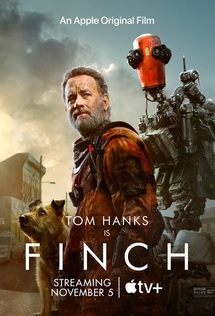
Finch Weinberg (Tom Hanks) lives on an Earth that has seen better days. The outside is an uninhabitable wasteland where temperatures and UV radiation are so high that you need a protective suit in order to wander around. We see Finch enter various collapsed buildings in search of food while he sings ‘American Pie’ by Don McLean. With him is trusty Dewey, a robot that appears to have a certain level of artificial intelligence. Finch manages to find some canned dog food and frantically returns to his home base just as a severe dust storm hits.

We watch Finch wash his suit, himself, and Dewey with care. A wracking cough indicating that Finch’s health is not in good shape. But his spirits rise when we see he has a companion, a pet dog named Goodyear. The lovable interactions between the pair, a clear sign of the bond they share.

His home is a combination of the futuristic mixed with the past. Finch is able to build and fix robots in a lab that also has shelves of books and an LP record player. He picks books, which he then places on a table for scanning by a robotic system. We see that some of the books being scanned relate to training and taking care of dogs. Finch tinkers with a new robot creation and proceeds to upload as much knowledge from the scanned books into its brain.

He powers up the robot and tests to see if it understands what he is saying. Eventually, it makes some progress and is able to communicate to Finch. However, the power goes out and Finch has to venture outside to fix up the wind turbine. There he sees a superstorm coming his way. He rushes back inside and asks the robot how long the storm will last and it predicts roughly forty days. Finch knows that he does not have enough food to survive that long. So with the robot’s knowledge transfer only 72% complete, he packs Goodyear and as much as he can into a modified motorhome and heads west to San Francisco.

Tom Hanks knows how to carry a film. If he can do it in Castaway with a volleyball he calls ‘Wilson’, he gets more than enough support from Goodyear, Dewey and his latest robotic creation, which it names itself as ‘Jeff’ (voiced by Caleb Landry Jones).

The motion capture and CGI creation that is Jeff is impressive. His evolution is a coming-of-age in an artificial intelligence-kind of way, and he looks up to Finch like a father figure. Set against a post-apocalyptic road trip, the journey and teaching of mortality are imparted on Jeff as he learns the difference between surviving and living, and the need for experience.

Though you know Finch will never live long enough to reach the Golden Gate Bridge and San Francisco, you will still be blubbering (or at least teary eyed) when he passes. The clock is ticking, and every moment Finch teaches Jeff is a moment that matters. A sci-fi film about existentialism that should be watched through those lens rather than the lens of a sci-fi thriller or action movie.

8 out of 10

Book Review: Saga (Volume 1) by Brian K. Vaughan & Fiona Staples

TL;DR – epic sci-fi series that centres on two individuals from opposing alien races that manage to fall in love against a backdrop of a never-ending war that spans the galaxy. When they manage to conceive a baby girl that has physical features from both their kind, they know their daughter symbolises a hope that threatens the war. Hunted by both sides, they do the only thing they can think of… they run.

Summary (warning: spoilers)

Alana and Marko are on opposite sides of a galactic war. A war that has raged beyond their two worlds and expanded to other alien races who have been forced to pick a side. Volume one contains the first six issues and focuses on Alana and Marko’s forbidden relationship and the birth of their daughter. Their family representing an aberration that could change the political landscape forever.

Review

Saga has been described as “Star Wars meets Game of Thrones”. That certainly is an ambitious undertaking. While this Eisner award winning graphic novel series certainly is epic in scale with a large cast of characters, it was for me more a Romeo & Juliet story as opposed to a Game of Thrones one (note: the Star Wars side is definitely captured in terms of the sci-fi elements and the multitude of alien races).

The story opens with Alana screaming her head off as she gives birth to baby Hazel. Her husband, Marko, is there and it is just the two of them in an old body shop. Immediately, there are questions that floated through my head: Why are they in a body shop and not a hospital? Why is it just the two of them? Where are the nurses? The mid-wives? The doctor? And why does the baby have horns?

If I had been paying attention to the art instead of racing through the first couple of pages of dialogue, the answer to the last question is obvious. Marko has horns; big, curling ram horns that would make Princess Leia’s hair stylist proud. But wait, Alana doesn’t have horns. She has wings; delicate, gossamer, emerald wings sprouting from her shoulder blades.

As volume one unfolds, it is revealed that Marko is a Wreather and Alana is a Landfallian, and Wreath and Landfall have been waging a war that has spread throughout the galaxy. We learn that their love is a definite no-no, and the fact they have a child together could turn everything on its head. Thus they are hunted by their respective sides in an attempt to prevent the rest of the galaxy finding out. It’s a Romeo & Juliet story on a galactic scale.

Landfall sends Prince Robot IV while Wreath sends a mercenary named The Will. The prince comes from an alien race that has a human body but a television for a head. I don’t know if there is some deeper meaning behind this though it is interesting how the television heads of the robot race display various images to convey emotions. By contrast, The Will appears like an ordinary man but with an extraordinary pet known as a Lying Cat (a giant feline capable of detecting when someone lies). Later, we see that The Will may look ordinary but he is exceptional at killing.

Volume one concludes with Marko, Alana and Hazel escaping Cleave, the mud planet where they met, fell in love, and Hazel came into being. But not before we learn a bunch of things about our lovers and the hunters seeking to track them down. Turns out Marko was engaged previously to a girl named Gwendolyn. He was naïve about fighting for Wreath (his eyes opened when he was thrown into the horrors of war) and made a vow to never unsheathe his sword in combat. Eventually he breaks this vow in order to protect Alana and Hazel and laments that his action will have consequences (violence begets violence).

Alana is revealed to have been indoctrinated into the idea of romantic love from reading trashy novels (think ‘Mills & Boon’ stories). She idiolises the author, D. Oswald Heist, who wrote her favourite trashy novel titled ‘A Night Time Smoke’ and believes there is a hidden message within its text. Heist lives on a planet called Quietus, and it is there that they aim to travel to.

Meanwhile, Prince Robot IV has been assigned the mission to hunt down the pair after just having served a two-year tour of hell. All he wants is to be with his wife and start a family. However, it is his father who requests he undertake the mission, much to his frustration. Following the trail of Marko and Alana, he encounters The Stalk (another mercenary hired by the Wreathers to also hunt down Marko and Alana and retrieve Hazel and happens to be the ex-lover of The Will). In a moment of panic, Prince Robot IV kills The Stalk thinking she is going for her gun.

The Will commences his own hunt to find Marko and Alana, but decides to not bother when he finds out from his agent that the Wreathers have also hired The Stalk. He instead ventures to Sextillion (a planet-size brothel) intending to sleep with whores but discovers a more insidious scene beneath Sextillion where children are being used. We find The Will does have some sort of moral compass and seeks to save a little girl but fails to free her. He then contacts, The Stalk, in hopes of partnering up with her to split the reward for killing Marko and Alana and retrieving Hazel (his plan is to buy the little girl’s freedom trapped on Sextillion). But he finds out that Prince Robot IV has killed The Stalk (he’s actually on the line talking to her when she gets shot). Now, The Will has two goals: free the girl from Sextillion and kill Prince Robot IV.

The multiple storylines are engrossing and the art by Fiona Staples is impressive. Worth the read for adult readers and shows publisher Image Comics are willing to explore stories that branch outside of the mainstream superhero/villain comic book form.

4 out of 5.