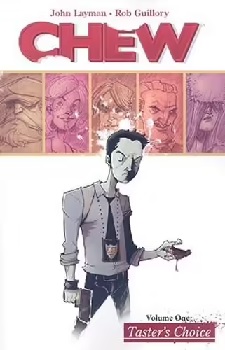
Book Review: Chew (Volume One) “Taster’s Choice” by John Layman & Rob Guillory

TL;DR – a dystopian world where there is a prohibition on poultry and individuals exhibit powers that revolve around tasting food. There’s conspiracy, intrigue and cannibalism… all you need in this award-winning graphic novel.

Summary

Tony Chu is a detective and Cibopathic. He can bite a piece of fruit and get psychic impressions of where the fruit was grown, what pesticides were used, and when it was harvested. Or he can take a bite out of a steak and get a much more violent psychic impression as to how the beef came to be served on his plate… the only food that does not trigger this ability are beets.

Together with his partner, John Colby, they work for the Philly P.D. busting illegal poultry distribution. Yes, you read correctly, it is illegal to sell, buy, or eat poultry meats. Why? Because years ago an ‘avian flu’ pandemic struck the world and wiped out millions of people. Subsequently, the governments outlawed the consumption of birds. This has led to conspiracy theories, protests, and plenty of underground racketeering in the area of poultry.

Volume one introduces us to this strange world where Tony’s unique ability allows him to solve many acts of culinary violence. Not that his boss treats him in any way other than a freak. Things take a more bizarre turn when he is recruited by the FDA (Food & Drug Administration), the most powerful law enforcement agency on the planet, and is thrown into a series of cases that hint to a far greater conspiracy than he could imagine.

Review

John Layman and Rob Guillory have created a story that is fascinating and gross in equal measure. This is a good thing for it provides a distinct feel, flavour and theme to the world of Chew. The story grabs you like a culinary delight filled with all manner of surprises, not all of them pleasant, but propelling you along to the next course with a curiosity that you can’t resist. The characters are all colorful and distinct, and artist Guillory has a style that is incredibly appealing. A combination of influences from other famous artists such as Steve Ditko, Dave Crosland, Rumiko Takahashi and Chuck Jones.

We’re introduced to Tony and John on a stakeout to bust an underground restaurant that serves chicken dishes. What they encounter is a sous-chef serial killer that has been kidnapping people and eating them (why eat chicken when you can eat human?)

Things quickly turn for the worse as they bust into the kitchen only for John to get a cleaver to the head. Tony captures the serial killer but not before he commits suicide by slitting his own throat (thinking he’ll take all his cannibalistic secrets to the grave). Tony, seeking to bring closure to the families of the murdered girls, proceeds to take bites out out of the killer to obtain the memories of the atrocities that have been committed. Tony closes all thirteen murder cases and captures the eye of Mason Savoy who recruits him to the special crimes unit of the FDA. And that’s all in chapter one…

Mason Savoy is a particularly fabulous character, a giant of a man, who talks with eloquence and a joy for rhetoric. He also happens to be a Cibopath and together they proceed to investigate a series of events including:

  • a missing health inspector
  • the Yakuza
  • a food critic named Amelia Mintz (who is a Saboscrivner; every dish she writes about is so real that people who read her words can taste the dish)
  • E.G.G (a terrorist organisation that believes the government has lied to the public about the avian flu)
  • and a bunch of astronomers working in a lab at the arctic circle.

There’s much to absorb in the first volume of this magnificent series. Every panel should be examined carefully as it provides hints as to what is to come. Chew will have you chomping at the bit for the future volumes. Enjoy the feast.

4.5 out of 5.
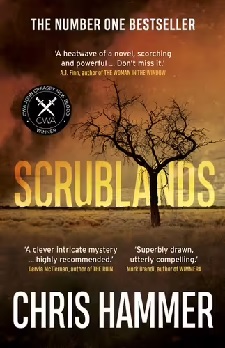
Book Review: Scrublands by Chris Hammer

TL;DR – Crime mystery novel that has been lauded for its realism in depicting a town devastated by tragedy and drought. The story is solid but I struggled to finish it (see full review below for reasons). In the end a passable read.

Summary

On a blistering, hot morning in Riversend, much-respected priest, Byron Swift, is getting ready for Sunday service. Wearing his casual clothes, he greets early arrivals and engages in friendly small talk. When Craig Landers, owner of Riversend’s convenience store, arrives with some of his mates from out of town, Byron shakes his hand, smiles, and they talk for a few minutes. When they finish Byron excuses himself and heads into the church to prepare for service. A few minutes later, the priest re-emerges wearing his robes, a crucifix reflects the sunlight and in his hands he holds a high powered rifle with a scope and proceeds to fire calmly and methodically on his parishioners. Five people are killed before the local constable arrives on the scene and shoots Byron dead.

Twelves months later, Martin Scarsden, a journalist, visits the drought-stricken town of Riversend to do a story on the one-year anniversary of the mass shooting. The story is only meant to focus on how the community is recovering, but it becomes evident that it has never recovered because the full truth is still yet to be told.

Review

The debut novel by Chris Hammer has a lot going for it, even if readers will see striking similarities with The Dry by Jane Harper. He captures outback Australia and a small country town dying from drought in a manner that will make your throat feel parched. A former journalist himself, Hammer is able to throw the reader into his main character, Martin Scarsden, and capture what it is like to be a journo and the methodical mind that is required for the profession. Scarsden also has his own mental and emotional issues, and this allows for a layered character that readers should find intriguing.

There is also care in creating a believable setting. A lovely map of this fictional town is provided at the beginning of the book and its description as Scarsden explores his surroundings comes to life off the pages. Outside of town, the scrublands is a place that is desolate and vast and will make you feel like it can swallow you whole without anyone ever noticing. When a bushfire comes screaming through the scrublands, Hammer describes the series of events as the townspeople rush to stop the devastation with such wonderful detail that you’ll be wanting to check the smoke alarms in your own home.

The plot is also intricate and should keep you guessing until the end. The mystery of why Byron Swift goes on his violent rampage and the many secrets each of the townsfolk are hiding allows the story to continue ticking over and suitably the pages as well. The many sub-plots almost seek to undo the ending, but Hammer is able to tie everything together in a way that is believable if fantastic in some areas.

All the above are strong reasons why Scrublands has done so well and Hammer awarded the 2019 John Creasey (New Blood) Dagger by the UK Crime Writers’ Assocation.

Where I feel it came undone was in how Hammer describes his female characters. His depiction of male characters is strong. Scarsden, Swift, Robbie Haus-Jones (the constable), Codger Harris and Harley Snouch are portrayed with depth. But the female characters didn’t grab me at all. The main female character, Mandalay Blonde (the name itself not doing me any favours) is portrayed as having “Hollywood” good looks. She has some level of complexity in that she’s a single mother and her own mum was allegedly raped. Unfortunately, she’s a “damsel-in-distress” type character and every time Scarsden sees her he’s amazed at how beautiful she is. In fact, in one paragraph of the book, Hammer describes Mandalay from the perspective of Scarsden as beautiful twice. He doesn’t even bother using a different adjective.

And, of course, Scarsden ends up sleeping with her. This was enough to take me out of the story on numerous occasions. Blonde plays a pivotal role in the story but she’s portrayed as helpless, in need of saving, and I found it annoying how Scarsden interacts with her. Her depth felt artificial as much as the description of how she looks.

If you can overlook how Hammer writes his female cast (to be honest, there aren’t many and that’s probably because he’s just not good at it) then the rest of the story can carry you through.

2.5 out of 5.

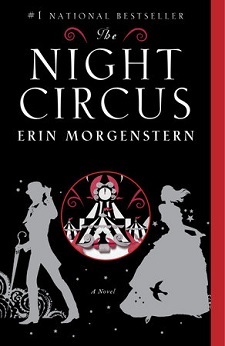
Book Review: The Night Circus by Erin Morgenstern

TL;DR – two magicians, who can conjure actual magic, compete against each other using their proteges.

Summary

Celia Bowen and Marco Alisdair are selected by two rival magicians to compete in a deadly contest where the night circus is the stage. The two proteges conjure ever more intricate and complex spells in the night circus without understanding the rules of the contest or why the contest exists. Through each encounter, both in the real and magical world, Celia and Marco begin to connect on a level much deeper than mere competitors. And it is only revealed much later by their cold-hearted, immutable magician masters that the only way the contest will end is if one of them dies.

Review

Erin Morgenstern’s tale of wonder and woe is sumptuously filled with evocative passages that seek to tantalise all the reader’s senses – sight, sound, smell, taste and touch. It’s an ambitious undertaking but she achieves it through her incredible imagination of the night circus; a magical venue that opens only between sunset and sunrise and transports itself around the world in a blink of an eye.

A key pre-requisite to the reader is not to ask why. If you want to understand why the contest exists between powerful magicians – Prospero the Enchanter and Mr. A. H. (aka ‘the man in the gray suit’) – then you will be sorely disappointed. If you ask, why do these two compete through proxy instead of duking it out themselves? You won’t get an answer.

Prospero and A.H. may have once been of this world, but from what I can gather they have reached a level of god-like power where they now use us as pawns in a chess game. They are aloof, stoic and lack empathy toward any other human being. This is demonstrated when Prospero is willing to use his own child as one of the contestants in their deadly game. Why? Don’t ask. I imagine the pair as two bored all-mighty beings who decided to use mortals in a game of life or death just for kicks.

Then there’s this little nugget that may drive readers to put this book in the bin or at least, back on the shelf:

“I’m not certain I understand the rules,” Marco says.

“You don’t need to understand the rules. You need to follow them. As I said, your work has been sufficient.”

Mr. A. H’s response is nothing short of him viewing Marco as a bug that needs to know how insignificant it is. The master magicians are perfect foils for making the reader care about Celia and Marco. And when the story focuses in on the young pair, the world opens to so much more.

What follows is an adventure that is spell-binding. A feast for fantasy readers. The supporting cast are integral in making the night circus come alive with more than the astounding magical feats of Celia and Marco.

Chandresh Lefevre (a theatre producer), Tsukiko (a contortionist), Friedrick Thiessen (a clock maker), Widget and Poppet (two children born on opening night of the night circus), Bailey Clarke (a young boy obsessed with the circus) and Isobel Martin (a clairvoyant and fortune-teller) are but some of the other characters and all have an important role in the the fate of the night circus and Celia and Marco’s lives.

I especially enjoyed Isobel Martin. Prior to meeting Celia, Marco and Isobel meet and fall in love. She is a tragic figure in the story because once Marco meets Celia he starts drifting away from her. But she plays a pivotal role in the circus. Her emotional conflict drew me in completely to the love triangle that confronts her, and actions that she takes are painful and genuine.

A welcome read that I have no hesitation in recommending to those who enjoy the fantasy genre.

Step right up, step right up, come one, come all and enter the night circus.

4.5 out of 5.

Book Review: Supermarket by Bobby Hall

TL;DR – A psychological dark comedy that puts you in the mind of a struggling writer looking to succeed at all costs. Even if it costs his sanity.

Summary

Flynn has dreams of being a successful author, but he can never finish a story he starts. When his girlfriend dumps him, it triggers a depression that almost drowns him, but he catches a break when a publisher offers a potential book deal on condition that he finishes his manuscript. He decides the only way to complete the story is if he goes method by working in a supermarket for which his story is set. The pressure to write causing his mind to blur the lines between reality and fantasy.

Review

Bobby Hall’s debut novel has been described as Naked Lunch meets One Flew Over the Cuckoo’s Nest – if they met at Fight Club.

If you are aware of these references then this does sum up Supermarket succinctly. It’s a trippy journey that is primarily fuelled by emotional napalm rather than narcotics or alcohol, and demonstrates the darkness that can consume a person that suffers from depression, stress and anxiety.

The human mind is a wondrous thing, but it can also be a prison. The book examines themes of schizophrenia, mental illness, treatment and therapy as we follow Flynn on a journey that keeps you turning the pages even if you can dissect what is real and not and can predict where the story is heading.

When Flynn decides to use the supermarket and his fellow workers as inspiration for his novel, it all makes sense. Writers often draw from their own experiences in order to tell a story, and what better way to tell a story set in a supermarket than actually working in one?

Flynn bases the main protagonist of his novel on Frank, an employee that Flynn admires for his rage-against-the-establishment attitude and laissez-faire outlook on life. Frank has his flaws: he’s chauvinistic, a womaniser, steals from the cash register, and has a gun in his locker for the day some maniac goes nuts in the supermarket. But these flaws are nuggets of writing gold for Flynn to create a more realistic character and are traits that, in their own strange way, Flynn gravitates towards.

There is enough banter, comedic moments, and flashes of hope (e.g. love interest Mia) interspersed amongst the madness that prevented me from putting this book in the DFA (did not finish) basket. It could have been too mind-bending for me to get to the last page, but Flynn’s interactions with different staff at the supermarket carried me along.

However, where I struggled wasn’t in the passages of darkness where Flynn battles his mental demons and his own sanity. Nor was it an inability to empathise with Flynn as Hall does a great job of capturing the challenges of being a writer whether it’s self-doubt, writers block, or procrastination.

What grated me was that Hall does the whole edginess and “see how clever I am?” a little too much like throwing a meat pie at my face and telling me to enjoy it even though I’m vegetarian. For example, when you’re a writer (Hall) writing a story about a writer (Flynn) who is trying to write a story and decides to break the fourth wall by having Flynn talk directly to the reader (me) and then admitting he’s taking you out of the story by telling you something directly… then it’s like what’s the point?

Then there’s a section in the second act where Flynn is describing an interaction at a library. He breaks the fourth wall by telling the reader that he’s not sure he should be describing this interaction. He purposefully diverts the discussion from the upcoming events at the library by telling the reader that this is what you do in novels… you describe stuff. And then goes on to say that he could have told his entire story in five minutes AND then he starts trying to actually summarise the two hundred pages I’ve read previously in a separate narrative to me (the reader) as if doing me a favour.

Is this meant to be edgy? Is it meant to be reflective of the mental instability of Flynn the character? Maybe both, but I don’t think Hall really pulls it off. Other readers may find these passages refreshing or original, but it took away for me what was a pretty engrossing story.

Still, Hall delivers in many other ways. In the acknowledgements, he talks briefly of how he wrote part one in the “darkest of times” and it was only two years later that he awakened to write part two. Clearly, this has been a work of passion (and catharsis) drawn from his own personal experiences and that resonates in the story of Flynn.

3 out of 5.

Book Review: The Wife and The Widow by Christian White

TL;DR – a brilliant suspenseful tale of two women and the lengths they go to for the ones that they love. If you like crime mysteries, this is a must read.

Summary

Grief-stricken Kate (the widow) discovers her husband led a life unknown to her. Abby (the wife) lives on a tourist island and is confronted with the prospect that her husband is a murderer. Both seek to uncover the secrets of the men in their lives and in the process discover not everything is what it seems.

Review

Christian White has written a crime fiction novel that will have you turning every page with an eagerness to reach the destination. When you get there, you will be filled with awe.

Or in my case, filled with an intense desire to throw my keyboard out the window and give up on writing for I was stunned that someone could write like this. The prose is eminently readable and the female leads are both vivid and convincing.

Kate Keddie is a Melbourne city woman waiting for her husband, John, at the airport. Her young daughter, Mia, bounces excitedly next to her seeking minute-by-minute updates. When the plane from London finally lands and passengers start emerging through the exit doors into the arrivals lounge, the atmosphere is filled with the anticipation that comes from a collective group of people waiting to spot their family or friends returning from faraway. But when John doesn’t emerge, the excitement is filled with a sudden dread. Kate checks she hasn’t missed any calls, texts or emails from her husband telling her that he missed the flight. Nothing on any of the channels. When later, Kate phones Trinity Health Centre for Palliative Care, where John works as a physician, she expects they would know of any news from her husband since they were the ones who sent John to the medical conference in London in the first place. That’s when she discovers, John hasn’t worked at the health centre for three months…

Abby Gilpin is married to Ray and has two teenage kids in Lori and Eddie. They all live on Belport Island, a holiday destination for the city folk. Abby is a dutiful wife, caring mother, loves reading true crime stories, and works at the local supermarket. Her husband Ray runs a business called Island Care, which provides cleaning and maintenance services to home owners. When a body is found on the island and it all points to murder, Abby becomes as intrigued as the rest of the locals until her world starts turning upside down when she begins to suspect Ray is involved.

White is skilled in throwing the reader right into the thick of it, and I found myself investing in the dilemmas of Kate and Abby and following their paths until they eventually cross. He also introduces a third, silent character that is every bit as important as the two main protagonists – Belport Island.

In summer, Belport Island is a tourist hot spot. Only a ferry ride from the mainland, it serves as the perfect place to getaway from the big smoke and city grind.

In winter, Belport Island is a ghost town. The locals rely heavily on the summer peak season to eke out an income, but most of the businesses close during the winter.

White captures the malaise that festers across Belport during the frigid months, and the love/hate dependency the locals have on rich city folk coming to their town. The island is a reflection of this attitude when tourists vacate after summer break is over and the cold settles in leaving the locals to fend for themselves. Everything feels harsher. The rocky shores look sharper, the currents of the sea more treacherous, the holiday homes empty and lifeless, and the streets sapped of warmth beneath steel grey skies.

Belport Island is the perfect setting, the perfect silent character, that weighs down on the minds of Kate and Abby as they each search for the truth about the men in their lives.

One of the best reads I’ve experienced in a very long time. Damn you, Christian White, damn you.

5 out of 5.