Book Review: The Elements of Eloquence by Mark Forsyth

TL;DR – no one ever talks about the language unless you are Mark Forsyth.

Summary (warning: spoilers)

An essential (I repeat essential) book for every writer, budding author, lyricist/songwriter, screenwriter or individual who is curious about what makes a phrase stand out from another. A writer without this book is like a pianist without a piano.

Review

Mark Forsyth has gone to the effort of demystifying how the greatest writers write. What makes a convincing argument? How did the masters of rhetoric (e.g. Greek philosophers, American presidents, famous musicians like The Beatles etc.) capture audiences and have them listening to their every word? Why is Shakespeare considered the greatest playwright in the English language?

Did they have angels (or demons) on their shoulders whispering turns of phrase into their ears? Did some higher power bestow upon them a gift greater than the gab? Or were they all individuals of destiny guided by a clarity of purpose that was beyond us mere mortals?

The answer is no.

It is none of these things. Forsyth not only breaks down the tools that makes a sentence eloquent, but he demonstrates that even, what the world considers, the greatest writer that ever lived in Shakespeare came about his creations through the in-depth study of formal rhetoric.

From alliteration to hyperbole to anaphora, Forsyth is able to summarise each and every one of these tools and provide a plethora of examples to demonstrate its effectiveness.

For example, an epistrophe is the repetition of words at the end of consecutive sentences for emphasis. The Pulitzer prize-winning Grapes of Wrath by John Steinbeck uses this technique:

“Wherever there’s a fight so hungry people can eat, I’ll be there. Wherever there’s a cop beating up a guy, I’ll be there. […] And when our folk eat the stuff they raise and live in the houses they build – why, I’ll be there.”

Forsyth does much more than explain these tools to the reader. One would think dissecting passages from great works would be a dry topic, and understanding the difference between polyptoton and antanaclasis would not aid in one’s writing but instead just give you a mild headache. But what Forsyth does is he explains these tools not only in an accessible way but also with humour.

It is a genius piece of work and actually gives hope to anyone looking to tell a story and get published. I cannot recommend this book any more highly.

5 out of 5.

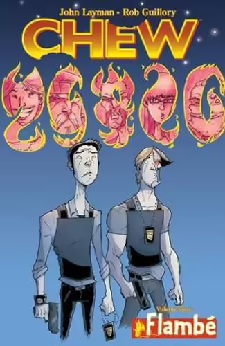
Book Review: Chew (Volume Four) “Flambe” by John Layman and Rob Guillory

TL;DR – In the aftermath of fiery alien writing appearing in the sky, the prohibition on poultry no longer seems a priority, but Tony Chu still has a job to do.

Summary (warning: spoilers)

Go to my book reviews page to see what has happened in previous volumes of this award winning graphic novel series. Volume Four begins with a flashback of a thriving chicken fast food industry and then the events of an avian flu that wiped out millions and resulted in the subsequent prohibition on cooking/dining/eating poultry.

Moving to present day and the appearance of fiery alien writing encircling the globe, and the population is no longer concerned with a poultry prohibition. Instead, everyone is focused on what the writing means. Is it first contact with an alien species? Is it an act of God indicating the end is nigh? Or something else entirely? The general agreement is that whatever the writing means, it isn’t good.

FDA Agent Tony Chu is still doing his job, investigating crimes related to food, but with government funds all now being poured into NASA to try and figure out the alien writing, enforcement of the poultry prohibition is taking a back seat.

Review

Chew Flambe begins to reveal more of Tony’s family, and building upon the introduction of the Chu household seen at the end of Volume Three (Chew Just Desserts). Specifically, Olive Chu (Tony’s estranged daugther) and Toni Chu (NASA special agent and Tony’s twin sister). The mystery of the alien writing is now at the forefront of this story arc and triggers many to react in different ways.

Chapter 1 has Tony hunting down an FDA agent that has gone AWOL by the name of Daniel Migdalo, who is a Voresophic (an individual with the power to look at pictures and give detailed historical profiles of the individuals in the pictures. He also needs to consume large amounts of food to fuel this cognitive/psychic power). Since the appearance of the alien writing, Daniel has gone off grid. When Tony finds him, he’s become ridiculously obese and has gone mad, continually spouting mathematical formulas, which one would have to think is reaction to seeing the alien writing. Whatever Daniel is trying to say is never understood as he attacks Tony only to lunge at a pack of mints which Tony throws out the apartment window. This results in Daniel going splat on the street below and killing himself.

Chapter 2 focuses on a nerd student (who has experienced constant bullying) at a school that Olive also attends. Said nerd has concocted some sort of drug that he puts in food and makes the person who consumes it do what he says. This results in the nerd getting revenge on the students who bullied him by inciting a food fight that ends in a blood bath of thrown cleavers, stabbing of forks and knives, and smashing of metal chairs over heads. Tony comes in to apprehend the nerd from blowing up the school.

Chapter 3 sees Tony and his partner, John Colby, joining a suicide mission to stop a mad General who has developed a bio-weapon that mimics what the avian flu did three decades ago. The reintroduction of the killer rooster Poyo is both hilarious and alarming.

Chapter 4 has Tony working with his twin sister, Toni, as they investigate Area 51 and bust a scientist making bullets from the metals of meteors. And the final Chapter involves Tony and John going undercover to get information on a cult that worships eggs and foretold the alien writing would come.

Throw in Mason Savoy who kidnaps Olive and a chunk of the earth disappearing (yes, literally going poof) and you can see there’s plenty to read in Chew Flambe. Lots go on and nothing is revealed as to the mystery of the alien writing that pervades in the sky. It’s a collection of stories of how people have reacted to it and how the world is devolving. The cliff hanger ending has ensured I will continue reading on in this excellent and weird series.

What has Savoy got in store for Olive? What is the explanation behind the alien writing? The various individuals that have powers connected to food still appears to all tie into this underlying mystery. Bring on the next volume!

4 out of 5.

Book Review: The Promise Seed by Cass Moriarty

TL;DR – an elderly man and a young boy are neighbours connected by loneliness. Both their lives are victims of circumstance. Together they discover that they have more in common than they initially realise, but when the boy’s single mother starts a relationship with an abusive man, choices will be made that will shake the foundations of their friendship.

Summary (warning: spoilers)

An old man, who seems to have never caught a break, lives alone tending his garden and taking care of his chickens. He reminisces about a life filled with heartache and hardship. It all started when he was a little boy, and he was found standing over the crib of his dead baby sister. The events of his life that followed were forever scarred by that moment. Several decades on, and he now wishes to live the remaining years of his life in peace. But the kid next door is always causing such a racket.

Next door lives a young boy with his single mother. The boy loves his mother, and she loves him but has no desire to take care of him. She wants freedom of a single life, her love for her son conditional on him taking care of himself while she goes drinking and comes home with strange men. The boy feels lonely and sometimes watches the old man tottering next door, working in the yard and hen house.

One afternoon, due to an incident involving the boy stealing cigarettes, he hides in the hen house. The old man finds the boy but doesn’t give him up to the strange man (whose cigarettes the boy stole from). This leads to a tentative alliance between the pair that slowly grows into genuine friendship.

However, their bond becomes threatened when the boy’s mother starts seeing a man with a penchant for violence.

Review

Cass Moriarty’s debut novel is an evocative, atmospheric drama set in Brisbane, Australia, that captures the innocence of youth and the frailty of age. Chapters alternate between the old man and the boy. Moriarty uses a clever, simple technique to give a distinct voice between her two main protagonists. She writes all the chapters about the old man in first person, and all the chapters about the boy in third person.

Her ability to capture the Australian slang and feel of the old man is spot on. A man that had his prime years during a time when computers were not common place and newspapers were printed using metal letters that needed to be arranged in the right order before a print run. And she achieves the same level of depth and feeling when writing about the young boy next door.

The reflections of the old man’s history is relatable and emotionally moving. It’s a life that was hard but also had highlights and pleasures even if they didn’t last. His reflections influence his interactions with the young boy; he sees a lot of himself in the boy and begins to realise the hardships the boy is going through could lead to destructive behaviour. So, even though he thinks he is old enough to put his feet up and not have to get involved with anyone else’s business, the kindred spirit he feels for the boy causes him to go out on a limb and try to nurture the potential he sees. And in the process, the boy (in his own way) teaches the old man that he still has plenty of things to live for. Together they raise chicks, build a vegetable garden, and spend a glorious Christmas day together on the beach.

All of this is beautifully written. When the boy receives a bicycle as a birthday present from his mum, I was taken back to when I was a child and received my first bike also. His excitement and the places he rides off to reminding me of my own childhood and those simple thrills and joys. Moriarty is exemplary in her ability to capture both young and old souls.

The tensions and inciting incidents that are introduced by the story’s antagonists come in the form of the boy’s mother and her bikie boyfriend named Snake. His name is due to a body length tattoo of a snake that winds itself all along his back with its head and eyes staring from the back of his neck. It is obvious that Snake is nothing but trouble. But the levels to which he takes things out on both the mum and the boy are shocking and disturbing. Domestic violence on this scale was an alarming counterpoint to the beauty and kindness experienced between the old man and boy. It shows the stark reality life has, that is, where there is light, there is also shadow.

A remarkable novel that moved me in many ways. Moriarty’s literary fiction drama was short-listed for the 2013 Queensland Literary Awards for emerging author, short-listed for the 2016 Courier Mail People’s Choice Queensland Book of the Year, and long-listed for the 2017 International IMPAC Dublin Literary Award.

4.5 out of 5.

Book Review: Nightflyers by George R. R. Martin

TL;DR – shoe string sci-fi horror about the crew of the starship Nightflyer seeking to explore the furthest regions of known space in search of an alien race.

Summary

Karoly d’Branin assembles a crew of scholars and experts on a journey to locate the Volcryn, an alien race with interstellar technology that surpasses every other race. The Volcryn’s purpose is a mystery. They pass through regions and events always moving outwards towards the fringes of known space, and they do so without any apparent desire to interact with anyone or anything. Karoly, determined to unlock this mystery, sets out on a transport ship called the Nightflyer. The starship is piloted by Royd Eris who locks himself in part of the ship where no one else can access. This results in most of the other crew wanting to find out who their enigmatic and secretive captain is and why he will not reveal himself.

When one of the scholars suddenly dies in horrific fashion, the stress of the journey, combined with the claustrophobic confines of the ship and a captain who is always watching them remotely, causes the rest of the crew to unravel. Karoly is determined to continue on and find the Volcryn, but will he ever achieve his quest or will external forces conspire against him?

Review

George R. R. Martin wrote Nightflyers prior to his critically acclaimed Game of Thrones series. In his early career, he wrote primarily sci-fi and combined them with horror elements, and Nightflyers is one of those efforts. Being a novella, Martin demonstrates he is as capable of writing epic length fantasy as he is in writing short stories. His ability to convey suspense and horror in concise, evocative language to maintain word length is exemplary.

In saying that, the story in Nightflyers won’t shock avid readers or movie watchers of the hybrid sci-fi horror genre. Books like Solaris by Stanislaw Lem or Blindsight by Peter Watts along with films such as 2001: A Space Odyssey and Event Horizon have themes and elements similar that run through Nightflyers.

Still, it is written in a way that will have you turning the pages even if you can see where it all leads. The reason for this is the colourful collection of crew that rides the Nightflyer starship.

Karoly d’Branin is the astrophysicist and leader of the group, who is obsessed in finding the Volcryn and study them.

Royd Eris is captain of the ship and never leaves his quarters. He communicates to the rest of the crew through speakers or a ghostly hologram.

Melantha Jhirl, a genetically engineering woman, is considered the epitome of the human species in terms of physical strength.

Lommie Thorne (cyberneticist), Alys Northwind (xenotech), Rojan Christopheris (xenobiologist), Dannel (male linguist), Lindran (female linguist), Agatha Marij-Black (psipsych) and Thale Lasamer (a frail young telepath) make up the rest of the crew.

All of the characters, except arguably Melantha, are flawed in some way (or multiple ways). By all appearances, Karoly chose his team solely on their expertise in their particular field and not on whether they can actually get along. Even Dannel and Lindran (the two linguists), who are in a romantic relationship, belittle and argue with each other all the time. It leads to conflicts on many fronts.

You will read this story because you will want to know who comes out of it alive., and in this way, the book is effective. An atmospheric novella more about the characters than the plot.

3 out of 5.

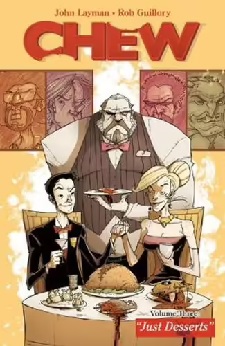
Book Review: Chew (Volume Three) “Just Desserts” by John Layman & Rob Guillory

TL;DR – Tony Chu is turning the corner and things are finally looking up. Work has become tolerable thanks to his partner returning to duty, and he’s found love in food critic, Amelia Mintz. But when you work for the Food and Drug Administration (FDA), you always have a target on your back and Tony finds himself in the cross-hairs of many enemies.

Summary

Go to my book reviews page to see what has happened in previous volumes of this award winning graphic novel series. Volume Three begins with Tony and Amelia infiltrating an elite diners club where the richest dine on the rarest and most endangered plants and animals. The ensuing bust leading to the full blossoming of their relationship.

Tony then goes on assignment undercover and retrieves the death-dealing rooster known as Poyo back into law enforcement hands. Meanwhile, Mason Savoy (ex-FDA agent, wanted murderer, and the man responsible for ripping off Tony’s right ear in Volume One) has been doing his own investigations into Ray Jack Montero who Savoy discovers knew about the ‘avian-flu’ that wiped out millions of people before it occurred.

Montero’s company is seeking to introduce a new artificial meat that tastes like chicken called fricken. Montero falls on Tony’s radar when he tastes the artificial meat and discovers it is actual meat albeit a genetically modified one (i.e. Montero’s scientists have altered frog DNA to now combine frogs and chickens into one). Tony and his team go in and bust Monetro’s operations, but in doing so unwittingly blows another FDA’s assignment (an agent by the name of Ceasar Valenzano, who has ties with Mason Savoy).

This leads to John Colby, Tony’s partner, encountering Savoy at an estate owned by Montero. Savoy is there in burglar gear rifling through Montero’s confidential files but is caught in the act by Colby resulting in the pair facing off against each other.

Review

Mason Savoy returns after his absence in Volume Two, and we see he still surveys a chess board that Tony Chu is but one of the opposing pieces (as opposed to a main player). Savoy’s motives are not fully revealed, but it is clear he has kept tabs on his former FDA partner and knows Tony is a threat. As with my reviews of Volumes One and Two, Savoy is one of my favourite characters and it’s clear he’s playing for the long game.

Along with Savoy, the connection between Tony and Amelia finally bears fruit, and it’s great to see their relationship evolve.

Colby, after getting a cleaver to the head in Volume One and being transformed into a half-cyborg, gets put through the wringer again when he fights a desperate Savoy.

All the elements that make this series engaging – great storytelling, killer art, distinct characters – returns in Volume Three and the ante is upped.

But what drives this volume to another level are the final chapters where we get a glimpse of Tony’s past and the introduction of Tony’s family.

The past is in the form of former fiance, Min Tso, who was so obsessed with Tony that she severed her own toe to give to him when he proposed to her. Safe to say, the relationship did not last. It’s a flashback that makes me wonder if Min might make an appearance in later volumes.

And then we finally meet the Chu clan at Thanksgiving. There’s Toni Chu (Tony’s fraternal twin sister), Chow Chu (already introduced in Volume 1, the older brother chef), Harold Chu (Tony’s cross-dressing younger brother), Sage Chu (moody younger sister), Bao Chu (mother), Bok Chu (deceased father), Ong Chu (grandfather), Charlie Chu (distant cousin), Rosemary Chu-Shen (older sister), Tang Shen (brother-in-law), Chip Chu-Shen (nephew) and Bree Chu-Shen (niece).

And then there’s Olive Chu… Tony’s daughter. First time we see her and you know immediately that their relationship is strained. Olive doesn’t have much to do with her father, and it seems Tony doesn’t know how to communicate to his daughter.

Prior to Thanksgiving, there’s a brilliant sequence of panels where we see Savoy having dinner and the last course is Tony’s ear (the one he ripped off violently in Volume One). Being a Cibopath like Tony, he starts getting images of all the people in Tony’s life and he eventually hones in one person, which you know he has targeted. Yes, you guessed it, Olive.

The flashback of Min, Savoy’s unsavoury dining experience, and the introduction to Tony’s family brings much expectation for the next volume.

Volume Three ends with a strange phenomenon as the Chu family are interrupted by the sound of a car accident. As they rush outside, they see that the cause of the accident is a series of alien fire writing that has appeared suddenly in the sky. The alien writing didn’t register until I went back to Volume One and realised they showed hints of this already. An alien planet named Altilis-738, the focus of the Gardner-Kvashennaya international telescope based in the arctic (and where Tony and Savoy ventures to as part of their investigation), receives the same fire writing in the sky before the alien planet is obliterated.

It’s clear things are about to get weird.

5 out of 5.

Book Review: The Vegetarian by Han Kang (translated by Deborah Smith)

TL;DR – a South Korean woman who experiences terrible dreams about animal slaughter decides to stop eating meat. This decision leads to a descent into madness and examines the impacts on those around her.

Summary

Yeong-hye has been the dutiful wife to Mr. Cheong and living a life that is routine. This all changes when she decides to abstain from consuming meat after a series of graphic dreams involving killing animals. Her abstinence slowly transforms into the belief that she is actually a tree and soon refuses to eat anything entirely. The degradation of her well-being causes ramifications to those closest to her.

The book is told in three parts. The first part is told from the perspective of Mr. Cheong. The second part is told from Yeong-hye’s brother-in-law (his name never revealed). And the final part is told from Yeong-hye’s sister, In-hye.

Review (warning: spoilers)

The winner of the 2016 Man Booker International Prize is a difficult read. Not because of the translation from Korean to English (Deborah Smith does an astounding job) but because I didn’t encounter anything that I liked.

All my book reviews are rated on enjoyment, and that enjoyment comes from a multitude of factors including character development, writing style, plot and themes. I do not exclude books on genre, nor will I rate a book poorly because of its genre. As with all readers, I do have preferences. I’m drawn more to fantasy/sci-fi and crime/mystery than I am to other genres like sick lit or horror.

The Vegetarian falls into literary fiction and Asian culture genres. The exploration into one particular Korean family, the way they live, and how it all falls apart is insightful and, at times, both horrifying and fascinating. However, it is not so much a story, as it is an indictment on how Asian families fail to support each other when one of them suffers from mental illness. I have read in other reviews that this was not necessarily Han Kang’s intention and that she was thinking more about universal questions surrounding innocence, beauty and violence. However, the story presents a picture that shows clearly the failings of a particular culture and the fault lines that can occur in family units.

None of this means that the book cannot be enjoyable. In fact, the story is effective in evoking images that will stay with you long after you’ve read the last page. The characters are vivid, the extremes in behaviour haunting, and the three perspectives showing different facets of personalities and the choices they make are initially intriguing. All of this lends toward a piece of work that deserves the awards it has won.

The problem for me is that effective does not always equate to enjoyable.

Take Mr. Cheong, Yeong-hye’s husband, who lives an existence that is nothing short of plain. This is how he wants it. A life without troubles or exuberance. A life of staying in one’s lane and never wanting to experience anything (uplifting or otherwise) in another lane. He chose to marry Yeong-hye on the basis that he thought she would make a wife that would not cause trouble and would allow him to maintain his existence of ordinariness. So, you can imagine the upheaval that is caused to his life style when Yeong-hye stops eating and begins to think she is a tree. He has no sympathy for his wife’s plight (or I didn’t buy into any attempts of sympathy, if anything he wants to be pitied for his wife’s behaviour). He makes one feeble attempt at an intervention by inviting Yeong-hye’s family over, who then proceed to force Yeong-hye to eat, which leads to violent and destructive results. Yeong-hye is hospitalised and Mr. Cheong, now widely taken away from his own lane, decides to leave her and serves her with divorce papers. Real nice… not. I found him to be a despicable character with no redeeming values whatsoever.

Then we have Yeong-hye’s brother-in-law. He is a video artist who becomes obsessed with the mentally ill, Yeong-hye, and imagines creating an art video involving two people making love with their bodies covered in painted flowers. He convinces Yeong-hye to participate because she likes the idea of flowers being painted on her naked body (remember she thinks she’s a tree). The brother-in-law hires another artist who agrees to have his body painted in flowers for the video, but the artist leaves when he’s asked to have actual intercourse with Yeong-hye. This leads to the brother-in-law having flowers painted on himself and filming a sexually explicit video with Yeong-hye. It’s essentially rape of a mentally ill woman. Again, another character that has no redeeming values even though, from his perspective, he tries to convince you his actions are reasonable. Reality check, it’s not. Not even close.

This leads to In-hye, the sister, who discovers the video and calls the authorities to arrest her husband. In the process, Yeong-hye is placed in a mental hospital. In-hye is the only character of redeeming value. She is also the only family member that seeks to help Yeong-hye (none of the other family, not even the parents, visit her in hospital). In-hye is the suffering character, she is now a single mother, trying to take care of her son as well as her mentally ill sister. She experiences her own mental breakdown and the story ends with no resolution.

The no resolution ending is probably what you would expect from this type of story. Along with the first two parts told from the two male antagonists, I also struggled with the fact that at no time do we go deeper into Yeong-hye’s mind or view any events from her perspective. The mystery of her horrific dreams, the reasons she believes she is a tree, and her descent into mental illness are never told from her view. The mental illness is merely the trigger to how other characters unravel.

The Vegetarian is evocative, effective and elusive, but is it enjoyable? For me, no.

1.5 out of 5.

Book Review: State Highway One by Sam Coley

TL;DR – After a car accident causes the death of his parents, Alex returns home to New Zealand and embarks on a road trip with his twin sister, Amy, to seek reconciliation and ultimately redemption.

Summary

Alex and Amy’s parents are not exactly nurturing. Absorbed in their own careers, they often leave their children to fend for themselves, giving them a freedom that their friends are envious of but they view as empty and unloving. Alex hangs around for as long as he can stand; he has a passion for music and a good friend who keeps him company when his parents are not around. His twin sister, trying to be more positive, seizes her freedom to do what she wants and holds parties while their parents are away.

In the end, an incident occurs that has nothing to do with their parents, which drives Alex to pack his bags and move overseas to Dubai (as far away as possible from his home country, New Zealand). Three years later, he finds himself rushing home after receiving the news that his parents have died in a car crash. He’s in a daze, filled with regrets, haunting memories and attends a funeral that is mainly a blur. He can’t face returning home and having to deal with all the stuff left behind, so his sister convinces him to hop in the car and they go on a road trip along State Highway One, starting from the north of New Zealand going all the way down to the south.

Review

Sam Coley’s debut novel is a well-deserved winner of the 2017 Mitchell Prize for Emerging Writers. It’s a sweeping tale that showcases the beauty of New Zealand and the fragility of life through the strained connection between Alex and Amy and their estranged relationship with their parents. Coley captures the guilt and angst of Alex through every thought, speech and action he has with his sister and does so with words that make you feel like you’re in the car with them, watching them smoke, drink, argue over the music playlist, and the glimpses of need amongst all the anger and reckless driving.

The story moves between past and present as the puzzle pieces of Alex’s life comes together to burn deep in the reader’s mind. State Highway One was recommended to me because I enjoyed The Wife and Widow by Christian White. As a result, I confess I was keeping an eye out for a specific device that Coley uses in his story. When I identified it, the story seemed to drag a bit, and I felt a desire to jump to the end because I knew the reveal.

As with most creative works, especially stories, it is best to go in without any preconceived ideas. You’ll enjoy it all the more I promise you. Instead, I found the repeated desire of Alex to stop the road trip because his sister was driving him nuts and wanting to buy a ticket back to Dubai wears thin after about the halfway mark. Each time he contemplates this action, Amy reminds him that he promised to take her all the way south, to the end of State Highway One. The signs are there if you know where to look and once you do, you’ll know where it is all heading.

Still, it’s a poignant tale, if a little long-winded for me. A journey of self-discovery through all the stages of grief and self-destruction amongst the amazing scenery of New Zealand before finally reaching a destination that is so insignificant in time and place to anyone else, but means everything to Alex as he keeps his promise to his sister.

3 out of 5.

Book Review: Chew (Volume Two) “International Flavor” by John Layman & Rob Guillory

TL;DR – Tony Chu, government agent and resident Cibopath (i.e. he gets psychic impressions of whatever he eats), finds himself journeying to a strange, tropical island where there is a fruit that tastes like chicken.

Summary

Chew (Volume One) book review provides introduction and background to the world of Chew. Volume Two follows agent Tony Chu to the island of Yamapalu where he hunts down clues in relation to a fruit called gallsaberry that looks like a cross between a pineapple and an octopus and tastes exactly like chicken when cooked. In the process he crosses paths with a covert operative named Lin Sae Woo who is hunting down an international mass murderer; uncovers a gambling ring involving cockfighting and a rooster named Poyo; stumbles into a business turf war over chicken substitutes between a rich Texan named Ray Jack Montero who is looking to scientifically modify frogs to taste even more like chicken and the Yamapalu governor seeking to sell gallasberry to the world and put his island on the map; and saves his brother chef Chow Chu and journalist Amelia Mintz who get caught in the crossfire.

Review

So much goes on in this graphic novel, both from the story written by John Layman and the art drawn by Rob Guillory that readers will enjoy going over Chew more than once. It’s always a sign of a great graphic novel when I revisit its pages and take in more details that I missed on previous readings.

As with the first volume, multiple threads develop. Some get tied off, while others are slowly being interwoven. The underlying mysteries indicating that the scope spans further than the boundaries of Earth.

What further draws me into the world of Chew are the individuals that exhibit culinary powers beyond the senses of smell and taste.

There are the three Cibopaths, individuals that receive images of the origins of what they eat. The first is our by-the-book and main character, Tony Chu, who finds himself having to bite into all manner of unsavoury things.

Next is the man of rhetoric and preamble, Mason Savoy, who has become Tony’s enemy. Sadly, Savoy does not make an appearance in Volume Two.

And lastly, the mysterious Serbian who pretends to be a vampire but is really a serial killer and targets other individuals that have culinary powers to try and absorb them through cannibalism.

Next there are Saboscrivners, individuals who can write down what they eat with such realism that whoever reads their words can taste the food also. Love interest, Amelia Mintz, is a Saboscrivner and is thrown into harm’s way in Volume Two much to Tony’s distress.

And then there’s Cibolocutors who can communicate written works (such as Shakespeare) and their own speech through food. The Great Fantanyeros is a Cibolocutor who becomes a target of the Vampire.

After reading Volume Two, I cannot help think that the reasons these people exist is tied to the mystery behind the ‘avian flu’ that wiped out millions of people and resulted in the global poultry prohibition. I’m eager to find out in future volumes if this is true.

Do yourself a favour, and take a bite into this fabulous graphic novel creation. I’m rating this half a point lower than Volume One only because my favourite character, Mason Savoy, is absent. He’s a terrific antagonist and was sorely missed. However, I’ve seen the cover for Volume Three and it’s clear that Savoy comes back!

4 out of 5.

Book Review: Lincoln the Unknown by Dale Carnegie

TL;DR – it is often said that behind every great man there is a great woman… and then there’s Abraham Lincoln.

Summary

A biography of Abraham Lincoln written by Dale Carnegie, who pulls back the curtains on a man who experienced almost unending darkness to achieve change during a time when blood, sweat and tears soaked American soil.

Review

Clementine Churchill was married to Winston Churchill for 56 years. Coretta Scott King was married to Martin Luther King Jr for 15 years before her husband’s assassination in 1968. Both women created lives that were filled with numerous accomplishments while being steadfast, supportive wives to their husbands. They are a couple of examples that fit the “behind every great man there is a great woman”.

Then came Mary Todd Lincoln who broke the mold. At least, that is how Carnegie portrays her and what you will walk away with if you read this biography.

I don’t normally read non-fiction, but when a friend of mine recommended me Lincoln the Unknown, I thought I would give it a go. While there have been many books written about arguably the greatest president in American history, I discovered that Carnegie’s biography of the man captures far more than Lincoln’s political accomplishments and chronicles a life that was profound with suffering and an almost unheard of strength of will to strive for what he believed in.

Though debated by historians, Carnegie states in no uncertain terms that Abraham’s first and true love was Ann Rutledge, who died of typhoid at the age of 22. The many events that follow leading up to his marriage to Mary Todd Lincoln will leave you gobsmacked.

By all indications, she was a manipulative, power-hungry, jealous, angry, and mentally unstable woman who made Abraham’s life a living hell. Carnegie does not mince his words and makes it clear in no uncertain terms that she was considered a devil woman with many of Abraham’s closest friends urging him not to marry her. The fact that he did through Todd’s manipulation and his own honour as a man demonstrates he operated in a time that no longer exists today.

How Abraham Lincoln went on to achieve everything he did is beyond me. From his first inaugural address to the Emancipation Proclamation to the Gettysburg Address and reunifying a nation torn by civil war, Lincoln lived a life that any other person would have looked at and said, “Yeah, that’s not for me.” Imagine the stress, anxiety, pressure, worry and insomnia he experienced as a result of being president during a civil war with an economy going down the tube and then throw in a marriage that left nothing but heartache and pain.

One could argue whether Lincoln would have achieved such immortal greatness if he was happily married. That being driven out of his home by a vindictive, jealous wife forced him to focus on his life’s work rather than the idea of life’s love.

We will never know.

4 out of 5.

Book Review: Scythe (Book 1 of Arc of a Scythe series) by Neal Shusterman

TL;DR – In a world where disease and death has been mostly conquered, over population becomes an issue. Enter the Scythedom, an organisation that is responsible for the selection of those chosen to be gleaned (killed) in order to maintain a population level that can be sustained. They provide a necessary service… or is it really necessary?

Summary

Humanity has created an artificial intelligence known as the Thunderhead. It has evolved to the point where it creates a near-Utopian society. Everyone has a link to the Thunderhead, a relationship that allows the AI to serve and protect them from sickness, disease, violence and even self harm. People now have the ability to live forever. This leads to the problem of over population.

The Scythedom came into being as a means to cull numbers, and it was decided that this could only be performed by humans. It also is the only organisation that the Thunderhead has no jurisdiction over. Along with a licence to kill, scythes are also given a ring that allows them to grant immunity for a period to the family members of those that they glean/kill; this immunity means that those family members cannot be gleaned themselves for a year.

With this as the backdrop, the story follows Citra Terranova and Rowan Damisch, two teenagers that are chosen by Scythe Faraday to be his apprentices. Both grab his attention for demonstrating a level of moral fiber that he believes is a requirement to become a scythe. He explains to them that the Scythedom meet three times a year at a great assembly known as conclave to discuss the business of gleaning and whether more scythes are needed. He has been given one ring to take on an apprentice. He decides to take on two and whoever succeeds in being anointed a scythe, the other will return back to their normal life.

But this gets turned on its head when Scythe Goddard (a rival scythe whose methods of gleaning, Faraday disagrees with) manipulates vernal conclave and obtains a ruling that whoever of Faraday’s apprentices gets ordained as a scythe, he or she must then glean the other apprentice. Thus sets the stage for book 1 of the Arch of a Scythe series.

Review

Neal Shusterman has written an astounding young adult novel that is both fascinating and gripping. A world where living forever creates a whole different set of problems (not just overpopulation but stagnation in individuals living a life of meaning and purpose) and a system is established through the introduction of scythes to stem the tide of population growth, Shusterman achieves enough dystopian realism that you believe that if such a world existed, the world of Scythe would be it.

Both Citra and Rowan are immensely likeable, their personalities and motives for accepting their apprenticeship distinct. Scythe Faraday is the perfect foil for both of them until events tear the apprentices away from their master. This inciting incident leads to them going down very different paths before meeting up again at winter conclave where it will be decided who will be ordained the next scythe and in turn also end the life of the other.

I enjoyed the ending of book 1, and it sets the stage for a larger scale story in book 2. You sense there is far more to be told than the two lives of Citra and Rowan. Hints toward a much more complex tale between Scythedom and the Thunderhead. Yes, the Thunderhead intrigued me to no end. And that is what you want in a trilogy. For each book to have a satisfactory end yet tying together a bigger picture. Remarkable effort.

4.5 out of 5.