Book Review: Shadow and Bone by Leigh Bardugo

TL;DR – Alina serves the Ravka army as a mapmaker. Assigned to cross the Shadow Fold, an expanse of darkness filled with demonic winged monsters, she almost dies but discovers a long dormant power that allows her to summon light and fend off the creatures. This discovery leads to a chain of events where Alina is thrown into the world of politics and manipulation to try and save her country from its enemies. Fans of young adult fantasy will devour this story.

Summary

Alina Starkov and Mal Oretsev are raised in an orphanage in Keramzin. Thick as thieves, the pair grow up together with a bond that is stronger than blood. When they come of age, they enlist in the First Army of Ravka. Alina is a mapmaker and Mal is an expert tracker. Their regiment journeys to Kribirsk where they see the Shadow Fold.

The Shadow Fold, also known as the Unsea, is like a gaping wound that runs south of Ravka to the border of Shu Han and all the way north to the border Fjerda. It is filled with demonic flying creatures known as the Volcra. Cut off from the coast, East Ravka struggles to survive and must often send soldiers through the Fold in order to access West Ravka so they can access the imports it receives from other countries that cross the true sea. Ravka has been at war with Shu Han and Fjerda for over a hundred years, and the Fold is a blight that traps the country between two enemies.

When Alina and Mal board a sandskiff and commence the perilous journey through the Fold, they are set upon by a swarm of Volcra. Among the blood and chaos, Mal becomes badly wounded and Alina rushes to his side. When a Volcra swoops down and latches on Alina to carry her away, all looks lost until she unleashes a blinding white light that destroys all the nearby Volcra. Alina loses consciousness in the process and awakens to find herself back at Kribirsk and is escorted unceremoniously to meet the Darkling.

The Darkling is the leader of the Second Army of Ravka. While the First Army are non-magical, the Second Army is comprised of Grisha (humans capable of conjuring magic). When the Darkling confirms that Alina is not only a Grisha but has the rare ability to summon light, she is whisked away to the Little Palace to commence training in the Grisha arts. There she is plunged into the political machinations and internal power struggle between Ravka royalty and Grisha. Alina is anointed the Sun Summoner, a being capable of freeing Ravka from the Fold, reuniting east and west, and finally making the country whole once more.

Will she save Ravka from its enemies (and itself) or destroy it?

Review

Book 1 of the Shadow and Bone trilogy introduces the world of Grisha, masters of the small science, who are capable of conjuring magic. Corporalki are able to manipulate the human body; they can heal and harm with a wave of their hand. Etherealki control the elements wind, fire and water. Materialki are inventors that have powers to change compositions of various chemicals and substances such as steel, glass and textiles. Collectively, they are known as the Second Army of Ravka.

Leigh Bardugo has built a fantasy world that establishes firmly magical arts that follow a set of rules. She then surrounds this fantastical element with real life common themes that humans see, experience and struggle with. Whether it is the emotions of love, joy, envy and jealousy experienced by the main characters or the broader impacts of war and political backstabbing, readers will identify with these as the familiar and thus be fascinated by the fantastical.

The greatest strength of Shadow and Bone comes not only from the character relationships between Alina, Mal, the Darkling and supporting cast but also from the established prejudices, suspicions, and power struggle between non-magical humans and Grisha. Ravka is ruled by a king and queen who are non-magical. The King has the First Army, soldiers who use armour and weapons to wage war against the northern Fjerdans and the southern Shu Han. The First Army is seen as the protectors of the country, the Second Army supports the First Army, and Grisha are perceived to be secondary. They all serve the King.

This does not sit well with the leader of the Second Army, the Darkling, who seeks to establish a world where Grisha are on equal footing. Actually, that’s not true, the Darkling wants to establish a new order where he is the ruler of Ravka and Grisha are respected as the higher beings. Forget equal footing, the Darkling wants to not only free Ravka from the Fold, the Fjerdans and Shu Han, but he also wants to be rid of serving a King that he perceives as inept.

This leads to what I felt was the greatest weakness of Shadow and Bone. The story that unfolds reveals that the King really is inept, he treats Grisha (including the Darkling) as servants. He surrounds himself with riches and comforts while the rest of Ravka starves and struggles to survive. Both he and the Queen are largely figureheads who hold parties and live lives of indulgence. Why the soldiers of the First Army along with all the non-magical peasants and serfs of Ravka follow the King is bewildering. There is no insight as to how the King holds on to his power, how he utilises it to control the Darkling and the Grisha. I can only assume that the King’s ancestors were wiser, stronger, and more powerful rulers, but this is never mentioned in the book.

Instead, I am left baffled why the Darkling and the Grisha put up with any of this nonsense. The Darkling could do away with the King in any number of ways and establish a new order, but he chooses not to. The only inference in the book is that he mentions to Alina that the age of Grisha power is coming to an end, and weapons technology of the First Army is advancing and will surpass Grisha power. From what I can tell, the Grisha population is substantially less than the non-magical population, so by pure numbers the Second Army cannot defeat the First Army.

Bardugo even goes even to the point of saying through one of her characters that everyone (including the Ravka First army and the non-magical people) knows who is the real leader and that’s the Darkling.

Still, putting this aside. Bardugo delivers a wonderful character in Alina and captures her naivety and eventual transformation into maturity well. Arguably, it is as much a coming-of-age story about Alina as it is a fantasy adventure. The interactions between her and the Darkling, and her and Mal, carry the story through to the end.

Plenty of symbolism will also have readers chomping at the bit. Alina is the Sun Summoner, the Darkling is the Shadow Summoner, who will prevail? Who can Alina truly trust while she is at the Little Palace training to use her power? Is it Genya, the Grisha tailor who Alina feels a genuine friendship because she is like a slave to the King? Is it Baghra who tries to teach Alina how to use light summoning magic? Is it Botkin, a former Shu Han mercenary, who teaches Alina in hand-to-hand combat? Is it the Apparat, a priest and spiritual advisor to the King who totally creeps Alina out because he seems to be stalking her? Or can Alina actually trust the Darkling and what he seeks to do (i.e. reunite Ravka)?

The one constant, Mal, is not with her. He has been sent off north to track down a mysterious stag that can act as an amplifier for Alina’s powers. Their separation is both heart wrenching and a driver for the story because you want them to reunite. And you know they will reunite, it is just a matter of when and under what circumstances.

Shadow and Bone closes in a dramatic but satisfying fashion and a key realisation for Alina comes in the form of an act of mercy. The writing flows easily and while aimed at young adult readers, it is imminently enjoyable for older ages who enjoy fantasy also. I look forward to reading book two – Siege and Storm.

4 out of 5.
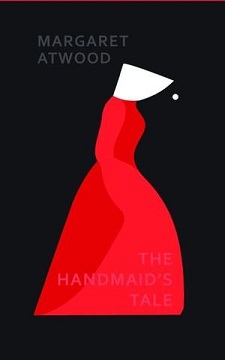
Book Review: The Handmaid’s Tale by Margaret Atwood

TL;DR – dystopian, speculative fiction about a world where freedoms have been overrun and women have lost all rights including the control of their own bodies. A disturbing look into a society that has lost all its humanity.

Summary

The Republic of Gilead (RoG) is a patriarchal, military dictatorship that has taken control of the United States. Set in a time where environmental pollution has caused the bulk of the female population to become infertile, the RoG restructures society based on extremist interpretations of the Old Testament, which results in human rights (especially those for women) being restricted or removed entirely.

The Handmaid’s Tale tells the story of Offred (not her real name) who becomes a ‘handmaid’ with the express purpose of having children for RoG commanders she is assigned to. This is her story, her journey to survive, to find freedom.

Review

What is there to say that has not already been said about The Handmaid’s Tale? Margaret Atwood has created a work that will likely stand the test of time and has cemented her as one of the great writers of the 20th century. I will not attempt to dissect all of this story’s messages, symbolism, and commentary on how it reflects on human society today. You can read any number of articles that do deep dives into Atwood’s work and/or you can just watch the TV series. Regardless, it is deserving of all its accolades, awards, and critical acclaim.

Instead, all I will say is what I felt when I read this book and whether I enjoyed it.

It achieves what it intends, a level of realism that disarms you and causes you to fall into a world that makes you think, “This could really happen.” Atwood’s mastery of the language places you deep inside Offred’s mind and you feel all her strengths and weaknesses as if they are your own. Atwood flourishes details as viewed from Offred in ways that hits close to home (or too close to home as it may be).

It is a world full of fear, where even those in power (i.e. the Commanders and, to a lesser degree, the Commanders’ wives) are also under the microscope for any signs of going against the established doctrine and system. For example, the Commander that Offred is assigned to invites her in to play Scrabble and gives her magazines to read. This would be seen as an act of treason. Offred is merely a vessel, whose sole purpose is to be impregnated. She is not meant to be seen as a human being with her own thoughts and intellect.

Every interaction and emotion described in this book demonstrates Offred’s humanity in an inhumane world. The fact Offred is able to see this humanity even in her captors demonstrates Atwood’s ability to create a world that is real and far from black and white. Disturbing and horrifying in parts mixed with moments of genuine tenderness and hope creates a roller coaster ride where I found myself having to reach the end.

But did I enjoy it? In short, no.

It is a brilliant piece of work, no doubt about it. Yet, ‘enjoyable’ is the last word I would use to describe it. Why? Because it is a dystopia that focuses on the very worst that we can become. Remember, how I said it can hit too close to home? I see enough dystopian behaviour on the news, in social media, and in day-to-day reality that I do not need to immerse myself in it through a story.

However, is it worth reading? In short, yes. It is worth reading because of how effecting it is and how it leaves impressions and thoughts that will make you ponder long after the last page is read.

But enjoyable, no, and as an avid reader that counts for a lot in my books.

2.5 out of 5.

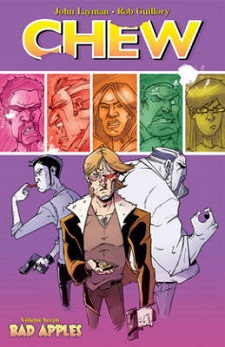
Book Review: Chew (Volume Seven) “Bad Apples” by John Layman and Rob Guillory

TL;DR – Tony Chu and his family are in mourning. Tony’s fraternal twin, Toni Chu, murdered. Sadness quickly turns to anger and Tony Chu takes his first steps on his path of revenge.

Summary (warning: spoilers)

Go to my book reviews page to see what has happened in previous volumes of this award winning graphic novel series. Volume Seven sees Tony Chu on a mission to hunt down The Vampire, the man responsible for murdering his sister.

The chapters in this volume follows a series of missions/assignments that Tony undertakes in order to find where The Vampire is. Starting off with uncovering those responsible for releasing into the market a soda drink that burns fat rather than putting it on, only to discover it does more than burn fat cells, it causes the drinker to self-combust literally. This leads to a shoot out involving the immaculate ova cult (religious fanatics who worship chicken eggs and want to kill anyone who eats chicken) at a chicken fast food joint. And then infiltrating a camp that trains ova cult fanatics.

Piecing together clues along the way, Tony eventually arrives to an undisclosed location in Eastern Europe where he sits down to a holographic image of The Vampire for a meal. The Vampire offers Tony a chance to join his side and for them together to consume others with ‘food powers’, so they can become the most powerful cibopaths in the world.

For the avoidance of doubt, Tony makes it clear to The Vampire that he has no intention of joining him, and that he is going to hunt him down and kill him.

The final chapter sees Tony trying awkwardly to reconcile with his estranged daughter, Olive. In the process, he discovers that his deceased sister, Toni, has left him something valuable.

Review

After the epic finish in Volume Six, which showed the grisly murder of Tony’s sister, and the emotional tidal wave that I found myself drowning in, Volume Seven was always going to be challenged in terms of delivering the same highs and lows.

In truth, Volume Seven goes about setting up plot lines that I am sure will be important later on, but there is not anything in these chapters that packed as an emotional punch as what happened in Volume Six.

While Tony spends most of the time angry and stopping bad guys with a single-minded obsession that rivals the ova cult fanatics, his partner, John Colby, discovers the truth about Caesar and his links to Mason Savoy.

Savoy tries to recruit Colby only for the tables to be turned in the final pages, and Savoy is arrested by Colby.

Overall, the events are a slow (necessary) build up, which I anticipate will lead to greater things. But by itself, Volume Seven did not shake me to the core or even rattle the cage much. The crazy and weird world of Chew now seems stock standard in this volume when compared to the earlier volumes. There are no great revelations or characters that drove me to turn the next page and devour it. If anything, the two primary antagonists – Mason Savoy and The Vampire – are not revealed in any new ways and their scenes are brief.

Perhaps, Layman and Guillory needed to take a breath and ensure the reader is kept informed of the multiple underlying subplots. A solid read but will not answer any burning questions that have been asked before. For example, what the hell is the alien writing in the sky? The world is meant to be missing a big chunk of itself, what happened to it? What is the alien fruit that tastes like chicken? What is The Vampire’s end game? The ova cult seems a big part of the story, but I don’t see why I should care about them? Nothing answered, nothing gained here.

Time to take a bite out of Volume Eight.

3 out of 5.

Book Review: On Writing: A Memoir of the Craft by Stephen King

TL;DR – part autobiography, part teachings & learnings, and all heart from one of the most prolific writers of our time.

Summary

To make a living as a writer, to excel at any profession, requires dedication, discipline and accepting the day-to-day grind. King seeks to tell stories of his own life in his journey to become a writer and published author. In addition, King provides examples, advice and practical tools for others who are seeking to undertake a similar journey and make a career out of writing.

Review

On Writing was King’s first published work after he suffered an accident involving a van hitting him while walking along Maine State Route 5. It is testimony to his resilience even after acknowledging that there were periods after the accident where he thought he would never be able to write again. The retelling of this accident in his memoir radiates the struggle of putting into words an event that could have ended his life but also concludes with a catharsis that would eventually see him write (or co-write) and publish a further 25 novels (and counting). I secretly suspect that King is part-cyborg.

The memories and reflection are poignant and demonstrate a person who has given much to honing his craft. The numerous rejections he received when he first started putting pen to paper showed he was far from an overnight sensation. The life he had growing up with his brother and being raised only by his mother (their father left them when he was two) paint a picture that was full of adventure and colour but also many hard truths.

Combining these autobiographical elements, King delves into his craft and the tools every writer should have. For some aspiring writers who have read other books on writing, there may not be much new in what King reveals, but I believe for most there will be lessons worth being reminded of or are new to be picked up.

Overall, On Writing is not so much a masterclass as it is an inspirational read that should encourage any budding writer to keep up the good fight and enjoy the journey. This book is a worthy addition to any writer’s toolkit.

4.5 out of 5.

Book Review: The Toll (Book 3 of Arc of a Scythe Series) by Neal Shusterman

TL;DR – Scythe Goddard rules the new Scythedom. Greyson Tolliver is now ‘The Toll’ and the only one who can communicate directly to the Thunderhead. The Thunderhead seeks to secure humanity’s future but needs to do so without being interfered by Goddard who seeks to thwart any plans to create a world where Scythes are not needed. Citra and Rowan were critical to the Thunderhead in creating a future of hope but, with the sinking of Endura, they are now forever lost. Or are they?

Summary (warning: spoilers)

For my review of Scythe (Book 1 of Arc of a Scythe series) and Thunderhead (Book 2 of Arc of a Scythe series) by Neal Shusterman, and what has happened previously please click here for my book reviews page.

After the sinking of Endura and the deaths of the Grandslayers, the new Scythe order is declared with Goddard as Overblade. Under his rule, Scythes are allowed to glean without restriction. However, not all regions agree to Goddard’s authority.

Meanwhile all non-Scythes (i.e. the rest of humanity) has been declared unsavoury by the Thunderhead. All except Greyson whose previous unsavoury status was lifted and is now the only one who has a direct connection to the AI. The religious Tonists have now titled him ‘The Toll’ (a prophet who will guide the rest of the world).

The Thunderhead sees the bigger picture and aims to secure humanity’s future, a future that does not require Scythes that have become corrupt with power. To do so, it needs to set in motion a plan that will require assistance from those not aligned with Goddard but also evolve itself to a new level of existence (an existence that seeks only to provide hope for humanity).

Citra and Rowan were believed to have perished in the sinking of Endura. Goddard wants to make sure their bodies are never retrieved. But the Thunderhead has other ideas.

Review

The dramatic conclusion to the Arc of a Scythe series is complex in its telling without being overwhelming. Shusterman is able to combine many threads of plot to weave a tapestry that provides the final picture of this gripping trilogy.

There are many themes explored in book three including power and responsibility, political and religious beliefs, sexual identity, tragedy and hope, mortal and immortal life and purpose, love and hate, reliance on technology, and what it means to be human. Shusterman blends these themes into an exquisite final book that concludes an epic tale of a dystopian (or utopian, depending on your point of view) earth.

I would love to know how much time Shusterman spent in mapping out the final arc. Not just the time taken but also how he went about plotting the concluding climatic scenes and tying together the numerous sub-plots. It is an achievement that has resulted in this trilogy deservedly winning numerous awards and has been picked up by Universal Studios to be adapted into a film.

Book three tells the story on a global scale. Shusterman had no choice (and likely every intention) to do this as book two expanded far further than the primary two protagonists in Citra and Rowan. To tell a story about humanity as a whole and the all-seeing, all-knowing Thunderhead required that the plotline went this way. This is both a strength and a weakness in the final book.

As a strength, it satisfied me (very happily) in terms of concluding what happens to the Scythedom, the Thunderhead, the Tonists and humanity’s future. All the large scale stuff is not left wanting and Shusterman ensures that he covers off on all bases. Hats off because this was no easy feat.

As a weakness, it means book three zooms out from the characters we love. Book one was all about Citra and Rowan, they are the pair that the lens focused on and their plight drove me to fully invest into the next two books. Book two still follows Citra and Rowan, but now includes the Thunderhead and Greyson Tolliver. I confess this made me struggle initially in the first few chapters of book two because all I really wanted to follow was Citra and Rowan. But the ending of book two was so brilliant that it blew my mind and I gave it a perfect score. In book three, Citra, Rowan and Greyson are all there but their roles while integral are only three pieces in a giant puzzle. Zooming out means you do not necessarily get the same emotion running through you when you read each chapter because Citra, Rowan and Greyson are already established. It is now about the world’s plight rather than just their individual plights and in this way, I felt book three did not move me in the same way as books one and two did.

But this is a very small quip in what is an outstanding creation of work. Fans of sci-fi and young adult fiction should devour this series.

4.5 out of 5.

Book Review: Thunderhead (Book 2 of Arc of a Scythe Series) by Neal Shusterman

TL;DR – The Scythedom is experiencing internal politics between two groups; one that wishes to move away from the old laws surrounding how they glean and the other that seeks to uphold the established principles. There is much afoot including Citra who is causing quite a stir with her revolutionary approach to gleaning and the ongoing hunt for Rowan who is targeting Scythes he deems as corrupt. All the while, the Thunderhead seeks a way forward for humanity.

Summary (warning: spoilers)

For my review of Scythe (Book 1 of Arc of a Scythe series) by Neal Shusterman, and what has happened previously please click here.

When last we read about Citra and Rowan, they both started journeys down different paths. Citra is now Scythe Anastasia. Though she does not see herself as any kind of revolutionary, her approach to gleaning is a significant leap outside of how scythes normally operate. While most scythes execute their duties in efficient and no warning type fashion, Citra gives those she chooses to be gleaned one month to get their affairs in order and to express how they wish to be gleaned. This causes quite a stir among the Scythedom and is of particular interest to the Thunderhead (the all-seeing artificial intelligence in the cloud), who monitors closely all of Citra’s movements.

Rowan’s path is less one that he has chosen and more one that has been forced upon him. Calling himself Scythe Lucifer, he seeks to weed out corrupt scythes and is a ‘most wanted’ figure by the Scythedom. Going rogue is tough business and as such he has to stay under the radar. But Thunderhead sees all and is also monitoring Rowan’s actions too.

Enter Greyson Tolliver, a person essentially raised by the Thunderhead, who wants to give back not only to humanity but to the Thunderhead himself… herself… er… itself. He feels compelled to become a Nimbus agent (the Thunderhead’s human counterparts that operate out of the Office of the Authority Interface (OAI) in regions all around the world and who help maintain a state of order). He enrols in the Nimbus Academy as a student to go through all the necessary courses and training to become an agent. His life is mapped out and on track. That is, until he gets called into the OAI headquarters and has a strange conversation with an Agent Traxler. A conversation that will change his life.

Review

Chapter 8 of the Thunderhead makes it clear in black and white: “The Thunderhead was power without hubris”. It is an interesting idea given we, as humans, have been designed with an instinct that centres around fight or flight. Our existence has survived the centuries because we are built with a defence mechanism. When confronted with a potential danger, our survival instinct will kick in and assess the situation that will drive us to either fight or flight.

To varying degrees this extends to how we live today. From crossing the road at a busy intersection to making business deals or buying/selling stocks to living in a country torn by war, our mind and instincts assess risks and make choices based on accepting or not accepting those risks.

When it comes to technology, there are many people who have a genuine fear of it. Aptly named ‘technophobia’, some have an inherent mistrust in advanced technology; the reasons are varied and complex. So to imagine an artificial intelligence that has achieved consciousness that has no guile, no malice, and no agenda other than to care for humanity sounds like an impossible idea. But that is what Neal Shusterman imagines when he refers to the Thunderhead in the ‘Arc of a Scythe’ series.

It is an impressive achievement for the Thunderhead becomes an integral character that is explored in book two of this stunning trilogy. The world is without death and disease and everyone can rely on the Thunderhead to serve and help them. In fact, at any point in time, the Thunderhead can communicate to a billion people simultaneously and it will not tax its resources (to the individual, it will feel like the Thunderhead is only talking to them). There is no ability for the Thunderhead to be corrupted by the power it wields.

Even those individuals who wish to rebel against the establishment, who want nothing to do with the Thunderhead, and seek to disrupt the Utopian society (and/or break the law) are unable to do anything significant because the Thunderhead is aware of such plans ahead of time and are caught. The Thunderhead labels these individuals as ‘unsavory’, who meet with human peace officers weekly and are unable to communicate to the Thunderhead.

The Thunderhead is not so much a ruler as it is a facilitator to assist humans in living their lives. However, there is one area that the Thunderhead cannot intervene and that is in relation to the Scythedom. An organisation with the responsibility to cull human population to ensure overpopulation does not become a problem.

This is the trigger that drives the story in book two because when the Thunderhead becomes aware that there is a plot involving the assassination of Citra and her teacher, Scythe Curie, it cannot intercede as it has no jurisdiction over Scythe affairs. In fact, the Thunderhead goes to great lengths by instructing Nimbus Agent Traxler to meet with Nimbus Academy freshman Greyson Tolliver and reiterate the rules between the Scythedom and the Thunderhead. Agent Traxler goes so far as to say that even if the Thunderhead became aware of a plot to murder Citra and Curie, it would not be able to do anything. Further, should a Nimbus agent (or even say an Academy freshman) were to take matters into their own hands and meddle with Scythe affairs then the Thunderhead would have no choice but to impose penalties on such an individual.

In this way, Greyson is informed of a potential plot and being (indirectly) asked to act without being (directly) asked to act. The Thunderhead has done nothing to breach its laws, but it understands who Greyson is and how he will react. In the end, it is Greyson’s choice whether to act on this information. And we, as the reader, knows he will.

Much to his dismay, even though Greyson saves Citra and Curie from being killed, he is marked unsavory for his actions by the Thunderhead and can no longer converse with it.

What follows are a series of events surrounding all the main cast from book one and now including Greyson, the Tonists (a post-mortal religious group), and the search for an island that supposedly contains a fail-safe in the event the Scythedom go off the rails.

The middle book in trilogies can sometimes be challenging, but Shusterman has somehow written a second book that exceeds the first. The ending of book two blew my mind.

And I am not talking about the climactic scene at Endura involving the wiping out of a whole heap of Scythes including the leadership in the Grandslayers.

I am also not talking about the eventual death of Scythe Curie and what appears to be the final curtain coming down on Citra and Rowan.

I am talking about the Thunderhead’s reaction and what happens to Greyson at the very end. I know this review has spoilers, but I cannot bring myself to spoil that by revealing what happens. You will have to read it yourself.

Mind… blown…

5 out of 5.

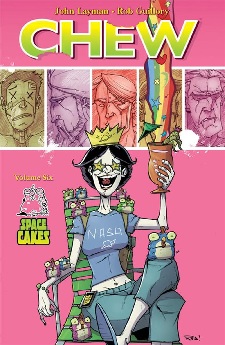
Book Review: Chew (Volume Six) “Space Cakes” by John Layman and Rob Guillory

TL;DR – With Tony Chu out of action, the story turns to his twin sister, NASA special agent Toni Chu. Her story is one to die for.

Summary (warning: spoilers)

Go to my book reviews page to see what has happened in previous volumes of this award winning graphic novel series. Volume Six revolves around Toni Chu, a Cibovoyant and NASA agent who has the power to see certain bits of the future by taking bites out of living people.

Her story involves being roped in by her chef old brother, Chow Chu, to investigate Barnabas Cremini, a collector of food art where the depictions are so real that if you lick the painting, you can taste the food; hunting down D-Bear who has stolen psychedelic chogs (genetically engineered combination of psychedelic frogs and chicken) and has been serving them in an underground restaurant; her on again off again relationship with her boss Paneer; stopping Professor Angus Hinterwald who has found a way to trigger a gene within beef to cause them to explode at the first sign of decomposition; and uncovering the murder of Judy Heinz-Campbell who had the ability to craft face masks out of food that transforms a person’s appearance.

Volume 6 also has an interlude chapter on Poyo, the killer rooster, whose resurrection from the depths of hell is pretty darn funny.

The final chapter sees Toni preparing to marry Paneer only to conclude in shocking fashion.

Review

John Layman and Rob Guillory know how to turn on the afterburners, propelling you along and engaging your heart in the exuberant and gregarious life of Antonelle “Toni” Chu and then thrusting you skyward without a parachute causing you to crash to the earth in a bloody mess. Your heart will never be the same.

Toni is the fraternal twin of Tony Chu (who we follow in the first five volumes). She is almost the antithesis of Tony. She is happy-go-lucky to Tony being always serious. She is full of life and energy while Tony is often gloomy and down. She enjoys a party while Tony probably prefers reading a book. She has a positive relationship with her family while Tony does not.

It is a fresh contrast and I was gripped in its pages from the get go. Splattered between the various plots that Toni gets involved in, she bumps into Ceasar Valenzano (FDA agent and sometimes partner to Tony Chu) several times. Each time, Ceasar believes Toni looks familiar and flashbacks occur that reveal they have in fact met before on different occasions and settings (once at a party leading to some drunken sex in the janitor’s closet). But Toni flat out denies they know each other every time (even though she does remember and it gives her the giggles). This laissez-faire attitude summarises Toni’s character.

She’s charming, adorable, loves her family, and can kick ass when the moment requires. One could not have a cooler twin.

And then Layman and Guillory decide to rip your heart out. Yes, dear readers, they make you care and then they laugh in your face. The first hint that something is not right comes at the end of chapter 4 where Paneer confesses his love to her, proposes marriage and allows Toni to bite his shoulder to get a glimpse into their future. Her ‘food power’ showing her that Paneer genuinely loves her and so she agrees to marry him. But when they hug, you see her expression (Paneer doesn’t see it because they’re hugging) and it is one of horror. I wanted to ignore this panel in the graphic novel. Almost doing a double take and thinking Guillory has illustrated her incorrectly, why does she look so sad and horrified when just a moment before she was happy to say yes to Paneer?

All is revealed in the final chapter when Toni goes shopping for a wedding dress with Paneer and is kidnapped by the Serbian cibopath known as The Vampire (an enemy of both Tony and Mason Savoy who is seeking to cannibalise and absorb all individuals that have ‘food powers’. Toni has already foreseen this happening and she allows it to happen because she knows it will lead to her brother eventually stopping The Vampire. In horrifying illustrations, Guillory depicts Toni tied to a chair but both her legs and one arm already amputated by The Vampire. The Vampire attempts to feed on her limbs but is unable to absorb her seeing-into-the-future powers (the reasons for this are revealed in flashbacks, and you understand that Toni has been preparing herself to be kidnapped and to thwart The Vampire’s plans). Toni does not give an inch and taunts The Vampire saying she has already seen the future and it is one where Tony will hunt him down to the ends of the earth, beating him to a pulp, before finally killing him. In a rage of frustration, The Vampire breaks Toni’s neck.

In the final panels, we see a flashback of Toni and Ceasar as little children, meeting at a playground. They begin to talk and Toni reveals her powers. Ceasar asks to know his future (not realising that Toni will need to bite him in order to see it). Toni does just that and reveals to him that he will be part of a team of special agents that will save the world. This flashback finally clicks in Ceasar’s memory and he remembers her but this happens after he breaks the news to the Chu family that Toni is dead.

John Layman and Rob Guillory… I hate you.

Yet I must concede that Volume 6 of Chew is story-telling and art at its finest.

5 out of 5.

Book Review: A Slow Burning Fire by Paula Hawkins

TL;DR – when Daniel Sutherland is found murdered on his narrowboat in Regent’s Canal, North London, the locals are naturally shocked. Those linked to Daniel and those who were last to see him alive are all interviewed by detectives. What is uncovered is a history of family tragedy and how preconceptions can lead to false assumptions of just who holds the power to the truth.

Summary (warning: spoilers)

Laura makes bad choices. The latest involving hooking up with Daniel Sutherland who is later found murdered in his narrowboat and she becomes the primary suspect.

Miriam lives on a narrowboat next to Daniel and witnesses Laura, blood on her face, limping away on the towpath. People see Miriam as a hermit, an old spinster, who sticks her nose in other people’s business. She is the one who finds Daniel’s body.

Carla is Daniel’s aunt. Divorced to Theo with a history of tragedy. First she lost her three year old son, Ben, then her sister Angela (Daniel’s mother) dies in a horrible accident, and now her nephew Daniel has been murdered. She is haunted by her past, can barely function in the present, and does not know how to look forward to the future.

Theo is a somewhat successful author. His novel – The One Who Got Away – achieved success but has received controversy as well as a claim by Miriam that Theo based key events in the novel on a memoir she wrote and shared with him. Theo, like his ex-wife Carla, has never managed to move on from the death of his son.

Irene lives next door to Angela, an eighty year old widower who never managed to have children of her own. She has her own personal demons and remembers quite well the arguments Angela and Daniel used to have, which carried through paper thin walls of their neighboring homes.

Questions of who killed Daniel and why leads to uncovering truths about the past, both horrifying and tragic for all those who had links direct and indirect with Daniel.

Review

A Slow Fire Burning is Paula Hawkins third novel published in the mystery thriller genre and examines the effects of neglect and the assumptions people have of others by their appearance and mannerisms.

Hawkins does an admirable job in depicting a cast of characters that are all deeply flawed in some way. On the surface, these flaws are unlikeable as opposed to interesting. I was in danger of losing empathy with practically all the main characters in this novel.

Generally, characters must have flaws in some manner otherwise the story will be dead boring. It is neither believable nor interesting when a character is perfect. Flaws create layers and demonstrate humanity that allows a reader to connect and become invested in that character’s plight. But Hawkins dares to create a bunch of characters that are all unsavoury in a way that will make you feel you don’t care what happens to them.

However, Hawkins manages to walk this tightrope and slowly reveal that there are deep seeded reasons to their behaviour. Not all of them pleasant but at least understandable, and you can see why they act the way that they do.

A Slow Fire Burning is not so much a mystery thriller as it is an examination of how the seeming powerless seize power, and the method by which they do so is not always altruistic or just. In fact, for many, it is power for selfish reasons only.

Surprisingly, what helps carry the story is the main detective, DI Barker, which one of the main characters, Laura, calls “Egg” because he has a head shaped like a cue ball and is completely bald. Barker is intelligent (not Sherlock Holmes intelligent but smart enough at his job) and he exhibits a level of empathy that was needed in this story.

The mistake that the main characters make when they interact with each other is judging who they are and what they are like from their appearance and external habits. Even Theo and Carla who were previously married and have a deeper understanding make false assumptions about each other. The reasons for these assumptions lead to igniting the slow burn to obtain power or revenge or justice (depending on whose eyes you look through) and stems from complex and tragic past events experienced by each of them.

Barker, on the other hand, is not burdened by their past. He was not part of any of the tragedies experienced by each of them. At the same time, he’s not presumptuous nor a cold-hearted fact finder focused only on the evidence to determine Daniel’s murderer. He is as human as the rest of the cast even if he is not so deeply flawed. Hawkins wisely uses him sparingly, but when he appears, he enhances the story and thankfully brings another dimension of humanity that is usually missing from law enforcement characters in these types of stories (unless the law enforcement officer is a main character, they are usually relegated to the background to indicate a crime is being investigated). Barker is a supporting character but is not left as a plot device in a crime mystery to indicate that the police are doing something. His interactions with Laura are particularly well done.

For the most of it, I found this book to be reasonably compelling, but one plot device is used near the end that deflated my enjoyment. The device is used on Miriam to allow progression of the plot between her and Theo. Unfortunately, the device is too convenient. It was like Hawkins was not sure how to put out one particular slow burning fire that was occurring between Miriam and Theo, so she threw in a series of last-minute scenes that would explain it and lead to a resolution between the two. I found it far-fetched because Hawkins does not give any hint that this is going to happen. She just inserts it at the end of a chapter, and you’ll be asking yourself, “Who the hell is this character? Why does she suddenly mention him after 32 chapters?” The remaining seven chapters plus epilogue explain the sudden appearance of this character, but it is all too coincidental and convenient. A shame really because the rest of it is decent read.

2.5 out of 5.

Book Review: Chew (Volume Five) “Major League” by John Layman and Rob Guillory

TL;DR – Tony gets kidnapped by a crazed sports writer, who wants to use his psychic food powers to obtain the histories of famous baseball players… famous (dead) baseball players. Given he achieves psychic impressions of the past only from items he eats, you know this is not going to be a pleasant.

Summary (warning: spoilers)

Go to my book reviews page to see what has happened in previous volumes of this award winning graphic novel series. Volume Five focuses on Tony Chu, his working partner, John Colby, and his estranged daughter, Olive.

Tony and John have been fired from the FDA and are assigned new jobs. Tony ends up in Traffic division riding a motorised scooter dressed in what looks like a Scottish bagpipe outfit and issuing parking tickets. What starts off as anger and reticence in what he perceives is a demeaning role turns out that he can still uncover crimes and make a significant positive difference. This leads to his new boss in Traffic division lauding him a hero and making Tony realise it helps working in an office where he actually gets along with his team (at the FDA, his boss made his life a living hell).

On the flip-side, John is assigned to the USDA; an all female government agency where agents are partnered with cybernetic-enhanced animals. Every agent seems to hate men, so when John ends up working in their agency, he is an immediate outcast. His boss, Director Penya, makes his life a living hell (similar to how Tony was treated by his former FDA boss) but unlike Tony (who put up with the hate), John takes action by sleeping with her resulting in some hilarious consequences.

Meanwhile, Olive has partnered up with the infamous Mason Savoy. She is unaware of the previous fall out between Savoy and Tony. Together with Caesar, they continue to hunt down individuals with food-related powers. One such individual is Hershel Brown, a fugitive that has the power to sculpt chocolate into any item and mimic the exact properties of that item (e.g. he can carve a machine gun out of chocolate and it will work like a real machine gun).

Tony’s elevated joy at the Traffic division is short-lived when he is ambushed and kidnapped by Dan Franks. Dan works as a sports-writer at the Mercury Sun, the same media outlet where Amelia Mintz works (Tony’s girlfriend). Dan used to date Amelia but she broke up with him, and he has been scoping out Tony for sometime. His true motives revealed in this volume.

Review

Chew Major League is as brutal and gripping as all the previous volumes. Both story and artwork move at a pace that makes you want to turn each page as quickly as possible, but this would be a mistake as you will miss on the small details that often hint to what will happen in future volumes. Being a graphic novel, the story is told through both words and art, so the need to take your time and absorb each panel is worthwhile and a testament to what Layman and Guillory have created.

Seeing Olive’s character unfold and her food-powers develop opens up a world of possibilities of where the story will go. And John’s exile to the USDA and his desperate attempts to get a hold of Tony (who he doesn’t know has been kidnapped) is hilarious yet he still manages to do his job uncovering a counterfeiting ring responsible for creating life-like cash notes made out of vegetables.

But this volume is really all about Tony. The purpose of his kidnapping surrounds Dan’s belief that famous baseball players have sordid stories and skeletons in the closet that would allow Dan to write a killer book titled ‘Superstar Sluggers’ Untold Sex Tales’. Tony is force fed the corpses of deceased baseball players and while he receives the images and histories of them, none of them have anything sordid to tell. So, he makes up tales in order to buy time.

In the end, it’s Amelia who comes to the rescue when she becomes suspicious of her boyfriend’s absence. Her own investigative skills come to the forefront in locating Tony. She almost doesn’t succeed but Tony (having consumed a number of famous deceased baseball players) uses newly acquired baseball skills to stop Dan. It’s all pretty ghastly but will still keep you glued to the page. As Tony collapses into Amelia’s arms having been bashed and beaten by his captors previously, she calls for an ambulance and Tony is rushed to hospital.

I cannot get my hands on the next volume quick enough.

4.5 out of 5.

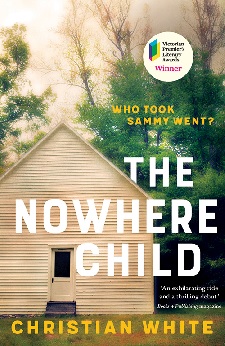
Book Review: The Nowhere Child by Christian White

TL;DR – mystery crime about a two-year old gone missing, a family with dark secrets and a religious fundamentalist snake handling group. Past and present revealed chapter by chapter until they collide.

Summary (warning: spoilers)

Kimberley Leamy lives in Melbourne, Australia and teaches photography. She is approached one day by a man who claims she is actually Sammy Went, a child who went missing twenty-six years earlier from Manson, Kentucky. The whole idea sounds absurd, especially when the memories of her childhood were generally happy, and she was raised by loving parents, Carol and Dean. However, when evidence is presented to her, she begins to doubt Carol and Dean are her biological parents and undertakes a journey to uncover her true origins.

Review

Christian White’s debut novel won the Victorian Premier’s Literary Award and is a gripping tale that alternates chapters between past and present to fill in the mystery behind the abduction and sudden disappearance of Sammy Went. It is a clever story if a bit convoluted, and White is adept at keeping the reader on course by tying you emotionally into Kimberley’s search for the truth and her own identity.

Travelling to America, she discovers a world completely different to the one she has lived for most of her life in Australia. And when it is revealed a Pentecostal fundamentalist group known as The Church of the Light Within is involved and part of their worship involves the handling of snakes, you know that things are going to get a little dark. The idea of snake handling is to demonstrate one’s faith and that you should be able to handle deadly snakes without being harmed. This also involves drinking snake venom and the individual not being poisoned.

Combining snake handling with the secrets being hidden by Kimberley’s biological family, you will find yourself turning the pages easily enough in a desire to see out Kimberley’s fate. It is a decent read though I would recommend The Wife and The Widow over this one. The last half of The Nowhere Child not delivering the thrills that the first half seeks to build up.

3 out of 5.