Book Review: Saga (Volume 2) by Brian K. Vaughan & Fiona Staples

TL;DR – Marko and Alana are on the run in search of somewhere to hide so they can raise their newborn daughter, Hazel, in peace. You would think that when you have a galaxy of planetary systems to choose from, it would be easy. But when you have two sides of a war trying to hunt you down and that war is raging across the entire galaxy, hiding turns out to be harder than expected.

Summary (warning: spoilers)

Go to my book reviews page to read reviews of previous volumes of this Eisner award winning series.

Volume two focuses on backstory between Marko and Alana; how they met, Marko’s parents and childhood, Alana’s change in perspective of the war, their eventual connection and relationship, and conception of Hazel.

This is mixed in with current events that revolve around their journey to visit author D. Oswald Heist’s home. Marko’s ex-fiancée, Gwendolyn, makes her first appearance and joins forces with The Will as they track down Marko and Alana. Along the way, The Will and Gwendolyn rescue Sophie (the young girl trapped on Sextillion in the first volume) that The Will attempted to free.

Also, hot on the scent of our fugitive couple is Prince Robot IV, who figures out that Alana and company are heading to Heist. He has read Heist’s novel that Alana believes is revolutionary. Prince Robot IV also believes that there is a hidden message within Heist’s text that talks about how love (and sex) can conquer war and thus two opposing sides can achieve peace (or at least stop from massacring each other).

Volume two ends with Prince Robot IV confronting Heist who says he wrote the novel simply for a paycheck and that there is no hidden message within. Prince Robot IV is unconvinced and sits down to wait for Alana and Marko to come to him with a gun calmly pointed at Heist. Little does the prince know that Alana and company are already there hiding in the attic.

Review

The end of volume one saw Marko, Alana and their newborn child, Hazel, blasting off in a tree-like rocket ship that appears partially sentient. Their destination is the location of D. Oswald Heist, author of Alana’s favourite novel, ‘A Night Time Smoke’. Why does Alana want to visit Heist? Because she believes his writings can unlock the never-ending war between Landfall and Wreath. In her mind, somehow Heist’s trashy romance novel equates to a message from on high.

Joining their journey are Marko’s parents, who magically appear aboard the rocket ship when Marko intentionally shatters his sword. He does this in an act of penance for breaking his vow to never unsheathe his sword and dish out violence. The sword was a family heirloom and magically bound. As soon as Marko broke it, his parents knew and homed in on his location, magically teleporting inside their ship.

Also along for the ride is Izabel, an innocent victim of the war, who is now a fluorescent pink ghost with only her upper body and entrails exposed. She convinces Alana to allow her to magically bond with Hazel in exchange for showing them how to start the rocket ship.

While volume one sets the scene, volume two delves much deeper into the impacts of the galactic war especially from an emotional and psychological stand point. At its epicentre is our daring couple, Marko and Alana, but their relationship ripples to all other parties linked to them.

Marko’s parents, his ex-fiancée, Gwendolyn, Prince Robot IV, D. Oswald Heist, and Izabel all have their own stories, views and biases regarding the war. This lends depth and gravity to the central story around Marko and Alana wanting to raise Hazel outside of the war. And shows the strength of Vaughan’s writing.

Staples artwork also seems to be fine tuned in this second volume with outrageous and eye-popping panels including a fat, naked giant that reveals too much of itself and a planet-sized egg that gives birth to an embryonic shaped creature that acts like a black hole and shoots black goo from its eyes.

With a story driven by strong characters and backed by killer art, Saga volume two draws you in and makes you think honestly about violence and the impacts of war. Oh and The Will saves his Lying Cat from dying in outer space, which was pretty damn wicked… I would’ve been bummed if the cat died.

4 out of 5.

Book Review: Saga (Volume 1) by Brian K. Vaughan & Fiona Staples

TL;DR – epic sci-fi series that centres on two individuals from opposing alien races that manage to fall in love against a backdrop of a never-ending war that spans the galaxy. When they manage to conceive a baby girl that has physical features from both their kind, they know their daughter symbolises a hope that threatens the war. Hunted by both sides, they do the only thing they can think of… they run.

Summary (warning: spoilers)

Alana and Marko are on opposite sides of a galactic war. A war that has raged beyond their two worlds and expanded to other alien races who have been forced to pick a side. Volume one contains the first six issues and focuses on Alana and Marko’s forbidden relationship and the birth of their daughter. Their family representing an aberration that could change the political landscape forever.

Review

Saga has been described as “Star Wars meets Game of Thrones”. That certainly is an ambitious undertaking. While this Eisner award winning graphic novel series certainly is epic in scale with a large cast of characters, it was for me more a Romeo & Juliet story as opposed to a Game of Thrones one (note: the Star Wars side is definitely captured in terms of the sci-fi elements and the multitude of alien races).

The story opens with Alana screaming her head off as she gives birth to baby Hazel. Her husband, Marko, is there and it is just the two of them in an old body shop. Immediately, there are questions that floated through my head: Why are they in a body shop and not a hospital? Why is it just the two of them? Where are the nurses? The mid-wives? The doctor? And why does the baby have horns?

If I had been paying attention to the art instead of racing through the first couple of pages of dialogue, the answer to the last question is obvious. Marko has horns; big, curling ram horns that would make Princess Leia’s hair stylist proud. But wait, Alana doesn’t have horns. She has wings; delicate, gossamer, emerald wings sprouting from her shoulder blades.

As volume one unfolds, it is revealed that Marko is a Wreather and Alana is a Landfallian, and Wreath and Landfall have been waging a war that has spread throughout the galaxy. We learn that their love is a definite no-no, and the fact they have a child together could turn everything on its head. Thus they are hunted by their respective sides in an attempt to prevent the rest of the galaxy finding out. It’s a Romeo & Juliet story on a galactic scale.

Landfall sends Prince Robot IV while Wreath sends a mercenary named The Will. The prince comes from an alien race that has a human body but a television for a head. I don’t know if there is some deeper meaning behind this though it is interesting how the television heads of the robot race display various images to convey emotions. By contrast, The Will appears like an ordinary man but with an extraordinary pet known as a Lying Cat (a giant feline capable of detecting when someone lies). Later, we see that The Will may look ordinary but he is exceptional at killing.

Volume one concludes with Marko, Alana and Hazel escaping Cleave, the mud planet where they met, fell in love, and Hazel came into being. But not before we learn a bunch of things about our lovers and the hunters seeking to track them down. Turns out Marko was engaged previously to a girl named Gwendolyn. He was naïve about fighting for Wreath (his eyes opened when he was thrown into the horrors of war) and made a vow to never unsheathe his sword in combat. Eventually he breaks this vow in order to protect Alana and Hazel and laments that his action will have consequences (violence begets violence).

Alana is revealed to have been indoctrinated into the idea of romantic love from reading trashy novels (think ‘Mills & Boon’ stories). She idiolises the author, D. Oswald Heist, who wrote her favourite trashy novel titled ‘A Night Time Smoke’ and believes there is a hidden message within its text. Heist lives on a planet called Quietus, and it is there that they aim to travel to.

Meanwhile, Prince Robot IV has been assigned the mission to hunt down the pair after just having served a two-year tour of hell. All he wants is to be with his wife and start a family. However, it is his father who requests he undertake the mission, much to his frustration. Following the trail of Marko and Alana, he encounters The Stalk (another mercenary hired by the Wreathers to also hunt down Marko and Alana and retrieve Hazel and happens to be the ex-lover of The Will). In a moment of panic, Prince Robot IV kills The Stalk thinking she is going for her gun.

The Will commences his own hunt to find Marko and Alana, but decides to not bother when he finds out from his agent that the Wreathers have also hired The Stalk. He instead ventures to Sextillion (a planet-size brothel) intending to sleep with whores but discovers a more insidious scene beneath Sextillion where children are being used. We find The Will does have some sort of moral compass and seeks to save a little girl but fails to free her. He then contacts, The Stalk, in hopes of partnering up with her to split the reward for killing Marko and Alana and retrieving Hazel (his plan is to buy the little girl’s freedom trapped on Sextillion). But he finds out that Prince Robot IV has killed The Stalk (he’s actually on the line talking to her when she gets shot). Now, The Will has two goals: free the girl from Sextillion and kill Prince Robot IV.

The multiple storylines are engrossing and the art by Fiona Staples is impressive. Worth the read for adult readers and shows publisher Image Comics are willing to explore stories that branch outside of the mainstream superhero/villain comic book form.

4 out of 5.

Book Review: The Real Story (Book 1 of the Gap Cycle) by Stephen R. Donaldson

TL;DR – a sci-fi space opera that started off as a novella and became a pentalogy. The Real Story is book 1 in The Gap Cycle Series and essential reading for adult sci-fi enthusiasts.

Summary (warning: spoilers)

Angus Thermopyle is the worst of the worst in Delta Sector (DelSec). A pirate and murderer who cares about only one thing other than himself and that’s his ship, Bright Beauty.

Morn Hyland is an ensign for the United Mining Companies Police (UMCP) and undertakes her first mission with her family aboard the UMCP destroyer, Starmaster.

Nick Succorso is a star captain with a reputation that rivals Thermopyle except his is one that everyone views as a hero. Or anti-hero as it may be. After all, he is still a pirate. Even among the riff-raff, Nick is considered the most desirable man in DelSec. He captains a sleek frigate, Captain’s Fancy.

When Angus and Morn waltz into Mallorys Bar & Sleep together, the crowd can’t make sense of what they are seeing. Morn stays by Angus’s side even though her expression is one of deep hate. The simple conclusion by most was that Morn was being held against her will by Angus.

So, when Morn and Nick make eye contact, the electricity is palatable. As much as everyone else in the bar would like to swoop in and take Morn from Angus’s clutches, no one dares take on the notorious pirate. No one except Nick.

And two weeks later, when Angus is arrested on a crime that will actually stick, and Morn rushes into Nick’s arms and they disappear, no one was surprised. Morn with Nick made much more sense than Morn with Angus. Everyone went back to their own schemes and drinking away their dreams.

But as Stephen Donaldson reveals, that is not the real story.

Review

When I first read, what is considered, Donaldson’s most successful series – The Chronicles of Thomas Covenant – I was blown away, and I thought there would never be a series that he could write that would be as good.

I was wrong.

The Real Story is the first book in The Gap series that follows three central characters – Angus, Morn and Nick – in a space opera of epic proportions.

What is brilliant about this series is Donaldson’s first book is one massive hook. What is mind-boggling is that Donaldson intended this first book to be self-contained, a novella that would stand on its own. But for reasons he explains in the afterword of The Real Story, he was driven to deep dive into this world he created and tell the full story resulting in four more books. We should all thank German composer, Richard Wagner, for his masterpiece Der Ring des Nibelungen, which is a set of four operas based on Norse mythology. It was these pieces of music that ignited the fire in Donaldson to expand from his initial novella.

Further, The Real Story being of novella size, it is easy to digest and if you find that it does not appeal to your sense of taste, you won’t have wasted much time. But if you’re like me, you’ll find yourself launching into the much thicker volumes two to five in the The Gap series with relish.

In Donaldson’s own words, his original intentions were ‘explicitly archetypal’. He goes on to explain the difference between a melodrama and drama. That is, a melodrama presents a victim (Morn), a villain (Angus), and a rescuer (Nick). A drama seeks to take these archetypes and have them change their roles. In this way, Donaldson cleverly flips things around so that Nick victimises Angus and Morn ends up being Angus’s rescuer.

This is an incredible feat given Angus captures Morn and puts a zone implant in her brain that allows him to control her every emotion and action. The abuse she receives is graphic and not suitable for young readers. Donaldson is a master at delving into the complexities of his three main characters and somehow portrays them in a different light by the time you reach the last page.

When you read the final words of the last chapter, you will realise that the stereotype portrayals at the beginning have gone through a freakish transformation: Nick is not a rescuer, Morn is not a victim and Angus is not a villain.

Donaldson take a bow. Cue applause.

5 out of 5.

Book Review: The Boy in the Striped Pyjamas by John Boyne

TL;DR – a Holocaust fiction novel told through the eyes of a German child who meets a Jewish child on the other side of a fence encircling a concentration camp. They become friends amidst a time of hatred.

Summary (warning: spoilers)

Set during World War II, nine-year old Bruno and his family move to Auschwitz because his father has been promoted to Commandant and assigned to oversee the concentration camp. Bruno does not want to leave their home in Berlin nor does he want to part from his best friends. Things are made worse when he arrives and sees the house they have to live in is nothing compared to their lavish Berlin home.

Miserable and lonely, Bruno ventures forth to a camp he has spied from his house and walks along the chain fence. There he encounters a boy named Shmuel who wears striped pyjamas (prison clothes) just like everyone else on that side of the fence. They strike up a friendship with Bruno not understanding what is going on in the camp, but smuggles food for Shmuel because he always looks so thin and hungry.

As time passes, their bond grows stronger even though Shmuel’s body gets weaker. Eventually Shmuel tells Bruno that his dad has gone missing, and Bruno wanting to help, agrees to sneak into the camp through a hole in the fence. Shmuel manages to find a spare set of striped pyjamas and Bruno puts them on to blend in. Before they can fully search the camp, soldiers round up a group of the prisoners with Burno and Shmuel among them. They are then led into a building, which Bruno thinks is a shelter used to protect from storms but is actually a gas chamber.

In his final moments, as they hold hands, Bruno says to Shmuel that he is his best friend. The door closes and the lights go out.

Bruno’s parents search for him, and it is only when Bruno’s father discovers his son’s clothes folded neatly next to the fence that he is able to piece together what has happened.

Review

John Boyne’s novel is a work of historical fiction. I am not going to delve into the accuracy or lack thereof regarding its setting and the depictions of the characters. There has been plenty of controversy around this novel. The concern around historical inaccuracies and the trivialisation of the Nazi regime has led to criticism and concern that this book will impact adversely on people’s understanding and education of the Holocaust. Again, I reiterate that The Boy in the Striped Pyjamas is fiction, so if your hackles rise because you’ll be upset by historical liberties taken in this story then I would suggest dropping this off your book list and reading a text book on the Holocaust instead.

There has also been criticism surrounding the main character, Bruno, who has difficulty pronouncing words like ‘The Fuhrer’ and ‘Auschwitz’ which he pronounces ‘The Fury’ and ‘Out-with’. This has been perceived by some as downplaying the significance and atrocities that occurred in Auschwitz. Given the story is told from the viewpoint of Bruno who is nine-years old, I have accepted Boyne’s capturing of a child’s perspective. If anything I believe it to be quite effective and not at all reducing the magnitude of the Holocaust.

The Boy in the Striped Pyjamas was a thoroughly engrossing read. Boyne was able to capture my imagination through his writing and insert me in a place that was vivid, horrifying and alien, and at the same time, made me care about Bruno even though I have the knowledge of the events at Auschwitz. Somehow Boyne is able to stay the underlying dread for long enough that you will see it through to the bitter end. This is in large part to capturing the eyes, mind and heart of a child that is Bruno. Though you want to ignore that deep down somewhere you know this whole thing will end in tragedy, you are tugged along anyway by this thread of hope that perhaps Bruno and Shmuel will somehow defy their situation and miraculously escape.

The fact that Bruno and Shmuel see each other as children and not German and Jew is the obvious moral and message that Boyne seeks to impart to readers both now and into the future. The moral imperative to treat each other as human beings, to care for one another, to show compassion is never more evident than in every interaction between the two children, whether that be Bruno saving food to give to Shmuel, their talks and sharing of stories, or in the final act when Bruno sneaks into Shmuel’s side of the fence to search for Shmuel’s father.

It is heart wrenching in its simplicity. The Boy in the Striped Pyjamas has been described as a cautionary tale and a fable. It is both these things and so much more. To me, it was not simply a fable to reflect the Holocaust but also a reflection on our world today and how hate and fear can divide us. This is never more evident than in the final words in this book where Boyne writes, ‘Of course, all of this happened a long time ago and nothing like that could ever happen again. Not in this day and age.’

4.5 out of 5.

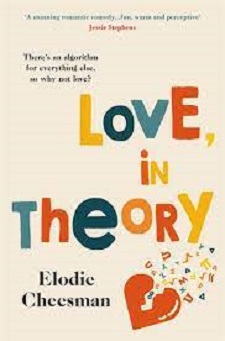
Book Review: Love, in Theory by Elodie Cheesman

TL;DR – a romantic comedy for the 2020s. Romy, not having seriously dated for two years, decides to jump back in using theories developed by psychologists, mathematicians and researchers to find love.

Summary (warning: spoilers)

Romy, an unusual, thoughtful 24-year old with a deep desire for rational thinking, decides to embrace science and statistics to find the ideal guy. She uses ‘optimal stopping theory’ to calculate that she is at the age where if she meets a guy that is better than all the previous men she has dated then he is likely to be the one she can build a life with.

She meets James who she has chemistry and spark with but ticks many of the boxes that are similar to her previous ex-boyfriends and doesn’t want to fall into the same trap of basing a relationship solely on a bonfire that will eventually flame out.

She then meets Hans who ticks all the relationship theoretical science boxes that she has set out for herself, but she can’t help noting that there is no initial bonfire that burns as deeply as what she experiences with James.

Who will she choose?

Review

‘Optimal stopping theory’ is a genuine mathematical theory that examines when it is an appropriate time to take an action to maximise reward or minimise cost. While the theory has been applied to statistics, finance and economics, it is with one particular problem that this novel is based on. The problem goes by many names including ‘the marriage problem’ and the ‘fussy suitor problem’.

In short, the problem surrounds when it is best to choose a partner and using the optimal stopping theory, one can calculate at what age based on your ‘expected dating life’ you should go about choosing a partner that you can live ‘happily ever after’ with. The magical number based on this formula is 37%.

This means, hypothetically, if you started dating at 18 years and wanted to settle down by 35 then that is a 17-year dating span. 37% of 17 is 6.29. Add 6.29 years to 18 and you get 24.29 years as the age that is your optimal stopping point.

It just so happens that Love in Theory‘s main character, Romy, is 24 years old and thus in theory, she should choose the next guy who is better than all the previous guys she has dated for the best chance of settling down with ‘Mr. Right’. Thus begins Romy’s dating escapades after not having seriously dated anyone for a couple of years. A different type of clock, not biological, starts inside her as she goes about finding someone based on the fact she has reached her optimal stopping point.

Whether you believe in the theory or not, Elodie Cheesman’s tale of finding the perfect match will likely propel young readers of romance (older readers who have experienced that relationships require work will probably not). Cheesman utilises all the current day mechanics that people use when they are trying to meet people (i.e. Tinder, Bumble, and other social networking or match-making apps). Romy’s introspection is reflective of a 24-year old who is a deep thinker, and the people she meets have a wide range of personalities that ensures she goes through the bores, the cringes, the narcissists in equal measure. Eventually her path crosses with two potential suitors: James and Hans.

In many ways, the character of Romy is deeply flawed. There is nothing wrong with this as characters that are flawed make for interesting reading. However, I do not know if certain flaws were intended by Cheesman. It certainly does not feel intentional. Romy comes off as an intellectual with a deep desire to scientifically analyse her love life and how she goes about searching for the ideal partner. She buys into the ‘optimal stopping theory’, attends an ‘intelligent dating’ class and is presented with research into relationships including a 2010 paper by mathematician Peter Backus entitled “Why I Don’t Have a Girlfriend”.

Backus calculated the odds of meeting someone who met all the traits that he was looking for in an ideal partner and came to the bleak probability of finding such a person on any given night out was only 0.0000034% chance. Through the ‘intelligent dating’ class, Romy is asked to identify three key traits (only three because the more traits you want ticked off in a partner will reduce the probability of finding someone dramatically. Just ask Mr Backus) and choose these three traits to create a relationship based on mutual liking (not lust or intense love, but liking).

Romy chooses the following:

  • ‘low novelty-seeking’ which means someone who is not always searching for something new. Romy reflects that her previous boyfriends were a combination of high extroversion, high openness and low conscientiousness, which made for a fun and spontaneous partner in the early days of the relationship, but also someone who was more likely to get bored and move on.
  • ’emotionally stable’ being someone who does not react intensely negative when things become difficult.
  • ‘agreeableness’ being someone who is ‘nice’. Nice people are generally kinder and better at intimacy.

From this approach, I felt strongly that here is a young woman who believes in rationality and using scientific research in finding the ideal partner (whether I agree with such an approach is beside the point, Romy’s personality is distinct and for the purposes of the story that is what matters). However, Cheesman then has two male characters in James and Hans that are Romy’s primary focus and while she reminds herself of the three traits she is looking for, it becomes apparent that for all her rationality she still wants the ‘magic’, the ‘spark’ or whatever other romantic trope you want to use.

Again, this is not necessarily an issue. Love in Theory, after all, is meant to be a romantic comedy. But I could not help rolling my eyes at how Cheesman goes about describing James and Hans.

Hans is tall, blonde, blue-eyed German with a ‘Statue of Liberty nose’, a strong jaw, wide smile with dimples. Might as well have described him as a ‘German prince’.

James is described at one point as wearing a white T-shirt and dark jeans that makes him look like James Dean or perhaps James Franco playing James Dean.

Look, I get it. We often judge books by their cover even if we say we don’t. First impressions make a difference, and I’m not saying Romy should date a guy she is not physically attracted to. But really no matter how much Cheesman tries to show the two male leads as having depth (and their own flaws), Romy still wants all the shine and physical sparkle as much as the rest of us. So, for all of her rationality, logic, and ‘scientific’ approach to finding someone, it was disappointing to me that the men she desires are Hollywood stereotypes in the looks department.

The fact Romy reflects deeply on her previous boyfriends, all charming, charismatic and good-looking and subsequently dates James and Hans who fit the same mould was disappointing. The only male character that presents themselves physically as flawed is Romy’s boss Graeme (for whom she is not attracted to in the slightest). Would it have detracted from the romantic comedy theme if the two male leads had physical flaws? I would like to think not. If anything I would have felt it would lend to a more authentic story and perhaps aligned better with the idea that Romy has learned from her past relationships and now applying her rational, analytical mind.

Was this intentional by Cheesman? I don’t know. But looks of the male leads aside, the story moves along to the conclusion we all suspect. That is, you can read all the science and statistics you want, but in the end love is more than this.

Romy is like a pendulum, she swings to the extremes applying theories to finding someone, she finds that person in Hans, and then swings to the other end, unable to deny her attraction to James and throws out all the theories. There is no balance in the delivery as the ending rushes in the final couple of chapters that has Romy having a supposed epiphany after being told by Alexandra (neuroscientist and Romy’s aunt) that the science of relationships can be cast aside if you feel that ‘magic’. She then rushes over to see James and confesses that she has been ignoring what they have and wants to be with him. And it should be noted that this is after things have ended with Hans through Romy’s own fault.

I found it a disappointing read because in the end, the book is lauded as being perceptive about love and relationships but ends up following a path well trodden. It’s Sleepless in Seattle where Meg Ryan’s character dumps Bill Pullman’s nice-guy character for Tom Hank’s character whom she feels the magic spark with.

Cheesman tries to offset this by describing two other important couples close to Romy: her parents and about-to-marry couple, Mara and Angus. We learn for both of these couples, their love blossomed from liking and the guy being ‘nice’ as opposed to a ‘love at first sight’ experience with explosions and fireworks.

Still, for all of her ruminations, thoughtful introspection, research and reading, her apparent belief in the science to create a relationship that will go the distance gets thrown out the window, and she ends up going with her gut in James as has happened with her previous ex-boyfriends. The book ends with her saying she has a ‘magnificent hunch’ that this time it will be different.

And perhaps it will be different, but as a romantic comedy it doesn’t say anything different. Listen to your heart instead of your head is the end message even though this book seeks to break out of all the Hollywood brainwash about ‘happily ever after’.

Had the inciting incident that wrecked Romy’s relationship with nice-guy Hans led to her actually trying to fight to get him back, and this in turn would lead to her choosing Hans over James… now that would have been different and broken out of the Hollywood rom-com mould. But alas, the formula has been set.

It is sad to think that hope fulfilled cannot stem as much from the head as it can from the heart (or at least, from a balance between the two). I guess that just doesn’t make as good a story and is not as sexy.

2 out of 5.

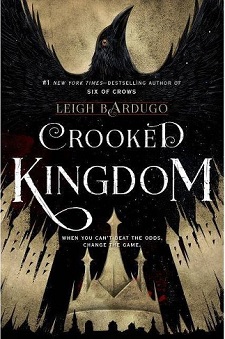
Book Review: Crooked Kingdom by Leigh Bardugo

TL;DR – The conclusion of the Six of Crows duology, which sees Kaz and his crew looking to rescue Inej from the clutches of Van Eck and take what is owed to them in order to start a new life.

Summary (warning: spoilers)

Go to my book reviews page if you wish to read my review of Six of Crows, the first book in this duology.

With Inej captured by the rich and corrupt merchant, Jan Van Eck, Kaz and the remainder of his crows – Jesper (sharpshooter & gambling addict), Wylan (demolition expert & disowned son of Van Eck), Matthias (Fjerdan witch hunter), Nina (Grisha heartrender) – must come up with a plan to free her without handing over Kuwei Yul-Bo, the son of Bo Yul-Bayur, the scientist responsible for creating jurda parem, an addictive drug that amplifies Grisha power but causes deadly side effects.

Van Eck lays a trap using Inej as bait, but Kaz does not fall for it as he blindsides Van Eck by kidnapping his pregnant wife, Alys. A furious Van Eck agrees to trade Alys for Inej but uses the opportunity and his influence over the Merchant Council to have the stadwatch (the Ketterdam police) nearby during the exchange. The tense exchange occurs, but Van Eck then shouts to the crowd (and nearby stadwatch) that the man before him is Kaz Brekker, the man responsible for kidnapping his son (Wylan). In truth, Wylan was not kidnapped, he joined Kaz’s crew and Van Eck actually wants his son dead. The stadwatch storm in but suddenly a series of explosions occur and Shu Han warriors appear seeking to capture Grisha. These particular Shu have been modified by Grisha fabrikators (high on the parem drug) to now have wings and armour beneath their skin. The Shu are just one of several groups after Kuwei Yul-Bo, seeking to take control of the only person who has knowledge of how to make the drug.

In the ensuing mayhem, Kaz and Inej escape and they meet up with the rest of the crew at their hideout; a large tomb on the Black Veil, an island that was once used as a cemetery for the rich and wealthy but is now abandoned due to a past plague that ran through Ketterdam. The Merchant Council decreed that no burial could take place within city limits and that those who died are cremated on the Reaper’s Barge.

While achieving their goal of rescuing Inej, Kaz is now faced with the fact that the millions owed to him and his crew from Van Eck will never materialise unless they take action. To make matters worse, he owes money to his most hated enemy, Pekka Rollins, and also his own boss, Per Haskell. The only ace up his sleeve is he has Kuwei Yul-Bo. His initial scheme to get their millions by ruining Van Eck involves buying up shares in sugar stock and destroying Van Eck’s silos containing sugar reserves. The scheme fails because Pekka Rollins reveals his hand and has joined forces with Van Eck. Together the pair has every man and his dog hunting down Kaz and company, and to make matters worse, contingents from Fjerda, Ravka and Shu Han are also hunting down Kuwei.

Kaz goes all-in and seeks to turn the tables by controlling the narrative and having Kuwei declare his indenture and services up for auction. Under Ketterdam law, any individual who puts themselves up for indenture, can thus auction their services to the highest bidder. This is considered sacred under Ghezen, the god of commerce and trade, for which the people of Ketterdam abide by. Kaz thus instigates a plan to take down Van Eck and Rollins through the auction where every foreign contingent will be present, along with the stadwatch and every Ketterdam gang and merchant. It is a dangerous game and Kaz has put the lives of his five crows and himself on the line. By Kaz going all-in, how much of his hand is legit and how much of it is bluff? Will all six crows survive? Or will casualties ensue? Whose dreams will become a reality and whose will turn to ash on the Reaper’s Barge?

Review

Leigh Bardugo has a way with words.

She is particularly adept at creating dialogue that is engaging and funny and full of sass that provides added dimensions to the Six of Crows cast. She also manages to deliver a plot that is both complex and cohesive. The many pieces on the chess board that Bardugo keeps track of and ensuring not everything is smooth sailing makes the Crooked Kingdom are marvellous read that will have you turning the pages.

It is a remarkable effort that reflects the many layers of all the characters but especially Kaz Brekker. He is not just the leader and the glue, but his mind generates schemes within schemes and fail safes within fail safes and even when all hope looks lost, he rises bruised and bloodied with crow-head cane in hand and an intellect that allows him to move what pieces he has remaining to achieve check mate.

As with all good endings, the conclusion to Crooked Kingdom is far from being tied up in a neat little bow. Enough happens that you will be more than satisfied and Bardugo is clever enough to leave a small enough crack in the door (e.g. the Council of Tides confronts Kaz with a little chat at the end) that will make you think that she will one day return to Kaz and the crows with another tale (even though she has gone on record saying she will not return to these beloved characters and that this particular story arc is complete).

Sigh. We can hope can’t we?

4.5 out of 5.

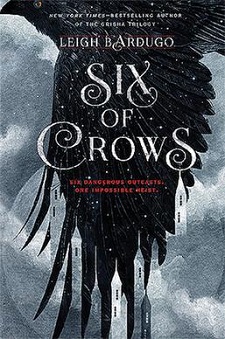
Book Review: Six of Crows by Leigh Bardugo

TL;DR – In the world of Grisha (individuals with magic powers), there is rumour of a drug known as Jurda Parem surfacing in Ketterdam. The drug enhances Grisha powers exponentially but at a terrible cost. The Grisha becomes addicted to Parem and will eventually die from it.

Summary (warning: spoilers)

Kaz Brekker (leader of the Dregs) is hired by merchant, Jan Van Eck, to rescue Bo Yul-Bayur, the inventor of jurda parem (an addictive drug that kills Grisha while temporarily amplifying their magical powers). Bo Yul-Bayur is being held at the Ice Court, the stronghold and capital of Fjerda. No one has ever breached the stronghold and lived to tell the tale, so Kaz demands an enormous sum to undertake the mission. He also trusts Van Eck about as far as he can kick him with his dodgy leg (Kaz uses a crow’s head cane), so he convinces Van Eck to have his son, Wylan, join his crew on this mission as Wylan has a talent as a demolitions expert.

Kaz and crew infiltrate the Ice Court and discover that Bo Yul-Bayur is dead. Instead, his son, Kuwei Yul-Bo is being made to make parem in his father’s shoes. Kaz and crew, along with Kuwei Yul-Bo, manage to escape and return to Ketterdam only to be betrayed by Van Eck who reneges on their deal.

The ensuing stand off reveals that Van Eck does not care that Kaz has his son because he has disowned Wylan from the family for being unable to read and could never run the family business. Van Eck thinking he has Kuwei Yul-Bo in his possession discovers that it is actually Wylan who has been made to look like the scientist through the use of Grisha magic. Enraged he captures Inej (Kaz’s assassin and expert spy for the Dregs) and gives Kaz a week to deliver the real Kuwei Yul-Bo otherwise he will torture Inej.

Thus ends book one of the Six of Crows duology. The story concludes in the Crooked Kingdom.

Review

While Shadow and Bone introduced us to the Grishaverse and the wonderful imagination of Leigh Bardugo, Six of Crows delves into characters that I found far more interesting. Don’t get me wrong, I enjoyed reading about Alina Starkov, Mal Orestev and the Darkling, and you can go to my book reviews page to see what I thought of Shadow and Bone. But in Six of Crows, Bardugo introduces us to a cast of characters that are a delight to read.

There is Inej Ghafa, a Suli spy known as the Wraith. She has acrobatic skills and a set of throwing knives that she names and uses with deadly accuracy.

Jesper Fahey is meant to be studying at a university funded by his goodwill farmer father, Colm Fahey. However, he develops a gambling addiction and falls into severe debt. He is an expert marksman and carries two pearl handled revolvers wherever he goes.

Wylan Van Eck is the son of a wealthy merchant, but is disowned by his father because he struggles in his studies and cannot read (turns out he’s dyslexic, but his father deems him a failure even though he is good at maths and music). Wylan also has an aptitude for making chemical bombs.

Matthias Helver is a Fjerdan witch hunter and has been taught to hate and kill Grisha. He is strong, muscular and reminds me of a Viking (which I am sure is where Bardugo drew inspiration when creating the country of Fjerda).

Nina Zenik is a Grisha Heartrender who has a complicated relationship with Matthias Helvar. She initially served the Ravkan second army but is captured by Matthias and his fellow drüskelle (Fjerda holy soldiers that hunt Grisha) and is thrown in a cage with other Grisha aboard a ship. The ship sinks during a massive storm and she saves Matthias from drowning using her Heartrender abilities. Forced to work together to survive, they slowly develop an attraction to one another though their world views often bring them into conflict. This is made worse when Matthias believes Nina betrays him and is sent to Hellgate (a prison) even though she did it to save his life.

This motley crew are the primary characters that make up the Dregs led by Kaz Brekker.

And it is Kaz that is the pièce de résistance. In Kaz, we have a multi-layered character that has a backstory as intriguing and complicated as the rest of the Dregs if not more so. Bardugo has created a lead that will have you wanting to digest every little detail to decipher what might be going through Kaz’s head.

The plans and safeguards he hatches, and how he uses the individual skills and talents of those around him is done with calculated brilliance. His motives and drive are slowly revealed throughout the book, and you will come to understand that he is a survivor driven to see the downfall of Pekka Rollins (leader of the Dime Lions and rival to the Dregs). Rollins used Kaz and his older brother, Jordie Rietveld, when they were younger and conned them out of everything they owned, leaving them to live a life of poverty on the streets of Ketterdam. Jordie later died of a plague that tore through the city, and Kaz sees Rollins as the man responsible for Jordie’s death.

Six of Crows builds upon the established world created by Bardugo in Shadow and Bone and will have fans eagerly awaiting for further tales from the Grishaverse. I devoured this book with a hunger that matches Kaz’s thirst for revenge on Rollins. Onto the Crooked Kingdom for the conclusion of this magnificent duology.

4.5 out of 5.

Book Review: The Etymologicon by Mark Forsyth

TL;DR – How words in the English language came to mean what they mean sounds like a topic best suited for language academics, but Mark Forsyth delivers fascinating insights into how words came to be and does so in hilarious fashion.

Summary (warning: spoilers)

Ever wonder what John the Baptist and the Sound of Music have in common?

Turkeys were first discovered in the magnolia forests of the Americas, yet they did not originate from the country, Turkey, so why are they called that?

Why was the horrible beheading device known as the guillotine named after Dr Joseph-Ignace Guillotin, who was actually against the death penalty?

If these questions circle your head like a bunch of vultures, and you toss and turn at night because you desperately seek answers to these mysteries, then (apart from the need to perhaps re-examine your life) look no further then The Etymologicon by Mark Forsyth.

Review

Mark Forsyth is the brilliant author of The Elements of Eloquence (a must-have book for any writer’s toolkit). You can check out my review of The Elements of Eloquence on my book reviews page. While both that book and The Etymologicon examines the English language, this one is quite a different read.

The Etymologicon is more about words that have come into existence that have origins that are often confused, funny and intriguing. Forsyth manages to actually make you interested in the words that we use and take for granted every day.

Of course, there are words that he explores that we don’t use in every day life but he dives in any way because it leads to results that will have you in awe (or perhaps because I’m a writer I’m left in awe and everyone else will just shake their heads in dismay).

One of the best examples of this is the word ‘buffalo’. Forsyth explains how buffalo came to mean buff (as in to ‘polish’, along with to be an ‘enthusiast’ like a music ‘buff’ or movie ‘buff’, and also the link with the word ‘to bully’). He then shows the connection of this word to New York firefighters and then to the city of Buffalo.

But wait there’s more…

Forsyth then writes the following sentence: Buffalo buffalo Buffalo buffalo buffalo buffalo Buffalo buffalo.

Believe it or not, this is the longest grammatically correct sentence in the English language that uses only one word. This is known as a antanaclasis, which means that it keeps using the same word in different senses. One can translate the aforementioned ‘buffalo’ sentence into:

Buffalo bison [whom] Buffalo bison bully [then] bully Buffalo bison.

You think that would be enough right? But Forsyth can’t help showing off. The man decides to go into other languages like Chinese, which is a tonally inflected language (i.e. you can change the meaning of a word in Chinese by changing its tone slightly – no wonder it is so difficult to learn!)

So if you think the buffalo antanaclasis is impressive, Forsyth reveals what a Chinese-American linguist did by creating a poem that in Westernised script comes out as:

Shishi shishi Shi Shi, shi shi, shi shi shi shi

Shi shishi shi shi shi shi…

This goes on for ten more lines of varying length all with the word ‘shi’ in it. Thankfully, the translation is given which talks about a poet named ‘Shi’ who lives in a stone den, is hungry, wishes to eat ten lions, goes to market to buy ten lions, seeing the ten lions he shoots them with arrows, who then takes them back to his den only to discover the ten lions are actually ten stone lions.

Yeah, makes as much sense as the untranslated version… still I laughed… somewhat hysterically.

4 out of 5.

Book Review: Big Little Lies by Liane Moriarty

TL;DR – Three mothers become friends and discover the deep pains they hide beneath the surface. They want to be good wives and loving mothers, but they first have to be true to themselves and that means confronting lies that have taken on a life of their own.

Summary (warning: spoilers)

Jane is a single mother. Her son, Ziggy, is a result of being raped. Jane is angst riddled and nervous about trying to be a single parent and she secretly worries that some sort of violent DNA is inside Ziggy because of her past trauma. Her fears appear self-fulfilling as Ziggy is accused of bullying another child.

Madeleine has turned forty-years old and is not quite sure how to deal with that milestone. She is a go-getter of a woman, divorced once, married twice, and gave birth thrice. Her eldest daughter, Abigail is now fourteen and is from her previous marriage to Nathan. Nathan did a runner on Madeleine when Abigail was a baby but has returned, apparently a reformed man, and remarried to Bonnie, a Zen-like yoga instructor, and they have their own child who happens to be going to the same kindergarten as Madeleine’s five-year old daughter, Chloe. It is difficult enough that Madeleine has to confront Nathan frequently but things become more challenging when Abigail starts idolising Bonnie. Jealousy and past pains arise.

Celeste is married to Perry, a rich banker, and has twin boys – Max and Josh. Celeste is a stunner, lives a life of luxury, has a handsome husband (with whom she still has hot sex with), and appears on the surface to have the perfect life. But as we all know, appearances can be deceiving.

Together these three develop a bond that will see them through some of the toughest and most horrific situations they will ever have to face including… murder.

Review

To be clear, the summary above makes it sound like the three main characters conspire to commit a murder. This is not the case.

However, the book opens with a school trivia night for parents that ends with someone dead and the police make it clear that it is being treated as a murder investigation. What events transpire that results in the trivia night transforming into a bloody disaster is revealed through subsequent chapters of the book. After chapter one, we are taken back six months prior to the trivia night and are introduced to Jane, Madeleine and Celeste.

Liane Moriarty captures Sydney suburbia and the daily trials and tribulations of motherhood with an ease that makes me jealous. It demonstrates the effectiveness of her writing and makes Big Little Lies an effortless page turner. The distinct voice she gives to her three main protagonists propels the reader into their minds and how they see their world. Their lives connect you and you want to find out where they end up and what choices they make.

This is the greatest strength of the story, and while there is an underlying mystery (i.e. who got murdered on the trivia night? why were they killed? and how?) that assists in driving the reader forward, it is how Moriarty captures the characters so well that it is engaging and engrossing.

Big Little Lies is all about how lies fester and damage us, and how truth can set you free. Nowhere is this more evident than with Celeste, who appears to have everything on the outside but behind closed doors, she is actually trapped in an abusive relationship. Moriarty captures this domestic violence situation with authenticity and shows us how Celeste convinces herself (essentially she is lying to herself) about her husband, Perry.

Moriarty then builds up the story to create a believable connection between Jane and Celeste (who, initially, appear to be polar opposites in terms of lifestyle and where they are in their lives). Astute readers will see the connection before it is revealed in the climatic scene at the trivia night, but you should still be rewarded with how it unfolds. I certainly was riveted by how Moriarty reveals that Perry turns out to be not only an abusive husband to Celeste but also Jane’s rapist. Madeleine is the glue that keeps the trio together, a bond that allows them to rely on each other even in the face of this horrific revelation.

But the icing on the cake comes from an unexpected source. An action by a character that I doubt many readers will foresee. That character is Bonnie, the level-headed, Zen-centred, loving-wife/mother that has filled Madeleine with jealousy and angst for most of the book. The final revelation is not that Perry is Jane’s rapist, it is that Bonnie grew up in a domestic violent family as well; Bonnie’s father would beat her mother. The life she has led has sought to bury her childhood and counter all that trauma. Though the story does not delve into Bonnie’s history more than this, one can only assume that Bonnie never sought to let this go or seek help for the trauma she experienced witnessing her mother being abused. Thus, when the trivia night occurs, and Bonnie witnesses the revelation that Celeste is in an abusive marriage and that Perry was the man who raped Jane, the calm demeanour vanishes, and the explosion is immediate. Bonnie attacks Perry with years of pent up rage and pushes him off the balcony to his death.

It is a brilliant piece of writing because 1) it actually makes sense and 2) you believe Bonnie’s hidden pain is as real as the pains the other three mothers have hidden. When she screams at Perry, “Your children see!” it is a pure reflection of her own childhood and completely believable. That is, the fact that in domestic violent situations, the children also see and absorb the abuse even if they are not the direct victims. This is a clever bit of writing indeed because Bonnie is a supporting character that we, the reader, believe has her head screwed on right and is there only as a focal point for Madeleine’s jealousy and insecurity. If you want to read any of Liane Moriarty’s work, then this is one you will not regret.

4.5 out of 5.

Book Review: Eleven Rings by Phil Jackson and Hugh Delehanty

TL;DR – Phil Jackson coached two teams – the Chicago Bulls and Los Angeles Lakers – to a combined eleven NBA titles. No other NBA coach has won more. This is his story of how he achieved such success with a group of professional athletes with huge egos.

Summary

Between 1991 to 1998, the Chicago Bulls won six titles (two sets of 3-peats), and between 2000 to 2010, the Los Angeles Lakers won five titles (one 3-peat and one back-to-back title). Those two dynastic teams were built around superstars Michael Jordan (Chicago Bulls) and Kobe Bryant (Los Angeles Lakers). They are arguably considered the two greatest scorers in the history of the NBA and were renown for taking on opposing teams by themselves in order to win.

But basketball is a team sport and there were plenty of other players and egos on those teams. As head coach, Phil Jackson had to be the central voice and present a road map and strategy that the players would buy into. How he managed to achieve this is detailed in this book and demonstrates that beneath the sport, the training, the games, the skills, is the essential need to understand human relationships.

Review

Like all professional sports, the need to win often overshadows everything else. Accomplishments achieved prior to taking that final step over the finish line are not given the credit they deserve because media and memories tend to focus only on whether the team (or individual) lifted up the championship trophy or won a gold medal. Just ask the Buffalo Bills (NFL American Football Team) who went to four straight Super Bowl finals but lost all four. To date, no other team in the NFL has ever reached four Super Bowls in a row and that achievement should be celebrated but instead all anyone looks at is the fact that they never won the Super Bowl in those four attempts.

However, unlike the Bills, the Chicago Bulls of the 1990s and the LA Lakers of the 2000s did obtain success in “winning terms” but their true success was blending together players and coaching staff into a cohesive unit. More importantly, they were not just championship teams, they became family (or as Jackson puts it a “tribe”). And because we are talking about humans and not robots playing a sport, the personalities, passions and conflicts all arise.

It is these narratives that make for fascinating reading (not the games themselves). Generally, my favourite read is in the fantasy/sci-fi genre, but I will read anything if it engages me. Non-fiction is not something I normally gravitate towards and Eleven Rings being about basketball is helped if you, the reader, understand the game. But there is enough in this book to show that some of the best stories revolve around real life people.

Phil Jackson was also unusual as a sports coach as he embraced approaches involving meditation, mindfulness and combining it with psychology and Native American philosophy. Players on Jackson’s teams reacted to his methods in varying ways. As you would expect some did not find meditation and mindfulness all that useful, while others embraced these alternate ways of improving team chemistry and performance on the basketball court. Jackson was coined the “Zen Master” in basketball circles and was considered quite unorthodox compared to other NBA coaches during that time.

The insights into how Jackson worked with and managed players such as Jordan, Scottie Pippen, Dennis Rodman, Kobe, Shaq etc. allows the reader to understand the challenges he faced and how leadership can blossom in different ways. The bonds formed and the chemistry that comes about if those relationships are allowed room to grow shows that even on the basketball court, creativity, understanding and trust can flourish.

Jackson, himself, is not immune from ego or internal struggle. I kind of wished he explored that more in this book regarding his own foibles, doubts and weaknesses, but overall he delves into the adventure undertaken during those years. That journey rivals any good fantasy quest or sci-fi saga and thus is worth a read even for non-basketball or non-sporting readers.

4 out of 5.